Flag conservation

Flag conservation
Textile conservator, Gwen Spicer of Spicer Art Conservation at work

Friday, March 7, 2014

Organizing, or "Ode to Embroidery Floss"

It had recently become apparent that some of our supplies needed serious re-organizing. The candidate to start was the cotton embroidery floss.


Here at Spicer Art Conservation, we use floss extensively. It comes in a range of colors and has a gentle twist that blends well with historic textiles. We might not have all of the colors that are produced, mostly due to the fact that we use more of the duller, aged colors (i.e. sadly, neon green rarely shows up in ancient textiles). But some of the brighter colors are just as much a challenge when grouping…where do you put the bright rose pink from that 1910 embroidery? Should it go with the reds, or maybe the purples? Should we put them in ordered sequence the way they are numbered according to DMC, or J&P Coats? Decisions, decisions.

art conservator supplies, conservation of textiles, studio equipment, organization
Floss grouped by color family, placed into bags linked together by a ring.

Over the many years since the business started, any effort at reorganization of the ever-growing collection has not been made. The original "system" was started at some time in the mid-1990's when similar colored floss was placed in zip-lock bags with rings punctured through the corners to keep the group together. Then as the collection grew, they were bundled by color and placed into drawers. A somewhat simple system, and it worked quite well for a while. But as color choices increased, and with many individuals working on various projects (or one big project), our volume of floss was quickly getting out of hand. For some colors (from smaller projects) we had only one skein, but others with many colors or several skeins of the same color (think of very large projects), things had really gotten chaotic. It was becoming difficult to find various shades that would best work with the artifact that was being treated, simply because the choices seemed endless!

Some of our most used floss are from this color family, often I reach for a blue, only to find what I really need is a gray, or sometimes even a green.  Thankfully there are many shades of each to choose from. 

An updated solution was desperatly needed.

What worked: the clear bags were good, they kept the thread skeins and loose threads together. Plus we could easily see the colors. And for the most part, the color shades stayed together.

What did not work: Color shades did not stay in sequence. Newly purchased skeins were placed with similar skeins, but due to the sheer number of them, they often were not grouped in the bag which already held exactly the same color. Instead, skeins were just placed in the larger box. When returning from travel and performing on-site treatments, colors removed for the trip were not returned to the bag they originally came from. But this is understandable, we all get busy and getting the work done is what is on the "to-do" list, not the reorganization of your floss collection.

In hind-sight, I realize the bags were too small, and as they became crowded, the skeins had to be bent to be placed inside, which created added bulk when the bags got too full.

An example of our "before" organization. It doesn't seem bad, does it?  Except that this is only 2 of the boxes, we had many more, and each was completely filled with floss.

A solution was desperately needed, yet looking at the solutions available resulted in no solution at all. How one organizes a supply or material that is used, is really dependent on how it is used. When I am reaching for a blue, it is not any shade, but one that must blend seamlessly with the artifact. This might be a shade that is far from my minds idea of blue. And it is only when it is placed near the artifact will it be known. The "blue" I am looking for might end up actually being a gray or green. Therefore the colors need to be organized so that one can easily and quickly move from one shade or sequence to another. (And alas, this is always against the assigned numbers of the colors.)

I looked into using pre-divided boxes, but they were often not the correct size. I had also tried some of the newly designed "stitchbow holder" that DMC sells. They are very nice, but I am a creature of old habits, and I prefer to pull the thread from the skein, not unwrap it. This also eliminated the smaller cardboards where the thread is wrapped around. I guess it is true, you just can't teach an old dog new tricks.  So what to do?

Stitchbow holders - sadly, they did not work for us. But how wonderful that they include an area to label the skein! 

I knew what I wanted: 

  •  The skeins should lay flat within the storage unit.
  •  I need to be able to separate out the various shades and assigned numbering systems.


What I found were clear plastic boxes created for 4"x 6" photographs. These boxes are thin, allow the skeins to lay flat, and they have lids. They allow for the zip-lock plastic bags to still be used, allowing for loose threads to be kept together with skeins. These boxes allowed for greater flexibility. I know that any organization is not static, but instead in a working business, it is a work in progress (even though Martha might want us to think otherwise). And most importantly, others need to be able to use it easily.

Art conservation supplies and tools, studio organization, archival materials
4"x6" boxes of floss "families" neatly placed into a large case with handle - easy to carry and to store.

So the colors were all layed out and were found to fall neatly within small groups that could easily fit within the lided boxes. Each box was labeled with the colors's numbers and threads. To make it even better, the 4x6 boxes are made to fit within larger boxes (see image above and below).

16 boxes fit perfectly into the larger case. They can be removed easily, and
perhaps more importantly, they can be put back easily.

A smaller test box had been purchased which we have already determined will be great for travel. That's right! Now when we need to go on the road, we can grab the colors that we think we might need and we are off. And then upon return, they can easily go back!

Ah, a perfect solution. Now, what to do about all that sheer netting?

_____________________________
Gwen Spicer is a textile conservator in private practice.  Spicer Art Conservation specializes in textile conservation, object conservation, and the conservation of works on paper.  Gwen's innovative treatment and mounting of flags and textiles is unrivaled.   To contact her, please visit her website.

Wednesday, February 26, 2014

Wha does a date mean when found on a artifact?

by Nicolette Cook, with Barbara Owens, SAC staff

What does a date mean when it is found on an artifact? It could be the date when the work was completed, or it could also be a commemorative or anniversary date of a particular event. Dates and what they "really" mean was a recent topic of discussion at the Spicer Art Conservation studio when we received an interesting 19th Century Chapeau de Bras dated "1812".


War of 1812, Chapeau, art conservation, repair, dating of artifacts and antiques
The front of Buffalo History Museum's Chapeau de bras featuring ribbon detail and brocade work.

On objects such as prints, paintings, embroideries, and samplers, if a date is present it typically represents the date when the work was completed. But with commemorative items, that certainty is not the case. One example that most people are familiar with is the specially minted commemorative coin. These coins are often re-struck at a later date but bear the date of the event they are commemorating. In some cases the coins are engraved with the event they are celebrating, but in other cases they are simply a copy of an original historic coin. So, it begs the question, if the item is an old reproduction, how can we tell it is in fact a reproduction and not from the original time period?


Don't these look old? These are reproduction pieces of Greek coins.  The website http://www.catbikes.ch/helvetica/owlcoins.htm#copies says that these are probably from the 1950 or 60's.


The same question can be asked for many prints and posters of significant events, such as newsprint posters from the day President Lincoln was shot. There are many reproduced and fabricated items from that time, and a reproduction will have the same typeface and the date of original publication. But that doesn't mean the artifact is from that time, or even original for that matter. For you history channel watchers out there, how many times have you seen the show, "Pawn Stars" where item is brought in with a date on it and the owner swears up and down that the date is real? The answer is: too many times. And usually they don't trust the item as authentic until an expert has checked it out. Likewise, the date on the chapeau cannot be fully trusted without investigation. As textile conservators, it is important to be aware of the various materials and construction techniques of a multitude of time periods. Luckily for us, we have an extensive library of the history of textiles throughout the ages. We are especially well-stocked on books dealing with military uniforms, which came in handy with this hat. 


Detail view of the nap of the silk.  The board layer can be seen where the silk has thinned.


The artifact in question, a bicorn military Chapeau de Bras from the Buffalo History Museum (BHM) is a hat that was designed to allow it to be easily folded and carried under the arm as part of official and ceremonial dress when it was not worn on the head. The literal meaning of "chapeau de bras" is "arm-hat." The brim is turned up on two sides to cover the crown and form two corners or ‘corns’, hence bicorn. During our first examination, the hat was found to be constructed from a beige cotton board material. This base layer is covered in a woven, pile fabric on both sides attached with an adhesive. The weave is brown cotton and the pile is a black shiny material, possibly silk. The crown of the hat is lined with two glazed cotton fabrics. The vertical interior of the crown has a beige and white stripe fabric and the top has an embossed plain weave white cotton fabric. On the middle of the crown lining is a printed label, which reads, “N, N. Weaver, No. 16 Genesee Street, Utica”. There is a leather sweat band around the internal rim of the crown. 


Dating artifacts and antiques, war of 1812, art conservation, conservator of textiles and objects
Detail view of the embroidered date.

But the most unusual detail of the hat was that the date "1812", which was stitched to the proper right outside of the chapeau in metal thread braid. The braid was stitched in position with small black thread stab stitches. At first I was willing to believe the date was affixed at a later date, but that it was in fact a hat worn by it's owner in the war of 1812. Just a few months before, I had worked on a War of 1812 military sash, which also came from the BHM, and had consulted many of the books illustrating uniforms from that war. The hat looked to be similar to the style, but was not an exact match. I was to learn later that the original owner of the hat was Major General Elias W. Benson (1796-1874) of Syracuse, NY. But then I learned that he was not a top-ranking officer during the war of 1812. He in fact served during the War of 1812 as an 18 year-old drummer boy for just less than a month, from October 27th, 1814 to November 21st, 1814. This hat was not the hat of a drummer boy. However, Major General Benson would later rise up the ranks of the NYS Militia and later was appointed Commander-in-Chief of the Veterans of the War of 1812. However, according to BHM, the chapeau dates from the 1820s-1830s. If that was the case, then why was "1812" stitched to the cap?

Sean Pekar, a former staff member at SAC, who now works at Fort Ticonderoga, was able to shed some light on the mystery. He immediately recognized that the style of the chapeau was not that of the War of 1812 and inferred that this chapeau de bras was worn in commemoration of the U.S.'s victory over the English during the conflict beginning in 1812. Thus for that reason the date would have been stitched to a later style military cap.


Example of a commemorative date, as opposed to the actual date of manufacture.  This image from the Smithsonian and the Project Gutenberg ebook: "American Military Insignia 1800-1851, by J. Duncan Campbell".  The paragraph below is an excerpt from Mr. Campbell's book discussing commemorative dates


J. Duncan Campbell wrote in his above mentioned book: "An example of this commemorative military wear is the above pictured insignia from The State Fencibles of Philadelphia who were originally organized as "Sea Fencibles" in 1812 for duty at the port of Philadelphia. This cockade, with brass eagle, was first worn about 1840 and it continued in use for many years thereafter. Dates incorporated as parts of devices are generally the original organizational dates of the units concerned—as is the case in this instance—and bear no necessary relation to the age of the badges. Some Militia cap plates bear the date "1776," and there are waist-belt plates bearing organization dates of 100 years earlier than the dates at which the plates were made."

Pekar had valuable insight on the construction of the chapeau as well. Confirmed by subsequent fiber analysis, Pekar identified the plush pile that covered the pasteboard core was silk. He pointed out that the use of pasteboard and silk plush had become common place in the 19th century because the cost of beaver felt (castor) was steadily rising. The rising cost was of course due to the rising demand of beaver fur in Europe, to the point that the animal was almost hunted to extinction on the American continent. In the 19th century the style of military caps changed, getting larger overall, thus the use of silk and pasteboard was the more economical option.  


This particular chapeau de bras is shown in its hat box.  This hat is featured on the website: navalswd.com, where they indicate it is in fact made of beaver pelt.


The chapeau de bras, and later the chapeau (made more rigid and therefore not to be flattened, hence the drop of "de bras") existed in military attire for approximately 120 years before they were finally phased out in the 1930's.  As you would guess, this style of hat changed quite a bit over those years.  Here is a great page from pinterest showing various expressions of the chapeau de bras: http://www.pinterest.com/mgcoste/chapeau-bras/

This image from Parks Canada is wonderful.  Re-creators show the uniforms worn, highlighting the two chapeau de bras in the front.  Wow, they are large.

The above images are illustrations from the site thelordz.org.  These 4 uniforms are those worn in New York State during the war of 1812.  Notice the hat is worn with the "corns" oriented front to back.


It seems totally plausible that this hat is a local militia officer's chapeau de bras that was worn in commemoration of the victory over the English during the War of 1812. And honestly it does not matter much whether it was worn in 1812, or in 1820 or 30, it is nonetheless a very old hat. Which means for us, from a conservation standpoint, our treatment approach will not differ. What was invaluable information, was learning about the silk covering, made to look and feel like fur. Having this knowledge would shape the way we approached the treatment of the hat.  

With that in mind, it leads to the simple fact that authenticity does not have much footing when it comes to the treatment approach. Regardless of the owner, or the war, this hat is an approximately 200 year-old hat composed mainly of cotton and silk and needs to be treated as such.  


_____________________________

Gwen Spicer is a textile conservator in private practice.  Spicer Art Conservation specializes in textile conservation, object conservation, and the conservation of works on paper.  Gwen's innovative treatment and mounting of flags and textiles is unrivaled.   To contact her, please visit her website.


Friday, January 17, 2014

Conserving a Vaudeville contortionist costume, certainly a one-of-a-kind textile

by Barbara Owens, SAC staff

The Maine Historical Society is perhaps not the place you would expect to find contortionist costumes from the Vaudeville circuit of the late 1800's, but is in fact the place you will find just such a collection.

Items in this group are associated with Charles Cheltra who was born in 1859 in Ashland, Massachusetts and lived and later died in Portland Maine in 1933. The items are from his career (from about 1881 to 1888) as a “contortionist” who traveled the northeast performing his craft.
Cheltra in one of his contortionist costumes.  Photo courtesy of Maine Historical Society.

Sometime around the age of 21 Charles performed as a contortionist in theaters, dime museums, and with minstrel and vaudeville shows. Early advertisements labeled him “the India Rubber Man,” and in 1885 he was listed as a Champion Heavy Weight Contortionist of America. During this period, Cheltra appeared throughout the northeast – mostly from New York to Boston. The last notice of performances is around 1888 – when Cheltra was 29 years old.

Charles Cheltra is listed here in this advertisement from Geneva New York in 1883.  Under his name it reads: "The wonderful India Rubber Man in his astounding feats".


Not many items exist from contortionists of the vaudeville era.  Harvard's Houghton Library, New York State Museum, and the Witte Museum in Texas are only a few of the institutions who hold artifacts like these in their collections.

When The Maine Historical Society contacted SAC about treating some of the costumes belonging to Cheltra, we were so excited. First of all, because we had never treated contortionist costumes, secondly, costumes of this era are so interesting. The colors are often bright and decorated with interesting embellishments, and the contortionist outfits belonging to Mr. Cheltra are just as interesting.

Cheltra shows off his flexibility.  Photo courtesy of Maine Historical Society.

In all ancient civilizations the "bender" was a present figure. Evidence of contortionists exists in both pictorial and sculptured forms from ancient Egypt, Greece, and Rome. This evidence makes it clear that the art existed from the very beginnings of civilization.

Yoga may be a more familiar "modern" form of contortion. Yoga is from the Hindu religion where, during daily meditation the Yoga practitioner assumes various contortion poses.  Each pose, if done correctly, provides mind and body benefit, but most importantly, a spiritual fulfillment.

Modern contortionists appear to be able to bend in a way that may suggest they are free of bones, and in fact, the only limitation in the art of contortion is the natural range in flexibility of a contortionists back bone. Contortionists are divided into to categories: the frontbenders who can easily bend forward at the waist and the backbenders who can bend the spine backward in what appears to be an unnatural way. In fact, photographs of modern contortionists show some back benders with there heads resting on their feet. Apparently you cannot be in both categories, as it is nearly impossible of to find a contortionist that is both a frontbender and a backbender.  Each takes tremendous preparation and a theatrical costume to accommodate each move.

The modern contortionist is probably most familiar to many of us in the ubiquitous Cirque du Soleil. In the image above, the performer is portraying a bug and the costuming is extraordinary. While the art of contortion has been around for centuries, the costuming continues to evolve (Above Photo: OSA Images). Compare the above image, c 2011 to the below image c. 1911 

New York State Archives is home to the collection of the husband and wife contortionists, Harry and Friede DeMarlo.  Above Friede poses in her frog costume, she is billed here as "The Original Frog Lady".  (Photo from New York State Archives). 

Cheltra is not just part of Maine's collection. He is also mentioned in the Kattenberg collection, which is  perhaps the largest collection of contortionist memorabilia (including a large costume collection), and is housed at the Houghton Library at Harvard. Looking at the costumes in their catalog, many are similar to the Cheltra costume we are treating here at SAC. Unlike modern costumes made of 4-way stretch lycra, the costumes from Cheltra's time were often created from wool, and the sequins of yesteryear are small disks of metal.  Wool costumes of course come with the possibility of damage from insects, and the metal disks dull over time.

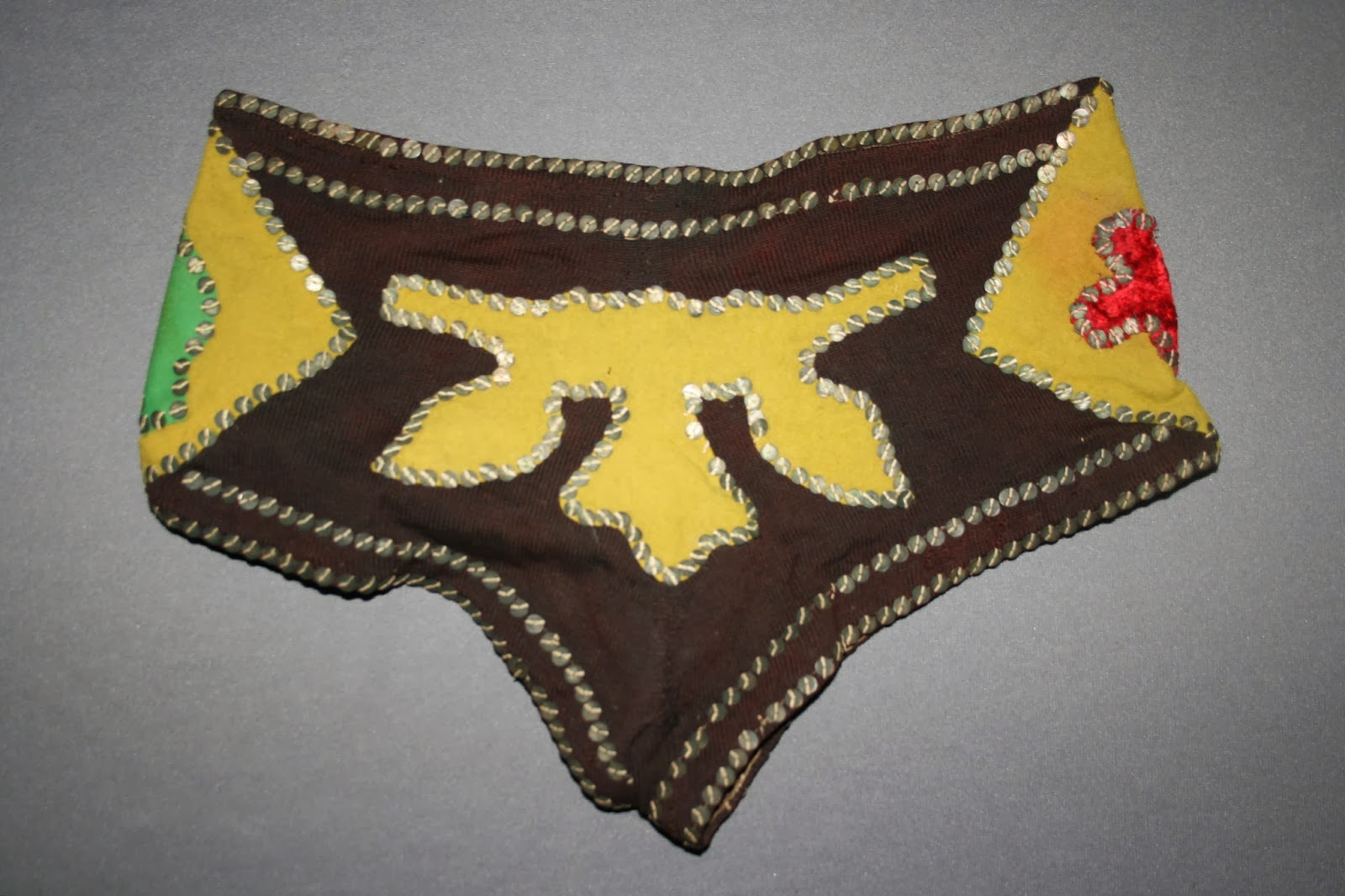
Below are the Before Treatment images of the Cheltra Costumes as they arrived at SAC. While the colors may have faded slightly, the dramatic effect of the bold lines and bright hues is still evident. The other obvious feature one notices when examining these costumes is that they were well used. Cheltra worked hard in these costumes. These particular items are all hand made, mainly composed of wool with velvet inserts, and are in good condition. Clearly the Cheltra family, who donated them to Maine Historical Society, cared for these items and kept them carefully, an important factor in the keeping of any textile.

Art conservation of historic costumes, textiles and garments, repair and restoration, Maine Historical Society
The before treatment photo featuring the body of the Cheltra "Black Costume". This top is beautifully
decorated with inserts of bright velvets, set on gold colored wool flannel. At the bottom, a safety pin
remains attached. The red  ribbon in the center was attached front-to-back, and kept the shirt in the trunks.

Front of the Black Costume.

Obverse side of the Trunks  from Cheltra's "black costume". This costume is a
bit more elaborate, with felt and velvet inserts. The metal sequins are
blackened near the leg openings.


Textile conservation of historic garments and costumes, contortionist, 1890's, hand-made, Cheltra
Before treatment close-up of  Cheltra's green trunks. The green "body" of the trunks are wool knit, while the red insert is wool felt, the metal sequins are hand stitched. (photo: SAC)
textile conservation of historic garments and costumes, contortionist, 1890's, after treatment photo
After treatmentclose-up of Cheltra's green trunks. 

Cheltra and others worked hard at their craft and clearly they worked hard at making costumes to be noticed in. We are so excited to treat these 3 amazing pieces from what remains of his costume collection.

vaudeville contortionist costume, textile repair and restoration, museum storage, padding out folds, archival materials
The after treatment photo of all three pieces, complete with their padded supports.


_____________________________
Gwen Spicer is a textile conservator in private practice.  Spicer Art Conservation specializes in textile conservation, object conservation, and the conservation of works on paper.  Gwen's innovative treatment and mounting of flags and textiles is unrivaled.   To contact her, please visit her website.


Monday, December 30, 2013

Modern materials and conservation

By Gwen Spicer, with Barbara Owens

With the New Year upon us, 2013 will become history. What items from this year will be in a conservator's studio generations from now? We at SAC spend so much time with artifacts from the distant past that we often do not think about modern art materials. That is, until recently.

Several things occurred at once: I was preparing to go to the NATCC (North American Textile Conservation Conference) in San Francisco where the focus at this conference was on "topics that concern modern materials"; I was also listening to Alternative Radio on NPR where the speaker talked about items which were purposefully engineered to fail (i.e planned obsolescence); and finally an article appeared in the newspaper about an artist who's medium were items which were non-permanent, i.e. they are meant to disappear. Coincidence? I think not!

This delicate bowl is created by Dutch artist, Geke Wouters, who made this paper-thin bowl from vegetables. The art created by this artist is meant to wilt. It is by nature, and her design, temporary.

I fully understand that art which is intended to "disappear (like the bowl pictured above or the dust drawings below), is not art to be conserved, that after all, would be the opposite of the artist's intentions.

Scott Wade is the artist who creates incredible works by utilizing the dust that coats car windows where he lives. His work is only a rain storm or wiper blade away from oblivion. See this image and his other works at the artist's website:  www.dirtycarart.com

What I am mostly thinking about is the conservation of modern art made of materials that are non-organic, these are the items which will be brought to the studios of future conservators. Particularly art made from objects that are considered "disposable". For instance, when does styrofoam, like the cup below, need to be conserved? After all, we are told that decomposition will occur in 1,000,000 years, but in the meantime, what kind of degradation might occur and can we perform preventative conservation treatment to slow it? What other possible breakdown is it subject to? And how long will that take?

When we talk about non-organic materials that have a "life span" of 500 to 1 million years or longer, in this respect, some modern materials perhaps should be thought of as the complete opposite from disposable art, after all, these materials have real "staying" power. It is ironic - we refer to disposable items as things that do not last, or are intended for limited use, yet the materials which comprise these items can last nearly forever.

Art on a styrofoam cup.  The artist is Cheeming Boey and the drawing on the cup is done in ink.  You can see more of his cups at his website www.iamboey.com

For conservators, we must carefully consider the idea of modern art and how to approach modern non-organics. Some ingenious art is being created right now, many are created from non-organics as a comment on our disposable lifestyle, our unnecessary waste, and the damage it causes our environment.  All of these non-organics will require specific conservation methods and techniques.

A garbage dump filled with discarded appliances. Many artists comment on our mass produced refuse, our mass consumption and the careless disposal in our society.  

If you are interested in hearing an artist talk about his work and the social consequences of the enormity of our culture, please listen to Chris Jordan's TEDtalk at www.ted.com. One of his artistic mediums is large format long-zoom artwork, meaning you are looking at each piece from a far distance, and as the image gets closer it begins to change until you are suddenly up-close and it becomes perfectly clear what it is on a small scale (visit his website here and see them for yourself: www.chrisjordan.com).  Each of his pieces is a statement on our society, our waste, and each piece is eye-opening.


"Lion" by artist Yong Ho Ji.  This, as well as other sculpture created by the artist, is made entirely from tires.  How will conservators approach the treatment of petroleum based products as they age?

I read in an article recently that film is considered completely obsolete as an artistic medium, and those who continue to use it as the medium for their art are finding themselves in the minority. Here is great story from 2011about Artist Tacita Dean and her struggle with obsolescence: http://www.artnews.com/2011/10/18/planned-obsolescence/. On the heals of this story is the work by artist Erika Iris Simmons, aka iri5. She takes obsolescence in the form of film and cassette tape and makes it into wonderful works like the one below "Ghost in the Machine - The Beatles." See more of her work at her website: http://iri5.com

Erika iri5 creates art by cutting and placing film and cassette tape (among other things) into iconic depictions of the famous. 

Modern art items, composed of modern materials, they are the true challenge. But after all, with challenge comes opportunity…

In an age of object disposal, it is a juxtaposition of ideas when art is created from that which was cast away as valueless, and beauty is created from the ugliness of our mass consumption. Conserving these non-organics as they become artifacts will bring change to the practice of conservation by way of new techniques, methods, tools and solvents. So much will change just as it always does. Each year brings change, and each year brings another era of history for art conservators.

So cheers to the New Year!  Happy Conserving!  And Happy 2014 to all!

_____________________________
Gwen Spicer is a textile conservator in private practice.  Spicer Art Conservation specializes in textile conservation, object conservation, and the conservation of works on paper.  Gwen's innovative treatment and mounting of flags and textiles is unrivaled.   To contact her, please visit her website.

Wednesday, October 30, 2013

What to do with Three-Dimensional archival objects?

By Gwen Spicer 

The majority of our posts this month (aka: "October is Archives Month") have focused on storage relating to flags which also fit in nicely with the NAVA annual meeting which took place October 11-13. It is true that flags can be found in Archives, however, the typical material that Archivists handle and need to store are flat materials consisting of documents, historical records, and photographs. These materials fit neatly within the standard document box, or smaller version: the document case.

Many museums or historical societies use document boxes or cases for storage, simply because they are standard sized, or perhaps it is the type of box which they have the most need for, or maybe it fits best within their storage area.

museum storage solutions, archival materials, document boxes, art conservator survey
Row upon row of Storage Cases - the smaller, upright, top-loading style of the document box.

Several years ago I was asked to speak to an Archives group regarding 3D artifacts. (Yes, 3-Dimensional items are archival items). Flat items are the typical materials to be found, but certainly 3D items need an archival home as well. In preparation for the workshop, I created solutions for possible 3D materials that could fit within standard document case packaging found in an archives storage facility. Below is a short video highlighting the retrofitting of a document storage case to hold 3D objects, as well as 2D objects, because yes, sometimes they can live together in one tidy storage case.


Many of the archivists present at the workshop mentioned that their archives would not be complete without the 3D items in their collections and that these items rounded out the document collections in that they gave depth to exhibits, making them more eye-catching. And sometimes the documentation exhibited required the 3D objects to illustrate more clearly the display, for example, one archivist had extensive textiles and bottles to accompany the documentation of early medical training at a nursing college.

art conservator survey of museum storage space utilization. collection care
Archival boxes, also referred to as document boxes, in the storage area.

The most valuable part of utilizing a document container as multi-dimensional storage, is making sure that the transformation of the box was easy to do and would involve only the tools and materials any archivist or conservator would have on hand, and use a technique that would be easily known (i.e. cutting mat board, acid free materials like twill tape)

The multi-dimensional document box/case storage provides excellent accessibility, while significantly limiting excessive handling, as each item can be removed independently of the others. Many workshop participants appreciated the concern for handling, as reduced handling of archival items is crucial to their integrity. Yet, having access is to archival items is key.

In the prior post, How to Store Your Flag Part 2 - The Sink-Mat, the sink-mat can be used to great effect. Remember that smaller sink mats can be placed horizontally by stacking them inside the box, while remaining flat. For this particular solution, a specific document box is required - the clam-shell or print box, with a drop front. Available through all archival suppliers, these boxes are meant to lay flat on the shelf, and when the lid is lifted, the front side of the box drops forward, thereby allowing full access into the box without moving the box - it is truly the perfect archival home for a sink mat!

We hope you have enjoyed October, and all of our posts about archival storage, as much as we have.  Look for more videos from SAC in the coming months, our next video will cover how to properly roll textiles.

_____________________________
Gwen Spicer is a textile conservator in private practice.  Spicer Art Conservation specializes in textile conservation, object conservation, and the conservation of works on paper.  Gwen's innovative treatment and mounting of flags and textiles is unrivaled.   To contact her, please visit her website.

Friday, October 25, 2013

Glossary of safe materials for storage

How to Store Your Flag parts 1, 2 and 3 have been met with lovely comments from old friends and colleagues as well as some new friends and colleagues, I'm so glad these were useful.  In this series of posts on storage we mentioned many materials. We thought that it would be helpful to just post the entire list of materials in one location, so as promised, below is the glossary - enjoy!

Acid-free tissues, papers and boards:
Acid-free or neutral pH materials should always be used. These materials are made of 100% cotton fiber, whereas acidic papers are made from wood pulp. Questionable materials can be tested with pH indicator pens. These pH pens can be purchased at archival supply, or craft and fabric stores.

The blue/gray boards have a buffering agent added. It is generally an alkaline substance with a pH over 7. This reservoir neutralizes the acids that may be absorbed from the environment around. The alkaline residues could react with protein materials, like wool, hair, leather and some photographs.

Buffered materials can be used for Cellulose materials, like paper, cotton, and linen, but not with proteins. It has been observed that being in contact with buffered tissue also affects some dyes. Therefore care is needed in choosing the correct material.  Use for interleaving, solid supports, and in storage containers

Adhesive Tapes (Double-sided):
As with plastics, tapes need to be chosen with care. A product by 3M, #415 double-coated tape has been found to work best. It is pressure sensitive made with a high tack acrylic based adhesive on a polyester carrier. Products #924 and #969 are acrylic-based adhesives with no carrier. Both are non-yellowing, inert and reversible with solvents. Both tend to cold flow.

Use these tapes only in construction of storage supplies, like encapsulating flat paper items, but not placed directly on the artifact.

Batting:
Look for polyester needle-punched batting. This batting is formed mechanically by fiber entanglement using barbed needles. The other commonly found battings are made with resins that bond the fibers. The resins have been found to yellow and then can transfer onto artifacts. The packaging will frequently be marked if one is purchasing from a fabric store. Polyester materials resist mildew.

Use batting for padding-out and filling in order to obtain the desired profile of a mannequin. It can hold shape even under weight. Best if secured with stitching. Can also be used as stiffening, like at the bottom of a petticoat. Note that all battings need to be covered.

Coroplast:
A rigid, lightweight, polypropylene/polyethylene copolymer corrugated (or fluted) sheet. It is lightweight and fairly strong. The archival grade does not have any anti-static or ultraviolet inhibitor additives. This grade is more expensive than the standard grades. Coroplast can be cut with a utility knife. It can be bent with heat, or scored. Sheets are available in several thicknesses, 2-6 mm, and in several colors. When used for storage box tray construction, the sides can be secured with brass clasps, and sewn with heavy weight cotton, linen thread or twill tape. Corners can also be secured with hot melt glue rivets.

For display, one can cut it into forms to support lightweight textiles. Cover Coroplast with batting and stockinette or exhibition fabric.

Ethafoam:
Ethafoam is a Dow Chemical Co. trade name for polyethylene, a thermosetting plastic. Ethafoam is a closed-cell foam with a smooth surface. The cut edges are softer than other foams, like Styrofoam. It is easily cut with knives, and wood working tools.

It is best to look for Ethafoam manufactured by Dow. Other foams have been found to include additives and stabilizers that can cause problems and yellowing.

Fabrics:
It is best to use unbleached 100% cotton fabrics, like muslin, stockinette, flannel and twill tape. Any fabric that is used with collection needs to be washed in hot water.

A word of caution about fabrics; many have finishing treatments like flame-retardant or durable press. These types of finishes need to be avoided and removed with hot water washes. Wool is also a fabric not to be used for exhibitions or storage. It can tarnish silver in closed environments and attracts insects. If felt is to be used, look for polyester types.

Foam-Core:
A Styrofoam sandwiched between paper or plastic. There are both archival and non-archival products available. These come in several thicknesses. Avoid using cores made of beaded Styrofoam, as the beads can easily break apart at the edges. Best to use as a temporary material. Not suitable for long-term storage.

Hook and Loop Fasteners (Velcro):
Not all-generic Velcro is made from the same formulation. Some forms of Velcro have been found to have adverse effects to the textiles to which they have been attached. It is suggested to purchase it in large batches and test it. Always attach the soft side to the textile artifact with a separator of webbing or a muslin tab.

Avoid using Velcro with pressure-sensitive adhesive.

Hot Melt Glue:
This is a thermoplastic adhesive that is applied in the molten state and forms a solid when cooled. There are several different formulations. The ethylene/vinyl acetate copolymer is generally suitable for construction of mount supports. 3M’s #3764, Bostik’s Thermogrip #6363 and Evode’s Evo-Stik #7702 have been found suitable.

The glue is very hot! Care is needed not to burn oneself. It adheres to most surfaces. It can be difficult to use with smooth surfaces. Can cause damage to rare earth magnets.

Marlvelseal #360:
A foil composed of layers of nylon, aluminum and polyethylene. Provides a good barrier that resists transmission of water vapor and gases. The polyethylene side or dull side can be heat-sealed and can conform to curved shapes with a tacking iron. Use Marlvelseal to seal questionable materials for display and storage.

Mylar:
Mylar-D is a polyester, transparent film. It is a strong, inert and dimensionally stable film that is very clear. It comes in different thicknesses. Look for virgin polyester, type D made by DuPont Co. Mylar does create static charge.

Use to encapsulate and separate materials.

Plastics:
Not all plastics are the same. Many have plasticizers that make the plastic material more flexible. Over time the plasticizer causes deterioration and should be avoided. Other additives that can be included and can cause damage are slip and anti-static agents. Dry cleaning bags turn yellow due to BHT that is added to the polyethylene.

Good plastics are made from polyethylene, polyester, polypropylene and acrylics. These are the most commonly found. Most archival products found in catalogs will be made of one of these types. Other less common plastics are: polytetrafluoroethylene, polycarbonates and silicone.
Plastics that cause adverse effects are materials and rubbers containing sulfur-vulcanizing agents.

Stockinette:
This comes as 100% cotton unbleached or 100% polyester surgical tubing. Both need to be pre-washed. It is used to cover mounts, tubes, etc. It is particularly useful in making arms and other sausage like shapes. It provides sufficient tension to lower the amount of stitching needed.

Tyvek:
A spun bonded olefin is a high-density polyethylene fiber bonded under intense heat and pressure, manufactured by DuPont. This product has many good qualities: it is strong, non-buffered, has low resistances to water and mold. Tyvek both protects artifacts from dust while allowing for air circulation. It is smooth with no binders, fillers or buffers. It is low linting, and resistant to water and chemical-aging. Some solvents cause swelling. Housewrap may contain ultra-violet stabilizers. It comes in a range of weights. The weight that is commonly used is Type 1443R. This material can be washed in the washing machine several times. It is good for dust covers and wrapping collections. Can be seamed or glued. However, is not a good barrier for preventing acid migration.

_____________________________
Gwen Spicer is an art conservator in private practice.  Spicer Art Conservation specializes in textile conservation, object conservation, and the conservation of works on paper.  Gwen's innovative treatment and mounting of flags and textiles is unrivaled.   To contact her, please visit her website.

Look for Gwen's book, "Magnetic Mounting for Art Conservators and Museums",  available in 2018.

Wednesday, October 23, 2013

How to store your flag, Part 3: Rolling

As stated earlier in "How to Store Your Flag, Part 1" proper storage is critical to the long-term preservation of any collection. Proper storage includes safe materials that are acid-free, a stable environment, protection from light, minimal handling, etc.

Rolling of textiles is an excellent option for flat, single layer, artifacts that are too large to be stored “flat”. Any rolled storage consists of four main parts: the tube, an internal support for the tube, the leader, and the outer wrapping. Specifically, for flag storage, the length of the tube is determined by the height of the flag, plus additional space for the securing of the outer wrapper. Remember that the hoist edge will run the length of the tube and will be rolled last. The tube and its textile is then supported on cradles, or in storage furniture.  Grouping your collection into standard sizes maximizes space and budget.

Illustration of the layers of rolled storage of textiles, art conservation, image property of Gwen Spicer
Illustration by Gwen Spicer of the various layers of rolled storage.

A paper, or muslin, apron is used to assist in the initial rolling of the textile. The textile can be interleaved with acid-free tissue, muslin, or cotton sheets for larger textiles like rugs. The textile is then covered with muslin or Tyvek and secured with twill tape ties.

The diameter of the tube needs to be considered with several factors in mind. The larger the tube, the better it is for the flag. However, there is always a balance among space, budget constraints, and the size of a collection. Unfortunately archival tubes are very expensive specialty items because tubes used for rolling textiles need to be made of acid-free cardboard, which is made from virgin materials.

A small lightweight flag can be stored on 2" diameter tubes. Medium size textiles are best on 3" diameter tubes, and heavier flags require even larger tubes, which may also need to be supported by metal rods. Part of the tube’s diameter selection is the degree of bend, or angle, that the fibers are required to conform. Over time, the fabric can have a memory of the curvature.

art conservator custom made rolled flag storage, carpet, rug and large textile storage, archival materials
Cutting tubes for a collection of flags.

Cradles are an integral part of rolled storage. If the rolled textile were allowed to rest on a solid surface, the point of contact between the surface and the artifact would result in stress, not just to the outside layer which runs the length of the tube, but to each layer beneath the outside layer. The weight of the textile and the storage supplies can easily crush and cause damage to fragile textiles. By raising the ends of the tube above the surface just slightly, this can be prevented. Cradles can be easily carved from Ethafoam. Ethafoam is a Dow Chemical Co. trade name for polyethylene, a thermosetting plastic. Ethafoam is a closed-cell foam with a smooth surface. The cut edges are softer than other foams, like Styrofoam. It is easily cut with knives, and wood working tools. It is best to look for Ethafoam manufactured by Dow. Other foams have been found to include additives and stabilizers that can cause problems and yellowing, these obviously should be avoided.

They can even be stacked, or with notches, placed in a row side by side. The cradles need to be positioned at the end of the tubes, away from the flag itself. Stacked cradles are useful when a small group of unusually sized tubes are needed, and it is cost prohibitive to purchase furniture for such a small collection.

art conservator Gwen Spicer create these cradles from ethafoam, which is archival safe for museum storage and ideal for  supporting large rolled textiles
Detail image of carved Ethafoam cradles for two flags.
large textiles storage, rolled flags, archival materials, proper rolling techniques of artifacts
The cradles were designed for the flags to be stacked. The locations
where the tube rests on the cradle is outside or beyond where the
artifact is located. The pressure of the cradle is only on the tube
and outer wrappings itself.
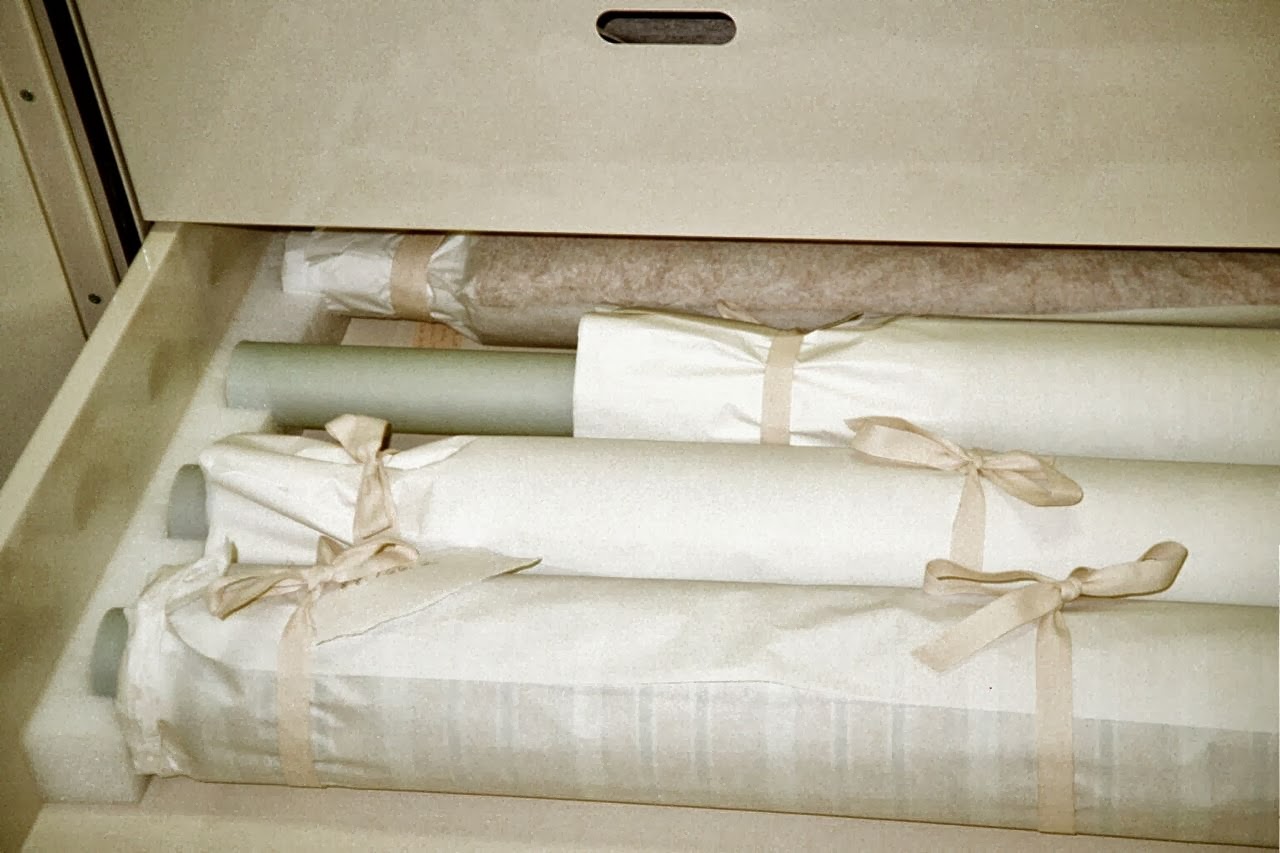
Shorter length tubes can be placed in boxes, or drawers supported with Ethafoam cradles to suspend the tube above the bottom surface. Care will be needed to ensure that the tubes are cut to accommodate the inside dimension of the drawer or box. This is especially true with long and bulky textiles that can become large in diameter as their length is rolled. Tubes within boxes or drawers can run either direction to provide more options for tube length. These shorter tubes do not require an internal metal bar for support like the longer tubes. Please note any cut end of tubing often needs to be sanded lightly.

Art conservation, proper storage, rolled textiles, large textiles, flags, rugs, carpets
Rolled textiles suspended in the storage drawer with Ethafoam cradles.
art conservator, rolled storage for large textiles, archival materials, museum archives, collection care
Flags rolled and suspended on cradles that are positioned onto shelves.

On occasion, a longer tube is necessary. To make a longer tube, an insert is made from a scrap tube section approximately 8" or 10" long. A cut is made along the entire length. (For thick-walled tubes, the cut needs to be the thickness of both walls.) One half of the scrap tube is inserted into the tube and its extension. These longer tubes will also need more attention paid to placement within the storage room. Each tube will need to be maneuvered through the storage room's door, possibly around cabinets to its designated location. These heavy textiles will need to be supported by metal rods.

There are several collections that use Mylar with the prospect that the artifact can be seen through the storage covering. This is an advantage. However, there are two main disadvantages, one is the static-charge inherent in the Mylar and the other is the potential of fading in the exposed area. If plastic is deemed necessary due to pest concerns, then Polyethylene tubing as the covering is a better choice. There are many collections that use Mylar as their outer covering to aid in seeing the artifact, but this conservator discourages this choice.

It is important to note that Mylar would not be fitted into another tube as that it creates surface abrasion. In addition, if the receiving tube is too small, it can crush the flag inside. Other drawbacks are that there is limited access to the rolled flag, and, when it is slid in, one does not know if it remained smooth or if it is bunched.

Flag Storage has many facets, to this point we have covered several methods of storage. Many terms have come out of these reviews of storage, in the next posting we will include a full glossary of safe storage materials.
_____________________________
Gwen Spicer is a textile conservator in private practice.  Spicer Art Conservation specializes in textile conservation, object conservation, and the conservation of works on paper.  Gwen's innovative treatment and mounting of flags and textiles is unrivaled.   To contact her, please visit her website.