Flag conservation

Flag conservation
Textile conservator, Gwen Spicer of Spicer Art Conservation at work

Wednesday, September 26, 2012

Historic Banners...they say a lot.

by Barbara Owens

Down with the Rent anti-rent sign, New York State, Art conservation, textiles
Early 19th century, Grafton
Public Library. 
Banners have been around forever, or at least a couple thousand years.  It is said that one of the earliest accounts of their use is of Moses employing banners to keep the multitudes organized as they made their way to the Promised Land.

Angel firehouse banner - image from ARTAID.org
Banners had (and still
have) one purpose, if you want to say something, you put it on a banner and hang it up for the world to see.  Banners have been used to make political statements, they tout success, they pay homage to heroes.  Such is the case with Firehouse Banners.  Several examples exist from the Victorian Period.  A firehouse banner usually has the fire department name on it, and as you would expect, it was hung proudly in the firehouse.  However, the firehouse banner cannot be pigeon-holed into the past, as evidenced by the "Angel" banner which now graces some of the FDNY firehouses whose firefighters were lost on September 11th, 2001.

Trade Banner, 1841, historic textiles, Maine Historical Society, art conservation, magnetic mounts for museum display and exhibit
Trade Banner, 1841. Maine Historical Society
Spicer Art Conservation treats banners each year, some political, some made in protest (see the "Down with the Rent" banner above), and numerous trade banners (see right) made for parades and rallies.  Recently,  SAC received a beautiful, two-sided, velvet banner (a truly unique choice in fabric), which had remained in the attic of the Morrisville, New York Firehouse for perhaps 100 years.  The banner was for the most part intact, as was the stitching which composed the embroidery on one side, and the painting which made up the image on the reverse.  However, the colors had faded significantly and it was very dirty.
Textile undergoing art conservation at Spicer Art, embedded dirt, historic banner and flag, cleaning, repair, restoration
Inside of the banner, filled with
100 years of dirt, but look at
the original teal color.

The good people of Morrisville wanted to restore their banner and, if possible, rehang it in the firehouse.  To do this the banner needed to be housed in a way that would protect it.  Remember though, this is a double sided banner.  If it is framed, one side will be lost.  The solution?  A two-sided display case.

The banner is to hang in the display case using the original brass rings, rod and finials.  The stress points caused from the junction where the ring meets the fabric and is stitched to the banner was deemed too fragile to re-affix the rings.  Another solution was needed.

banners, during historic textile conservation repair and restoration, flags and rods
Textile conservation, reducing stress on fabric, banners, historic antique repair and restoration, museum displayTo construct, sometimes you must deconstruct.  The banner has two sides, and those sides required separation from each other during internal cleaning and re-application of the badly disintegrating padded layer making up the center of the banner.  SAC conservators Gwen Spicer and Nicolette Cook came up with the idea to integrate a piece of sheer fabric, which would run the length of the top of the banner.  It would be secured using running stitches and approximately 2 inches of the sheer fabric would be extended from the top of the banner.  The sheer fabric created a sleeve (much like the space where the rod passes through a curtain).  The fabric would hang from the rod, and the banner then would hang from the fabric.  The brass rings would then be affixed to this sheer fabric, thus eliminating the stress to the original fabric.  The trick was to get the rings around the rod, and through the sheer fabric.  In other words: the sheer fabric had to go around the rod, the rings had to go through the sheer fabric and around the rod, and then the banner had to be stitched to the fabric, therefore "sealing" in the sheer fabric, rings and rod.
Embroidered historic banner, art conservation of textiles, antique, repair and restoration
The banner just before it is affixed to the sheer fabric.  In this photo you can really see the degree to which the fabric of the embroidered side had faded from a deep burgundy to an almost brown shade.
Historic banner and flag conservation. textiles, antique restoration and repair, exhibit and display
Banner after treatment - fabric covers the rod, the rings are "embedded" between the rod, fabric and banner.

The sheer fabric was cut in a "comb" like pattern.  The top of each comb, was seared with a soldering iron to create a perfectly round hole, which the ring would fit into.  Additionally, the color of the sheer fabric was intentionally chosen to create a near match to the rod, allowing it to become virtually invisible once the brass rings surround it.  The outcome is a banner that is conserved and displayed in a way that is beneficial to the banner and pleasing to the people who found this lost treasure in the hopes it would not only be displayed again, but for a long time to come.

1887 Banner repaired and restored by textile conservator, Gwen Spicer.
Side 2, after treatment

Restoration and repair of historic antique textiles, art conservation, 1887 banner and flag
Side 1, after treatment


Tuesday, September 11, 2012

Museum Worthy?

by Barbara Owens


Some things are simply so prolific you need only mention their name and instantly you can picture it clearly in your head.  Let’s test it out: Leonardo DaVinci’s “Mona Lisa”, Jan Vermeer’s “Girl with a Pearl Earring”, Gustav Klimt’s “The Kiss”, Grant Wood’s “American Gothic”, Edward Barcolo’s “Barcalounger”

Huh?

The Barcalounger: you know it well, but does it really belong grouped with such iconic works?  No, probably not, but it is nonetheless in the collection of the Buffalo and Erie County Historical Society where it was recently treated by SAC.  Are you asking why Buffalo would have such an interesting and quirky piece?  It is because the Barcalounger, of course, was originally manufactured in Buffalo where it was introduced in 1940.

The original Barcalounger is not much different from the Barcalounger of today – save for the changes in upholstery and styling.  The concept remains the same, chair goes into reclining position, you are helpless to its power, and quickly find yourself napping.

As most conservators who treat furniture will tell you, furniture conservation has intrinsic challenges.  Centuries of the various styles of furniture and upholstery that reflect changing tastes and decorating trends can fill volumes.  As a conservator you could treat a piece each year and perhaps never see the same style twice.  But nearly guaranteed, is that you will probably never be asked to treat a Barcalounger.  So when The Buffalo and Erie County Historic Society (BECHS) asked us to treat theirs, how could we possibly say “no” to a once-in-a-lifetime opportunity?

A barcalounger is cool.  It is a piece of Americana.  And conserving a chair that nearly folds out to a bed is a unique experience.  Here are the answers to your immediate questions: 1) No, we did not test-drive it.  2) Yes, it still “lounges”.
Textiles in need of repair, restoration and art conservation, barcalounger vintage, antique, historic
Close up of the chair seat before treatment
The Barcalounger before conservation treatment of the upholstery, textile historic repair and restoration

The BECHS chair was in desperate need of treatment.  The chair’s original upholstery was splitting and had several areas of loss, and the polyurethane foam was disintegrating.  However, the mechanics of the chair were still sound, as was the frame.

Following conservation, the chair would be part of the exhibit, "Bflo Made!" highlighting things that were “Buffalo born”.  More than 700 products, inventions, and artifacts in the Bflo. Made! exhibit highlight Greater Buffalo’s pride in its commercial and industrial heritage and present-day manufacturing and research.  What else came out of Buffalo you ask?  How about the pacemaker, the jet pack, the kazoo, Cheerios, the disco floor (yes, I mean THE disco floor, as in the one that Travolta graced with white disco suit and finger pointed strait in the air in the movie Saturday Night Fever).  The chair remains on permanent exhibit and if you happen to be in the great city of Buffalo, New York check out BECHS.


We will probably never have the chance to treat another Barcalounger, which makes this treatment so memorable.  In our day-to-day work, SAC tends to do conservation of items with similar themes: flags, maps, prints, and what seems like an endless amount of period clothing.  And while each of those items is always amazingly rich in history and so often the pieces are historically significant, it is so refreshing to do something completely different from anything else.

Barcalounger art conservation, textiles and upholstered furniture, Buffalo history
The Barcalounger post-treatment


Friday, August 3, 2012

Update: Edison's tinfoil, can the sounds on it be retrieved?

by Barbara Owens
When we first talked about SAC having the honor of doing the conservation work on Edison’s tinfoil back in April (see the blog entry from April 19th), we said that the foil was being prepared for digital scanning in an effort to retrieve the sound imbedded upon it more than 130 years ago.  As we at SAC researched Edison’s life, we discovered that when this particular tinfoil was made, Edison had only one phonograph, and it was he who traveled the country, demonstrating it in hopes he could find buyers for his fabulous new invention.  The bottom line is that Edison’s voice is probably on it.  

How exciting is that?


Edison tinfoil, art conservation, before treatment by conservator Gwen Spicer
Edison's tinfoil before treatment.
As far as we know there are only two complete tinfoils in existence: the one that we treated, which is owned by "miSci" the The Museum for Innovation and Science (formerly the Schenectady Museum), and a second, which is owned by the Smithsonian.  Here’s the interesting tidbit, the one at the Smithsonian had been glued, facedown, to a board.  Getting sound from it is going to be a challenge.

The Schenectady tinfoil, that SAC treated, which had been folded several times and then crammed into an envelope, required extensive flattening before it could be scanned.  And so, after some nerve-racking and incredibly delicate treatment, it left SAC’s studio and has traveled to California where the sound is being carefully coaxed from its surfaces.  So the big question is: who is on it and what did they say?


Edison tinfoil after art conservation treatment by objects conservator Gwen Spicer, scanning
Scanning the Edison foil. photo from Schenectady Museum
The short answer right now is that the tinfoil has been scanned and they definitely found sound on it.  Who is speaking?  Right now we know there is a conversation between a man and a woman.  Could it be it Edison?  Stay tuned for information as it unfolds, and visit the miSci (The Museum for Innovation and Science, Schenectady NY) for more information.  

Wednesday, August 1, 2012

The mystery of Angelica Van Buren's wedding dress

by Barbara Owens
Our 8th president (1837-1841), Martin Van Buren, had been a widower for nearly 20 years and hence had no first lady, yet someone needed to fill the position.  He called upon his daughter-in-law Angelica Singleton Van Buren (1818-1878).

Angelica has been described as a beguiling; everyone loved her, every woman wanted to be her.   She was the Jackie O of the 1800s.   She has also been described as a young, beautiful, gentle woman who was confident, poised and religious.  Raised in South Carolina as the daughter of wealthy southern plantation owners, she had a genteel southern spirit and had benefited from an excellent education, which was only afforded to few young women at the time.  

And remarkably she served as the the first lady of the United States at just 21 years old. 


Angelica Van Buren dress, textile art conservation
Angelica Singleton VanBuren's portrait was painted by artist Henry Inman in 1842.  Today it  hangs above the fireplace mantle in the Red Room of the White House . 
When Van Buren takes the presidency in 1837 he is busy with the financial burden leftover from the previous administration that has left the United States in a depression.  Understandably, Van Buren has little time for social life or parties.   Van Buren had been a widower for nearly 20 years and for the first year and eight months of his presidency, there was no First Lady in the White House.  Van Buren is the father of four sons, and while he could have asked one of his female relatives, or a spouse of one of his Cabinet members, he chose to not invite anyone to preside as hostess at the White House.  

Enter Dolley Madison, former first lady and D.C. socialite, with her young cousin Angelica in-tow for a dinner with the Van Buren men.  The president's eldest son, Abraham, is smitten with the young lady who is described as "a lovely, charming belle with "Roman goddess" features, dark, expressive eyes, fashionable corkscrew curls, and a long neck."  Angelica and Abraham are married in November 1838.  The President reportedly approved of the marriage and the ties it brought between the White House and the powerful Southern aristocracy.  Van Buren found himself in the crosshairs of the North and South; the Northern Democrats had abolitionist sentiments and the Southern Democrats wanted to ensure that slavery continued to support their agrarian economy.  

The new Mrs. Van Buren made her debut as official White House hostess on New Year's Day, 1839. It is said that Cousin Dolley coached and trained Angelica extensively for her role.  The annual White House New Year's reception, which is the only social function that had taken place thus far during Van Buren's presidency, was a massive success.    

At the end of the 1839 social season, Abraham and Angelica honeymoon by taking an extensive grand tour of Europe.  While abroad, Angelica achieves celebrity status.  She was presented to the royal courts of England and France meeting the then freshly coronated Queen Victoria as well as  France's King Louis Philippe.  

Upon returning to America, Abraham and Angelica Van Buren moved into the White House.  Angelica employed many European-style etiquette techniques she had witnessed in her extensive traveling.  While many in Washington high society admired her regal style, Angelica was criticized by the president's foes as being extravagant and monarchical at a time when the majority of the U.S. was languishing in economic despair.  

Angelica is unflappable and continues as the White House hostess, but perhaps in a more understated way.  It is well quoted that the French minister, Adolphe Fourier de Bacourt, who was often critical of Americans, claimed that "in any country" she would "pass for an amiable woman of graceful and distinguished manners and appearance." Many historians agree that President Van Buren enjoyed Angelica’s company and truly appreciated her assistance with the social duties of the presidency.

During her years as "Lady of the President's House" she brought back not only style, but true etiquette to the White House.  The President and she gave mostly small dinner parties dispensing with all large functions other than the New Year's Day reception.  When it became necessary to redecorate and replace some of the furniture that remained from the previous administration, she was careful to not be extravagant as she had learned a hard lesson of how appearances can be perceived during a time when hard economic depression gripped the land. 
Angelica in a later portrait, although the exact date of this portrait is unknown.  Notice the dress.  The neckline is similar, she clearly liked this style of dress.

Angelica’s time at the White House was also marked by personal tragedy. In 1839, she became pregnant, and give birth in March of the following year to a daughter, Rebecca.  Details are varied, some reports claim that Rebecca dies within hours, other claim that both mother and daughter were ill for several months following the birth, and that Rebecca died at the White House in the fall of 1840. Angelica and Abraham had three sons after they left the White House. During those years, they maintained close relations with former President Van Buren. Angelica Singleton Van Buren died in 1878.


Angelica Van Buren dress, art conservation by textile conservator, Gwen Spicer
Angelica Van Buren's wedding gown.  Is it the same gown as in the White House portrait?
SAC had the opportunity to rehouse the wedding dress worn by Angelica Van Buren which belongs to the United States National Park Service, Martin Van Buren Historic Site, Columbia County, New York.  The dress has creased and yellowed, is in poor condition, and is awaiting treatment.  It was at this point when the dress was identified to us as possibly being the same dress, only altered, that Angelica wears in the White House portrait.  Here at SAC we love a good historical mystery (and gosh there are plenty of them!).  The facts are that the actual fabric of the dress appears to be identical, only the color has changed over time.  The neckline and the cut of the bodice as it dips to a point in the front appears similar.  But, if the dress that SAC conserved is the wedding dress, and the White House portrait is the same dress, then shouldn't it now look like it does in the portrait?  Not necessarily so.  Keep in mind that the portrait is a painting, the artist is free to take plenty of artistic license, including making a dress appear more extravagant.  Also, Angelica learned a tough lesson about the nation's opinion of how money is spent during a depression.  Would she have a dress made, or want to appear more frugal by wearing her wedding gown?  In addition, no portraits were made at her wedding, perhaps she could think of nothing else she would want to wear when her image was captured for prosperity.  Lastly, Angelica may not have been the last person to wear this dress, perhaps a granddaughter used it later and that is why the fabric is the same, but alterations have been made.

What do you think?  Is it the same dress?


_____________________________
Gwen Spicer is a textile conservator in private practice.  Spicer Art Conservation specializes in textile conservation, object conservation, and the conservation of works on paper.  Gwen's innovative treatment and mounting of flags and textiles is unrivaled.   To contact her, please visit her website.

Wednesday, July 25, 2012

Girlhood embroidery - the world of the sampler

by Barbara Owens
textile conservation of historic samplers and embroideries, repair, restoration, antique
Pictorial Sampler c. 1876

When you talk about samplers, an image is conjured of a rectangular piece of old linen with a hand-stitched alphabet, or perhaps a biblical verse, and a “signature” of a girl, perhaps between the ages of 8 and 12 at the bottom, often accompanied by the location of where she lived or went to school. But the world of samplers goes far beyond to include intricate, highly skilled pieces such as mourning pieces, coats of arms, genealogies, pictorial works, and landscapes. Some feature painted silk, metallic threads and velvet appliqué.

The underlying history to each sampler is that it is also a documentation of the education of girls at a time when girls were seldom educated, and when they were, it was a focus on domestic arts that often dominated their studies. For it was said in an early Italian proverb; “A girl should be taught to sew and not to read, unless one wishes to make a nun of her”.

The study of samplers is an immense field with numerous texts written on everything from the way a sampler was produced, to similar sampler themes and elements which make it indicative of a certain region, to the methods of stitching, and the list goes on and on. 
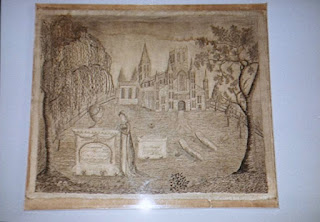
Historic samplers and mourning embroideries, conservation, repair and restoration of antique textiles by professional art conservator
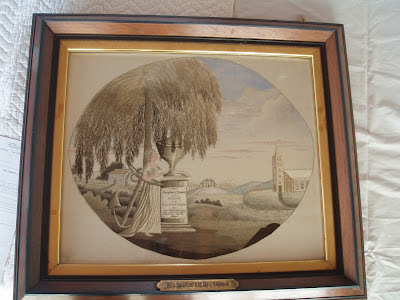
A mourning piece c. 1864.  Notice the willow tree?  It appears frequently in this kind of sampler.
SAC has had the pleasure of working on countless samplers from nearly every decade from the late 1700’s through the mid to late nineteenth century when the dominance of needlework in education came to a close. Not to say that samplers first appeared in the late 1700’s, in fact they begin to appear as a “graduating accomplishment” in the century before and early samplers can be traced back to Renaissance times. The late eighteenth to mid nineteenth century was signified by a time when girls were sent to be “educated” in a way that made them suitable for a domestic future. Needlework was clearly important, reading might be taught, however writing was not always deemed necessary. Girls may also have received instruction in history or arithmetic, but equally important would be painting, drawing, and perhaps dancing and piano. This all depended of course on how much a family could afford, or if they could afford to send a daughter to school at all. 
Conservation of historic embroideries and samplers, textiles
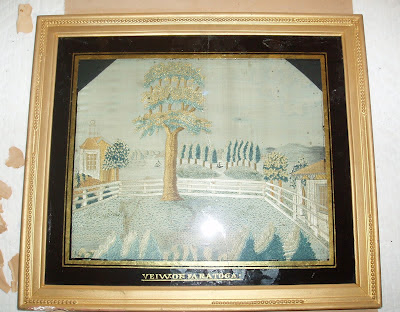
A beautiful pictorial work.  Notice the original frame and the painted glass.
historic embroidery, antique textiles, before art conservation
Another pictorial piece prior to conservation.
Many times SAC receives samplers that are “incomplete”, meaning all that exists from the original is the linen and the thread in which it was worked. Gone are other key elements that include the stretcher, the glass (which is often edged in black paint and guilding), and the original framing, which if you are lucky, has the stamp of the framer who put the entire thing together. Samplers were the culmination of a young girl’s study. The family would provide the linen (or in some cases, the silk), the thread (mostly silk, and sometimes wool, but almost never cotton as it was incredibly expensive) and then the family would have the work framed and it would hang in the home as a testament to the abilities of their daughter and her completion of an education of propriety and piety.
Here the framer has documented his work "picture put back in the original frame Oct. 1st 1908".

While each sampler is different, the conservation of samplers often presents the same problems. So often a sampler has gotten wet in some way; either it was stored improperly, damaged in a flood, or the humidity levels were too high. This results in the dye of the thread beginning to “bleed” into the other colors or on to the linen. Moisture in/on samplers can also lead to tide marks in the linen.

Damage to samplers can also be “self-inflicted” in that the thread used to create the sampler contained tannins, which due to their own acidic nature, became brittle and then disintegrate. 
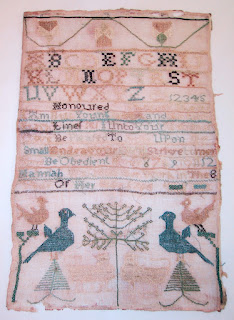
Embroidery and samplers, textile conservation of historic and antique needlework
Front side exposed to constant light. 
A sampler that has been displayed for years can also have light damage. The threads become faded and the linen darkens. Dust and dirt collect on the stitches and linen, furthering a dark, faded appearance. Turning a sampler over will reveal a glimpse of what it originally looked like. The reverse, particularly on samplers which are in their original frame, shows the original color of the linen and the vibrant colors of the thread.
Light damage to textile, historic embroidery and samplers, art conservation
Reverse side that had been protected from light - notice the difference in color.


Regional samplers come from a particular geographic location and can often be identified simply by what is in the picture. It has been speculated that this is simply because the schoolmistress gave out the same pattern to her students year after year. Particular style elements or unique stitches have been attributed to an individual teacher and can be traced to her as she moved from one school to another, therefore influencing the samplers of the towns in which she taught.

Dudley castle, Albany New York
Dudley Castle, which is now the Dudley Observatory in Schenectady, New York 
Hair samplers and mourning embroideries, historic and antique textile conservation
A mourning piece done in hair?
The Capital Region of New York has a unique feature to some of its samplers. Unlike samplers from other regions, these were worked in a small, fine, stitch that appears to be a brown or black thread. Here’s the rumor – it is said that the thread is actually the hair of the girl who created the sampler. Now that’s really putting yourself into your work! If it is hair, shouldn’t there be “blond” or “red” works?
mourning piece typically of those found in the Capital region of Albany New York, art conservation of textiles
A close-up of a "traditional" Capital Region piece 


_____________________________
Gwen Spicer is a textile conservator in private practice.  Spicer Art Conservation specializes in textile conservation, object conservation, and the conservation of works on paper.  Gwen's innovative treatment and mounting of flags and textiles is unrivaled.   To contact her, please visit her website.


What do you think, is it possible, is it probable?

Wednesday, July 4, 2012

Textile Conservation of the Brandywine Flag

by Barbara Owens
Happy Independence Day!

The year is 1777, fourteen months have past since the Declaration of Independence was signed and the colonists fight for their freedom in America’s first great war.  The British have set out to capture Philadelphia.  Washington’s best defense against General Howe and the advancing British army lies at Brandywine Creek, approximately 25 miles southwest of the city.  Washington has strategically positioned his troops at vital crossings along the creek, choosing high ground at Chadd's Ford as his primary defensive position.

On September 11, General Howe pretended to launch an attack at Chadd's Ford, but in fact, the majority of his army had crossed the Brandywine farther north, surprising the Americans with an attack to their right flank.  Howe's strategy works and Washington orders a retreat, but the Continental Army remains intact.  The British take Philadelphia, but the rest, they say, is history. 

The Brandywine Flag, reportedly flown during this historic battle, was a banner carried by Captain Robert Wilson's company of the 7th Pennsylvania Regiment.  The company flag received the name after it was used in the Battle of Brandywine.  The flag is red, with a red and white American flag image in the canton.
Art conservation of the Brandywine Flag by textile conservator Gwen Spicer, historic flags, Revolutionary War, repair and restoration
Brandywine Flag 
Washington's coat-of-arms
As any good vexillologist will tell you, the 7th Pennsylvania Flag may have been one of the first American flags to feature stars and stripes.  It has been referred to as a flag within a flag or a canton within a canton.  Specifically, the flag shown in the canton of the Brandywine Flag uses a 4-5-4 star pattern.  As it is composed only of red and white, perhaps this was to reflect Washington's own coat of arms?

Canton of the Brandywine Flag, art conservation of historic textiles flags and banners
Close up of Brandywine canton
About 13 years ago, Spicer Art Conservation had the opportunity to perform the textile conservation of this very flag, and what an honor it was.  There is really something magical about an artifact that comes from a time period that defined the beginnings of what was to become the United States of America.  Flags of this era (and other wartime flags) are nearly always hand-sewn.  They exude pride.  These flags were made by wives and mothers who were sending their men into battle.  The men carrying them were not expected to come back, however the hope of their return was undying.

The flag survives today and is housed at Independence Hall in Philadelphia, where it will likely never be displayed again.  Why?  Light damage.  For 30+ years the Brandywine flag sat sandwiched in a display case with fluorescent lights imbedded into the frame.  These lights blasted the flag from two sides, in what is referred to as "raking light damage".  Imagine that the flag is not just being exposed to light from the front, but the light is intentionally directed to its surface horizontally from both the left and right.  This type of damage effectively cooked the Brandywine Flag to an irreparable state.  Light of this nature does not just fade colors, it chemically changes the material itself.  In this case, the Brandywine Flag is made of a plain balanced silk.  It is not terribly thick and the weave is not super tight, and silk, when exposed to unrelenting light, goes from being supple to becoming still flexible, but if touched, turns to a fine powder.  And so, while this piece of history lives on, it must survive in storage.

Treatment of this flag was a slow and delicate process.  The flag had been encapsulated between two layers of silk and was mounted on wool (can you say bug infestation?) with a fine filament line.   The wool and silk would have been a perfect feeding ground for a variety of insects, however, while the display box and its constant light caused damage, possibly it was this very box that kept the bugs at bay and saved the flag from being eaten by insects. 

This begs the question: Did the curators and conservators of thirty years past think they were doing anything that was damaging to this artifact?  Certainly not.  But in hindsight, they chose to display this flag in a way that was profoundly destructive.  Looking back through the history of textile conservation and the various methods in which textiles have been displayed, one can not help but wonder if the methods we are using now will be considered detrimental in the decades that follow?

_____________________________
Gwen Spicer is a textile conservator in private practice.  Spicer Art Conservation specializes in textile conservation, object conservation, and the conservation of works on paper.  Gwen's innovative treatment and mounting of flags and textiles is unrivaled.   To contact her, please visit her website.


Wednesday, June 13, 2012

The conservation of a 34-star American Flag

by Barbara Owens

Americans have always cherished and proudly honored our Grand Old Flag. But it was not until 1916 when President Woodrow Wilson issued a presidential proclamation to establish June 14th as national flag day. June 14th is significant as it also commemorates the same day in 1777 when, by resolution, the Second Continental Congress adopted the official flag of the United States. And of course the US army also celebrates their founding on this same day in 1775.

The flag has undergone a tremendous amount of change in the past 230 + years. Traditionally, each July 4th, the flag would be updated to incorporate any additional states. And so, as each state entered, a new flag with an additional representative star was born.

Rare 34 star US Flag from the Gettysburg Visitor's Center
Illustration of US Flag with 34 stars 1861-1863
 
Let me take you back to 1861. Lincoln is president, the flag has 34 stars, and it will remain this way for just two short years.  (sidenote: A flag with 34 stars is very rare and no two are really alike because the "rules" for flag making were pretty loose - does this sound like another blog entry - yes! look for "Flags, Flags, and More Flags", in the next few weeks). The United States battles within its own borders in the early days of the Civil War and each citizen is trying to do their part. Enter William Clark, owner of the steamship Oregon who tenders his boat free of charge to move the sick and wounded and transport soldiers up and down the Hudson River bound for New York or Albany. Clark’s daughters, Sarah and Clara, hand-stitch a flag of substantial proportions to fly from the Oregon. The flag, measuring 109” x  80”, now makes its home at the Columbia County Historical Society in Kinderhook, New York.

Flag conservation, historic textiles
Close up view of the Oregon flag's stripes
Flag conservation by conservator Gwen Spicer, historic flags, silk, damage
Close up view of Oregon's stars
By 2010, the flag was in tatters and desperately required conservation. The flag had two main challenges: its condition and its size.  Measuring over 9 feet in length, working on this flag was going to require a lot of room and some pretty big tables. As we laid the flag out, it was clear that it needed to be secured from shifting or moving, yet this had to be accomplished in the most delicate manner.


ENTER MAGNETS. Have I mentioned how indispensable magnets are in a conservator’s toolbox? (If you are not using them now in your treatments, you must start!) 


Flag conservation of historic flags and banners by textile conservator
Another view of Oregon's tattered stripes

Art Conservator at work, Spicer Art Conservation, rare earth magnets

While the normal course of action here would call for double sided tape, we opted for a smarter approach. The outside edges of each table the flag rested on (three tables total pushed together) were fitted with a metal strip (see photo below, metal strip has holes and is beneath the backing fabric). We then prepared 4-ply mat board strips by placing small, rare-earth, magnets at even intervals. The magnets were then secured to the mat board by wrapping them in framers tape (this process is illustrated in the photo above).  

Art conservation using rare earth magnets
The entire perimeter of the metal-edged tables were then covered with the mat board/framers tape strips. By sandwiching the supporting fabrics between the metal strip on the table and the magnetic strips, we were able to create a fully stable edge that caused absolutely no stress on the object. Amazing, right?

Flag conservation of historic and antique flags, textiles, banners, american flags
Flag conservation, historic and antique flags and banners, restoration and repair, mounting
Treatment complete and ready to go to the museum!
Ultimately, the flag was encapsulated using a custom-dyed nylon net. Utilizing this treatment enabled the piece to be conserved as the historical society intended it to be seen: allowing the original flag to be shown in its current state. The flag is now featured in a Civil War exhibit at the Columbia County Historical Society.


The use of magnets showed itself as invaluable in this step of the treatment as well. By placing the netting over the flag and then securing it in place with the magnetic “tape system”, we guaranteed the layers to be free from movement or shifting.  The net never had to be pinned to the already incredibly fragile fabric. Imagine the converse to this – hundreds of pinholes from the straight pins, which would have had to be used to secure the net to the flag! (Have we sold you on magnets yet?)

The use of magnets for an encapsulating treatment are an absolute necessity and we at Spicer Art Conservation, LLC will never do it any other way. Magnets are presenting their usefulness to us in a variety of ingenious ways, look for more examples in upcoming blog entries. In the meantime, check out our website –www.spicerart.com - to see how we used magnets to re-tuft a Hunzinger chair. 

rare earth magnets used in tufting of antique chair, historic furniture, museum collection, reupholstery, reproduction fabrics


Magnets and upholstery? You betcha!


for more information about the Oregon's flag, Visit the Columbia County Historical Society’s website at: www.cchsny.org and select "collections" from the left menu.

_____________________________
Gwen Spicer is a textile conservator in private practice.  Spicer Art Conservation specializes in textile conservation, object conservation, and the conservation of works on paper.  Gwen's innovative treatment and mounting of flags and textiles is unrivaled.   To contact her, please visit her website.

Look for Gwen's book, "Magnetic Mounting for Art Conservators and Museums",  available in 2018.