Flag conservation

Flag conservation
Textile conservator, Gwen Spicer of Spicer Art Conservation at work

Wednesday, May 30, 2012

Conservation of Memorabilia

by Barbara Owens 
The French Exposition of 1889, or the World's Fair as it is more commonly referred to, is probably best known for the construction of the Eiffel Tower which served as the entrance arch for all fair attendees to pass beneath.  Lesser known perhaps is that this particular Exposition was attended by the "greats" of the time including: Oscar Wilde, Thomas Edison, Buffalo Bill and Annie Oakley, along with painters, Whistler, Gauguin, van Gogh, and Munch.  This was also the first fair ever lit with electric lights, making night time attendance possible.

The French Exposition had millions of visitors, and nearly each one would take home a souvenir of their trip.  A brand new keepsake, which would soon take the world by storm, was a small glass globe filled with water and tiny white flakes in which a miniature Eiffel Tower stood - you guessed it, the very first snow globes.  Some people took home less permanent items like chocolate, while others took postcards, posters, handkerchiefs, or umbrellas.

Recently, Spicer Art Conservation received a lithography print from a client which featured a view of the fair, surrounded by smaller views of some of the most enticing exhibits.  This particular print had been damaged from a fall.  The print was scratched by the shattering glass and had damage from age and the previous ways it was displayed (old tape, high humidity, mold and stains).

Paris Exposition of 1889, art conservation of paper lithograph
Exposition Universelle de Paris 1889

What stood out was the color and detail of the lithography.  What also stood out to us was the origin of such a lovely print.  Certainly, it was from the Exposition, but was it a piece of memorabilia that was purchased at the Expo by a fair goer?  Perhaps it was a poster to publicize the upcoming event, or maybe it was distributed to exhibitors?  We just did not know, and looking deeper only revealed more questions and amazing facts about the 1889 Exposition.  If you search the term "1889 Paris Exposition", this image is one of the first to come up and copies can be purchased at any poster shop, so clearly it is a well known image.  But short of seeing that there is an original of this print at a French Museum, not much other information exists.  Who was the artist?  How was it produced?  How many were made?  No one seems to know.

Often times a conservator is asked to work on a piece that is striking and valuable, sometimes we work on the mundane, and sometimes we work on the obscure.  This print was probably not terribly expensive in 1889, it probably was not rare, it probably was not "important" in that it was not created by a famous artist.  Yet today it is somewhat rare and is a lovely glimpse at the way images were "printed" just a short 123 years ago, which in a way, gives it importance.

As we at Spicer Art Conservation began to think about it, we realized that it is ALL memorabilia - everything we work on, from flags, to coats from a long-ago war, to furniture, quilts, maps, papers, anything and everything we conserve - everything was saved by someone who cherished it.  People have a propensity to keep things that are important to them, and that importance usually stems from an emotional connection to the object.  Often that emotional connection, along with the piece, is passed to the next generation, and so on.  Lucky for us, or we would not have so many amazing items to work on!  Each day something new comes through our studio doors.  Opening a shipping container from a museum or private collection is an exciting conservation adventure that always comes hand-in-hand with a lesson in history and the importance of memorabilia.

_____________________________
Gwen Spicer is a textile conservator in private practice.  Spicer Art Conservation specializes in textile conservation, object conservation, and the conservation of works on paper.  Gwen's innovative treatment and mounting of flags and textiles is unrivaled.   To contact her, please visit her website.


Tuesday, May 15, 2012

Simultaneous Exhibit and Storage of Historic Flags - The Best of Both Worlds

The Maine State Museum has 340 flags in its collection, ranging in size from several inches to 85 feet long.  As with most institutions, space is limited.  So how does the Museum save Maine's colors, store an extensive collection, stay within a set budget, and keep them accessible to its citizen's as they have been for the last 150 years?  By thinking outside the box.

Prior to being placed in the care of the Maine State Museum in 2000, about half of the flags hung in the "Hall of Flags" (the ceremonial heart of Maine's government) in the rotunda of the State House.  Understandably, these flags suffered the most damage.  They were at times arrayed in the open, handled extensively, cut into by souvenir seekers and they were stretched and tacked into place in cabinets.  By the 1960's several flags were in tatters.  By the time an assessment was performed in 1993, not only were the conditions of the flags identified as a high conservation priority, but also the environmental conditions in which they were housed.  In the Hall of Flags, the flags were exposed to light levels ranging from 33 to 166 fcs (foot candles) and the environmental conditions were identified as widely fluctuating.

Spicer Art Conservation is recognized as a flag expert in the conservation, preservation and care of historic battle flags from State collections to small private collections.
Hall of Flags ca. 1872.  Note the careful arrangement of the flags in the case.  This design involved tacking the flags to the wall and cutting off the staffs so the flag would fit the case.


Yet even with the imminent deterioration of the flags upon them, state legislators remained determined to keep the flags in the State House.  At the head of this issue was the ability of the public to access the flags.  For many Maine residents, the historic flags represented their connection to ancestors and the brave men and women who fought in various conflicts from 1820 to 1990.  Consensus was found in 2000 with a simple solution:  replace the flags in the Hall of Flags with replicas, while cleaning, stabilizing and housing the originals.  Through this method, the public gained greater access to their flags than ever before through long term exhibition at the Museum, as well as a full catalog of images and background information always available on the Museum's website.

Flat storage of flag collection, art conservation of flags and banners, historic flag collections repair, restoration, mounting
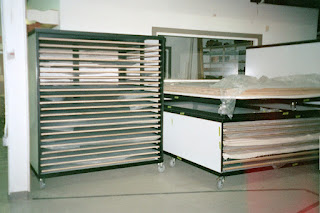
Flag storage allowing flags to remain flat.


Changes in the location of the flags meant changes for the Museum.  It now had custody of the 340 flags and was to treat, and store, or ready them for exhibit in an already incredibly limited space.  Revolutionary thinking had to occur. And it was from this out of the box approach that the idea of a hybrid display case came to life.  The case would be housed in the exhibit space of the museum, and would simultaneously act as the storage space for additional flags to be rotated into the exhibit at an interval of every six months.  Revolutionary to the approach was also that the display cases were built for the size of the flags, not the space of the floor (previously some flags had to be folded to be stored).  Museum staff designed these hybrid cases with incorporated storage units hidden behind cloth covered panels, housed below the flag exhibit case.

simultaneous flag and banner display and storage, art conservation of flag collections
Large double capacity flag case for exhibit and storage.  Hidden storage for mounted flags that are ready to be rotated into exhibit is behind the cloth-covered front panels.


The display case accommodates two of the largest sized storage units in the hidden area below, this was designed mainly for the average size of the flag in the collection - Civil War guidons and regimental flags as well as military regimentals from the mid 1900's.  Flags being displayed are supported by an aluminum honeycomb panel which is held in place by angled iron supports.  An added feature is ease of use.  Flags can be removed from below and placed into the display case in less than one hour and can be accomplished by just two members of the museum staff.


The case also houses a datalogger for humidity monitoring as well as fiber optic lighting which have allowed museum staff to keep light levels at or below 2.5 fcs.  In addition, case lighting is tied to motion sensors, further limiting the amount of light which each flag is exposed to.

Light meter.  Replica flags were used for lighting adjustments.


Because the flags were stabilized in-house, and the panels were designed to go from storage to display, the costs to stabilize the flags was only 25 - 33% of what it was originally estimated.  Unfortunately, funding and practicality do not allow for each flag in the Museum's collection to be mounted (for example, the 85 foot pennant from a ship).  Yet each of Maine's flag's are stabilized and available to the public, via internet catalog, exhibit or replica, thus achieving the Museum's goals.

As a conservator, employing practicality in a project is rewarding.  The needs of this particular space clearly dictated the way the objects needed to be stored and demanded that the conservation team needed to approach this project in a way that challenged us all.  While the end result seems like such a simple and logical approach it also seems so underutilized, perhaps because we fall into the habit of doing things the way they have been done simply because they have been done that way for so long.

To read more about The Maine State Museum's exhibit visit here: http://collections.mainestatemuseum.com/collection/results.do;jsessionid=40236684A78BDFE062309B27AF7277E0?highlight=38

This post by Barbara Owens is a summary of a talk and paper by Gwen Spicer, "Saving Maine's Colors: Collaborative Strategies in Flag Conservation and Exhibition at the Maine State Museum" at Tales in the Textiles: The Conservation of Flags and Other Symbolic Textiles .

_____________________________
Gwen Spicer is a textile conservator in private practice.  Spicer Art Conservation specializes in textile conservation, object conservation, and the conservation of works on paper.  Gwen's innovative treatment and mounting of flags and textiles is unrivaled.   To contact her, please visit her website.


Friday, May 11, 2012

The Dilemma of Historic Conservation - Which Era to Preserve?

Imagine you are an influential architect who's life spans nearly a century and who's work resonates from your home where it is carried to all the commissions you receive.  Such is the case of Philip Johnson who built his famous Glass House in 1949 and its accompanying guest house, referred to as the Brick House.  Why was Johnson's second home so significant?  Simply because it is where he allowed his architectural dreams to take flight.  Here existed his "practice palette" for his most influential ideas.

Original 1949 floor plan of Johnson's Brick House
Brick House in foreground, Glass House in back ground (c. 1949) 

In 1953 Johnson created the dramatic interior of the Brick House.  The most important elements are the arched ceiling, supported by triangular pillars, and the Fortuny fabric, which hung as curtains, covering its walls.  Johnson would use these elements in many of his subsequent projects, some of which can still be seen today.  His choices in fabric and his architectural vision seem timeless.  In fact, the Fortuny fabric he used nearly 60 years ago is still available from the company's active line.

Johnson's weekend estate underwent many changes throughout the decades.  None were more dramatic than those that occurred in the 1980's; curtains became sliding panels, the fabric was stretched and stapled to these panels, the bed, floor and built-in bookshelves were all altered, all under the direction of Johnson, who was now in the early winter of his life.

Johnson's 1953 renovation - substantial changes only four years after the original construction. 


In 1986 the National Trust acquired the property and Johnson was allowed to remain in residence until his death in 2005.

What is in store for a historical landmark that has a history as rich and evolving as this?  Here lies the dilemma: interpretation.  Most historic sites are faced with common questions when the site undergoes restoration.
- Which elements are critical to the original concept?
- How have the elements changed over time?
(For example, has the Fortuny fabric altered sufficiently to no longer create the luminous quality Johnson intended?  How are decisions reached for restoration, and are they consistent from room to room?)

As with most decisions, underlying issues are at play.  One issue is mold and whether the levels are safe for visitors.  The other is the period of interpretation.

Brick House bedroom 1953 with original Fortuny Fabric curtains and Ditzel wicker chairs


WHICH TIME IS THE RIGHT TIME?

The National Trust states their period of interpretation is between 2001-2003, literally the final years of Johnson's life when the interior consisted of worn, fading and stained textiles and when Johnson was no longer actively working as both his sight and health were failing.  When the site was nominated as a historic landmark in 1997, the period of significance was indicated as between 1949 and 1995, (an long stretch of time based on the dates which reflect Johnson's working years.)

Clearly these two periods of interpretation are in conflict and are the crux of the tension derived from  such a decision.  The site must decide what is important: that it be left as it was at the end of his life?  Or restored to what he envisioned in 1953?  Or the 1980's.  Or perhaps some other time?

Brick House, art conservation of historic site, survey of collections
The Brick House bedroom during its 1980's renovation.  Johnson has replaced the curtains with panels with the fabric now stretched, the carpet is void of texture, the ottomans replace the original wicker chairs and the bed is narrowed.

DILEMMAS:

While era for interpretation may be the main dilemma, other dilemmas exists, which may not be as obvious, but will directly impact the site and how it moves forward.  Mold levels must be reduced, without this preventative step, the site may not be suitable for visitors.  As for long term preservation: what will be the traffic flow into the building?  How will it impact dust migration?  How will this impact wear and tear on the textile elements?  The Fortuny fabric covers every wall, it is a large component of the room and demands attention.  Will the site staff maintain the NT's period and surface clean only?  What about removal of the wall covering to treat it and return the original covering to the walls incorporated with with new mounting and backing?  Lastly, the fabric could be completely removed and re-housed, replacing it with vibrant "reproductions" (remember that the EXACT fabric can still be purchased today - a rare circumstance).

Lastly, is this an "all or nothing" dilemma?  Do all the pieces need to be treated or replaced?  These are the issues any historical site faces when evaluating renovation.  As a conservator, we must give our best  professional opinion and be prepared to assist the site in whichever it chooses.  Drawing on each aspect of conservation - treatment, re-housing, storage, preservation and stabilization - a site project of this magnitude provides both the challenge of dealing with these dilemmas, but most importantly, the opportunity to solve them.

This post by Barbara Owens is a summary of a talk given by Gwen Spicer called "Decoding the History of the Fortuny Fabric at Philip Johnson"s Brick House Interior" at the New England Conservation Association, held at the Shelburne Museum in 2010.

_____________________________
Gwen Spicer is a textile conservator in private practice.  Spicer Art Conservation specializes in textile conservation, object conservation, and the conservation of works on paper.  Gwen's innovative treatment and mounting of flags and textiles is unrivaled.   To contact her, please visit her website.


Wednesday, May 2, 2012

Conservation of a 400 Year-old Map; and the Difference Between Parchment and Vellum

by Barbara Owens

400 year-old maps are fragile, rare and priceless.  As a conservator, balancing the delicate nature of a skin artifact with the stabilization of the piece requires skill, concentration, and a gentle touch.


paper and object art conservation of parchment, vellum, skin and leather artifacts, historic maps, artifacts, Spicer Art Conservation


"Paper" in the 17th century existed as parchment or vellum.  Parchment and vellum at this time were both animal based, derived from cow, sheep or goat.  Vellum, parchment's finer cousin, required more steps to be produced (and therefore made it more expensive) it was also typically made of calf skin.  The Renselaerwyck Map is referred to as being printed on both parchment or vellum.  Truthfully, to distinguish one from the other in a piece from this era would be nearly impossible and would probably require chemical testing of the object.  Clearly, testing a historically valuable piece of this kind would not reveal any information pertinent to its history.  Conclusions can be drawn however, simply from the fact, that vellum was a more expensive medium and, Kiliaen van Rensselear is, at the time of its commissioning, one of the most important men in the new world and could certainly afford it.

The Map of Rensselaerwyck (printed on the map as "Renselaerwyck") is a piece of New York history reflecting the unique early Dutch settlements of the Hudson River.  This particular map was stabilized to be included in the exhibit: "1609" at the New York State Museum in Albany, New York.  

Surprisingly, for its age, this map was in very good condition.  Perhaps because of its inclusion in the restricted access section of the NYS Archives and its vaulted storage.  The map had suffered some small tears and losses which were repaired at some point in the past.  Comparison of photographs from the early 1900's shows the fragility of the ink and its susceptibility to the environment.  The map required a variety of treatments, from flattening the skin while in a controlled humidity chamber, to tears mended with Japanese tissue.  


check out the virtual tour of the "1609" exhibit here:  http://www.nysm.nysed.gov/1609/


_____________________________
Gwen Spicer is a textile conservator in private practice.  Spicer Art Conservation specializes in textile conservation, object conservation, and the conservation of works on paper.  Gwen's innovative treatment and mounting of flags and textiles is unrivaled.   To contact her, please visit her website.

Wednesday, April 25, 2012

Conservation of a 200 year old War of 1812 coatee, including a custom mannequin for display, and storage

by Barbara Owens

War of 1812, Art conservation of historic military uniforms, custom made mannequin


Last year, Spicer Art Conservation, LLC had the great honor of working on the John Ellis Wool coatee, c. 1813, from the Rensselaer County Historical Society.  RCHS was a 2011 recipient of a Conservation Treatment Grant from the Greater Hudson Heritage Network.

Wool's 200 year old coatee, a rare (only three known coats of this type exist) uniform from the War of 1812, had considerable damage to it from previous insect infestation, with holes scattered over much of it.  It had open seams and deteriorated thread and cording.  The jacket also had overall soiling and grime.  A few creases and folds were evident.

Each of these areas of treatment needed to be addressed, but equally important is that Wool's coatee is often studied by military researches and re-enactors.  It is also requested for exhibition at other museums and historical societies.  These various needs, from very different groups, required that the coatee be prepared for exhibition, study, storage, and transport.

Through the Conservation Treatment Grant, RCHS was able to have the coatee itself preserved and stabilized.  The next step was to create a custom-made mannequin form for exhibition.  The form consisted of metal armature which supported a Ethafoam structure.  The Ethafoam was then covered with both cotton knit fabric and display fabric where visible.

But this is no ordinary mannequin, this mannequin included something unique.  This mannequin's custom built components are two-fold.  They serve to provide both structure in exhibition, as well as support while in storage.  This is accomplished by building a "vest" (which fits around the mannequin) with attached padded arms that stay with the artifact during both exhibition and storage.  The vest is separate from the form, however it remains inside the coatee to provide support in storage.  An additional padded form was made to retain its three-dimensional shape to prevent crushing and deformation during storage.  This padded form would be inserted into the "vest", inside the coatee for storage.  (See photos below: the first is the inside view of the vest, the second is the storage form inserted into the vest.)

custom designed display and support for War of 1812 coatee, art conservation of historic textiles

custom designed support and display of War of 1812 coatee, art conservation of historic military textiles

A custom-made storage box was also created from inert, conservation approved materials to hold the padded coatee.  The storage system made the coatee accessible for study whilst protecting it from excessive handling.

Working on a grant-funded project like this one from RCHS poses challenge and opportunity.  Never before had Spicer Art Conservation been asked to not only provide expert preservation of a garment, but to provide a versatile mannequin capable of providing structure and support for very different needs and demands.  It came out beautifully and the garment has since travelled to Canada for a visiting exhibition.  

Doing the conservation work for the Wool coatee also marked an important milestone for Spicer Art Conservation.  This was the 11th consecutive year we have done conservation for at least one of the organizations who were recipients of the Conservation Treatment Grant from the Greater Hudson Heritage Network.

Learn more about John Ellis Wool's coatee and RCHS here: http://www.rchsonline.org/


_____________________________
Gwen Spicer is a textile conservator in private practice.  Spicer Art Conservation specializes in textile conservation, object conservation, and the conservation of works on paper.  Gwen's innovative treatment and mounting of flags and textiles is unrivaled.   To contact her, please visit her website.


Thursday, April 19, 2012

THOMAS EDISON'S TIN FOIL RECORDING

by Barbara Owens
The envelope containing the Thomas Edison phonograph tinfoil, preserved and conserved at Spicer Art Conservation


What does a conservator do with a one-of-a-kind piece of American history from the greatest inventor of all time?  Let me tell you.

The date is June 22, 1878. 

Thomas Edison is perfecting his phonograph, a machine that will literally change the future and the recording of voice, music and sound, as we know it.  Edison is not without his critics.  Then, just as today, people resist change and many are not sure about Edison’s new device.  Edison however knows that his invention will change the world.  It is not known for sure where Edison is on this exact day.  But it is believed he is in St. Louis, one of many stops he makes to demonstrate (and hopefully find buyers for) his revolutionary new device. 

The following is an excerpt from an interview Edison had given earlier in 1878 when he spoke to a Washington Post reporter in Washington DC.  Edison speaks to the reporter while at the Smithsonian where he is to demonstrate his new invention.  Here Edison describes in his own words how the phonograph works, including the role of the tinfoil in the recording of sound:

When do you give an exhibition of your phonograph?"
"At 4 o'clock.  Have you ever seen it?  Well, come in and I'll show it to you."  And leading the way, he (Edison) entered the room adjoining the secretary's office, uncovered the wonderful "Sound Writer," and began to explain it.
"Here the phonograph, you see, is a thin disc or diaphragm of iron, beneath which is this fine steel point, which moves up and down by the vibrations of the disc.   Beneath this is the revolving cylinder, on which is this spiral groove.  On the axis of the cylinder is a screw, the distance between the threads being the same as the distance between the grooves on the cylinder.  The cylinder is covered with a sheet of tin foil--you will see it operate by and by--and when the cylinder is revolved the steel point presses the tin-foil into the spiral groove.  If now the diaphragm be made to vibrate by the voice the steel point makes a series of indentations in the tin-foil grooves, corresponding to the sounds uttered.  On going over again the same groove with the steel point, by setting the cylinder again at the starting point, that is, by going over the same ground, the indentations in the tin-foil cause the membrane again to vibrate precisely as at first, thus reproducing the sound originally made.  The same sound wave you first made is returned to you in whatever shape you made it.   Your words, for example, are preserved in the tin-foil, and will come back upon the application of the instrument years after you are dead in exactly the same voice you spoke them in."
"How many times?"
"As long as the tin-foil lasts.  This tongueless, toothless instrument, without larynx or pharynx, dumb, voiceless matter, nevertheless mimics your tones, speaks with your voice, utters your words, and centuries after you have crumbled into dust will repeat again and again, to a generation that could never know you, every idle thought, every fond fancy, every vain word that you choose to whisper against this thin iron diaphragm."
"How old are you, Mr. Edison?"
"Thirty-one."
"Very young yet."
"I am good for fifty; and I hope to astonish the world yet with things more wonderful than this.  I think the world is on the eve of grand and immense discoveries, before whose transcendent glories the record of the past will fade into insignificance.  This is a very poor specimen of a phonograph, however.  You see how simple the mechanism of this idea, and how simple the idea itself; and yet, after all, it is curious."
And the reporter, turning away to record the utterances of the sages in the room adjoining, thought of that passage of Holy Writ which says, "every idle thought and every vain word which man thinks or utters are recorded in the Judgment Book."   Does the Recording Angel sit beside a Celestial Phonograph, against whose spiritual diaphragm some mysterious ether presses the record of a human life?

Spicer Art Conservation has the pleasure of restoring a full page of Edison’s “tin foil”!  This particular piece of foil was given in July of 1978 to General Electric’s Hall of History and then later was moved, with the entire Hall’s Collection, to the Schenectady Museum and Suits-Bueche Planetarium, which later was renamed the Museum of Innovation and Science ("miSci"). 

The object’s current condition is clear from the photographs.  It has been folded for some time into a 5” x 1 7/8” package.  Upon folding, the edges were left unsupported; this resulted in distortion and perpendicular tears.  Further damage occurred when the tinfoil was opened at some point in the past.  The tinfoil then experienced additional creasing of parallel folds between the tears.  Two narrow sections at one end are more tarnished than the other six sections, this occurred because these sections were located on the outside of the folded package.

The tinfoil has resided in the climate-controlled archives of the Schenectady Museum.  It is housed in a flat, acid-free box and lies flat while in the cabinet.

SO WHAT DOES IT SAY????!!!!

The answer (right now) is that no one knows.  The goal of Spicer Art Conservation’s treatment of Edison’s Tinfoil Recording is to flatten as much of it as possible.  The foil was originally going to be sent to England to be digitally scanned.  It will now be sent to the Lawrence National Laboratory where equipment has been adapted to scan and reproduce the sound from this incredible American treasure.

Spicer Art Conservation will also create housing for transportation of the piece.  While all of this is very exciting, it is a bit daunting in that next to nothing is known about this particular material due to its rarity.  The foil must be flattened by hand with utmost care to preserve the surface “ticks” that create the sound.  The restoration is time-consuming and painstaking, but more importantly it is an honor to work on such a rare piece from an iconic figure and legendary inventor.

This recording is one of only two believed to have survived in its entirety.  The other is housed in the Smithsonian where Edison demonstrated it some 134 years ago.

Want to read more about this piece and see some additional pictures?  Check out this article from the Albany Times Union: http://www.timesunion.com/local/article/Here-s-the-oldest-voice-you-never-heard-1331323.php
And look for more details on the restoration of Edison’s Tinfoil here in our blog.

Wednesday, April 11, 2012


The modern age has come to Spicer Art Conservation’s studio with the start of this blog. We hope it will be a place of exchange.

Many of our clients only get to see what we are working on and discuss new trends that we discuss during their visit or as part of phone conversations. But with this blog we can more easily share with everyone what we are facing at SAC and in the field of art conservation generally.