Flag conservation

Flag conservation
Textile conservator, Gwen Spicer of Spicer Art Conservation at work

Thursday, May 28, 2015

A magnet is only as strong as . . .

. . . . its receiving side will allow it to be.  Yes, that is right, a magnet on its own has no power. But in the company of another magnet, or a ferromagnetic material, it will show its pull force.

Metals are grouped by their magnetic behavior, and this is an important factor in determining a magnet's effective pull force. Metals are divided into three groups:
  1. Ferromagnetics which are very/highly attractive
  2. Paramagnetics which are weakly attractive
  3. Diamagnetics which are opposed to magnetic fields


Magnets used in art conservation, spicer art conservation, textile, paper, object conservator

The magnetic system will not function to its full ability if the receiving component is not properly paired with the magnet. This is because the full strength of a magnet can only be reached if the ferromagnetic material it connects with can become magnetically saturated. This means that the receiving material has to be able to hold all the magnet’s “flux” (i.e. the amount of magnetic field passing through a given surface) to utilize 100% of the magnet’s pull force. 

Of the three metals most often magnetized—nickel, cobalt, and iron—iron alloys are the most readily available. Among all elements, these materials can be temporarily magnetized (also referred to as “soft” magnetization) when in proximity to a permanent magnet. (When positioned near a temporary or “soft” magnet, the permanent or “hard” magnet creates the attachment force). But that attraction is lost once the permanent magnet is removed. One common example is a magnetized chain of paper clips: a permanent magnet touches a paper clip, that paper clip becomes magnetized, a second paper clip touches the first and it also becomes magnetized, and so on. Each paper clip has become a soft magnet, but once a paper clip is detached from the chain, it loses its magnetization.


Steel, composed mainly of iron and carbon, offers a wide range of characteristics including high strength, shock resistance, and machineability. Other metals, like manganese, silicon, chromium and molybdenum, are added to alter the properties of the steel to make carbon steel, alloy steel, or tool steel. However, their addition lowers the ferromagnetic properties of the material.

When a sheet of steel is too thin, some of the magnets strength will extend behind the steel, because the steel isn’t thick enough to hold it all. If another ferromagnetic material is placed behind it, just like a paper clip, it too will be attracted and become a soft magnet. In this way the magnetic field can travel to several neighboring layers of ferromagnetic material, increasing the magnetic force as needed. However, if the sheet of steel is thick enough, then the reverse side of the metal shows no magnetic attraction because the steel has become fully magnetically saturated.

The arrows indicate the alignment within the domain walls

Ferrous metal sheet thickness is measured in gauge, commonly found between 30 (thin) and 8 (thick); therefore the higher the number, the thinner the sheet of metal. Specifically, a gauge 8 metal sheet is 0.4 cm (0.1644 inches) thick; a gauge 30 metal sheet is .03 cm (0.0120 inches) thick. 


Gauge measurement refers only to the thickness of the metal sheet, not to the percent of iron alloy or any applied coating; hence one cannot rely on a specific metal’s gauge to ensure that it will have the intended effect. Galvanizing adds to the thickness of the metal and has its own reference tables. Thus, a 24-gauge steel sheet and 24-gauge Galvanized steel sheet have different thicknesses but are equivalent magnetically. 

When using rare-earth magnets, using 22-gauge or thicker is optimal (the minimum gauge steel sheet to use is 24-gauge). Selecting the best gauge of steel sheet for the magnet system is more critical than the overall weight of the mount.

It is also important that when recording your system that along with the shape, grade and size of the magnet, that the gauge and type of the ferromagnetic material (i.e. galvanized steel) is noted. Without these details the system cannot be fully documented or reproduced.


_____________________________
Gwen Spicer is an art conservator in private practice.  Spicer Art Conservation specializes in textile conservation, object conservation, and the conservation of works on paper.  Gwen's innovative treatment and mounting of artifacts is unrivaled. To contact her, please visit her website.

Learn more about magnets and their many uses in the new publications Magnetic Mounting Systems for Museums and Cultural Institutions. Available for purchase at www.spicerart.com/magnetbook.

Thursday, May 14, 2015

Magnet use in art conservation: charts, tables, references & further reading

Magnets are fascinating, but greatly under appreciated because they are so common in our everyday life, therefore it is assumed that they are simple in function and there is nothing more to know. However, the way they work is really complex and there is so much to know about them. When I mention their use for conservation treatments or mounting for exhibition, I usually hear two different responses:

1)  "I don't use magnets, I don't know enough about them and I'm worried I will harm the artifact, OR I'm afraid the magnet(s) won't securely hold the artifact and it may slip or fall."

2)  "I use magnets! But, I don't know too much about them other than I put the artifact against a magnetic surface and then I put a bunch of magnets on the surface (probably more than I have to, but I want to make sure the artifact won't slip or fall)."

My own use of magnets started when I used them to secure an object to a mount. Truthfully, at the time, I knew so very little about magnets, yet I was keenly aware that I needed to be cautious about using any that were too strong for fear of causing damage. The artifact I mounted was a perfect choice because it was sturdy and there was no risk of crushing or marring any surface. The magnets were placed on the mount with metal washers placed inside of the object. A layer of protective Mylar was placed between the magnet and the object.

When choosing the type of magnet to use for this first project, I knew that some magnets were stronger than others, especially that there were these really strong magnets called "rare earth". I knew magnets needed a receiving material - a metal that they could "stick" to; and that some metals created a stronger "stick" than others. But truly what was physically happening within the magnet or the receiving metal was sort of magic. I needed to understand this magic and I needed to be able to create a mount that was SAFE for whatever artifact I was working with. As I began to understand magnets, I realized that the possibilities were endless; mounting textiles, upholstery work, I could think of so many opportunities where I could employ magnets.

Art conservation, rare earth magnets, textile, object, paper conservator, magnets used in conservation
The tufting of a seat using rare earth magnets.

The next project that was perfect for magnet use was to create the tufting on a chair. Disk shaped magnets were the perfect "button" for the tufting site. Strong magnets made a nice tuft as they were strongly attracted to the washer embedded in the seat layers, and the fabric was a reproduction so there was no risk to harming a textile artifact. When the project was completed I was completely hooked on magnets. I had done countless mock-ups in preparation for the tufting, trying various magnet sizes and strengths, pairing these magnets with various sized metal washers, and determining how the fabric layers in between their junction effected the attraction.

Did I make mistakes in the beginning? Yes, of course. For instance, I had no idea that extreme heat would have an impact on how rare earth magnets functioned. So, in an early project I had the great idea of using hot melt glue to affix foam to the magnet, not knowing that the heat of the glue was too hot and made the magnet useless! How sad to find that I had ruined a few magnets before I realized what was going on.

Rare earth magnets used in art conservation, art conservator, Spicer Art Conservation

Also, if I redid some early mounts, I would have ALWAYS put the receiving metal inside of the artifact, never the magnet. Only because reusing rare earth magnets is more desirable than leaving them inside artifacts because of their cost and the environmental damage caused by the mining of these materials. Also, unless the artifact is clearly labeled "magnet within" (or some other kind of warning), it could be placed too near a metallic surface where an attraction could be made, not a pleasant surprise for the person handling the artifact.

Magnets have been around for a very long time. Articles citing artifacts mounted with magnets appear as early as 1988. These were all important early "pioneer" projects, and as art conservation projects using magnets moves forward in time, the complexity of the magnets and materials grows.

To understand and sort out all of the magnet information I had gathered, I began to create charts to reference information I might need again. The charts are listed below and are linked to the image of the chart itself.

- comparison of types of magnets (and their performance properties)
- a list of art conservation projects using magnets (compiled in 2012)

As I began to understand that there are three parts to a magnet system: 1) the magnet, 2) the space between the magnet and the metal receiving material, called "the gap", 3) the receiving metal; I realized that this was more easily understood if diagramed in a cross section.  Below, are the two most requested diagrams from various projects to illustrate each of the components of a magnetic mount and how they work together.

1) Hunzinger chair tufted with the use of Rare Earth magnets:

Spicer Art Conservation, textile conservator, rare earth magnet, re-tufting of chair, upholstery conservation, restoration


2) Hanging system for textiles using "L" bracket

Mounting artifacts with rare earth magnets, Spicer Art Conservation, textiles, objects, paper


Word to the wise:
There are a few things that I have learned that I would strongly advise when using magnets:

1) Don't use hot melt glue. Instead, read this invaluable information about how to safely glue rare earth magnets from the wonderful and knowledgeable people at K & J Magnetics.
2) Think twice if you are tempted to use the products labelled "magnetic paint" to simply paint a wall and then affix magnets to it to hang an artifact.  While this may seem okay when you test it, mathematically there is just not enough strong magnetic attraction created in this type of a system and because of that simple fact, it would be the most likely system to fail.
3) Fingers get easily and painfully pinched when they inadvertently find themselves between two strong magnets that are "jumping" together. If you are using strong rare earth magnets, keep them in containers where they can be separated and handled one at a time - contact lens cases are PERFECT!


Finally, I have compelled a list containing the references for some books or articles written about magnets, especially the aspects of their environmental impact. I have used many of these as a reference in my papers, talks, workshops, or articles. Additionally if you will find a comprehensive list of my magnet articles they can also be accessed on my website, under the PUBLICATIONS tab.

Also, if you have not picked up a copy, my most recently read magnet book is: "RARE; The High Stakes Race to Satisfy Our Need for the Scarcest Metals on Earth" by Keith Veronese.  Get yourself a copy and read it!

_____________________________
Gwen Spicer is an art conservator in private practice.  Spicer Art Conservation specializes in textile conservation, object conservation, and the conservation of works on paper.  Gwen's innovative treatment and mounting of artifacts is unrivaled.   To contact her, please visit her website.

Learn more about magnets and their many uses in the new publications Magnetic Mounting Systems for Museums and Cultural Institutions. Available for purchase at www.spicerart.com/magnetbook.

Wednesday, April 29, 2015

Preservation week and the importance of preserving artifacts

A week devoted to the preservation of cultural heritage is a wonderful week indeed! We get many phone calls and email messages asking for advice or help to care for artifacts from families and museum collections.  Sometimes, the items in question are in need of care from a professional conservator, but other times the items are just not being kept as carefully as they could.  The most frequent advice we give to those looking for proper storage and care is threefold:                          


  1. Watch the temperature and relative humidity of your storage/display area.  You do not want large fluctuations in either; temperature should be between 65 and 70 degrees F, and RH should always be below 50%.  The chart below illustrates the ideal conditions for the safe-keeping of artifacts.  
  2. Direct light is a NO-NO!  Keep your items out of the light. Light damage is accumulative and irreversible.  "No light" is therefore the best possible environment, especially for your paper, textile and upholstered items.  
  3. Use acid-free materials to support and store your collection. 


Artifacts, storage, art conservation, antiquities, museum collections, relative humidity

If the only thing you can do is the three items listed above, it is a great start!  The recommendation of the above three items is always followed with the next three questions:

  1. How in the world do I determine relative humidity?
  2. What can I cover my windows with? OR is there a UV protecting glass I can use?
  3. What is "Acid Free"?

As luck would have it, there is an answer for each of these questions.

  1. Relative Humidity, temperature, and light exposure can be determined quite easily and with no great expense using a HOBO data logger.  If that is just way more than you think you need, then just keep in mind the guidelines above: between 65 and 70 degrees F and below 50% humidity.
  2. Cover your windows with curtains or light blocking/filtering shades or light blocking/filtering cling-style window films.  Cover your lights with diffusers.  And use UV filtering plexiglass on your framed artifacts.  And if you want to measure what kind of light a particular room or area is receiving, you can use British Wool Fading Cards to determine that.  Bottom line = Light is bad!
  3. An in-depth discussion about Acid Free materials can be found in our October 2013 blog entry entitled:  "What is Acid Free?"

ALA, the American Library Association reports that after the first comprehensive national survey in 2005 of the condition and preservation needs of the nation's collections, "it was reported that U. S. institutions hold more than 4.8 billion library items. Libraries alone hold 3 billion items (which represent 63% of the whole).  A treater trove of uncounted additional items is held by individuals, families, and communities.  These collections include books, manuscripts, photographs, prints and drawings and objects such as maps, textiles, paintings, sculptures, decorative arts, and furniture, to give a sample.  They include moving images and sound recordings that capture performing arts, oral history, and other records of creativity and history.  Digital collections are growing fast, and their formats quickly become obsolescent, if not obsolete".

The survey showed that, "some 630 million items in collecting institutions require immediate attention and care. Eighty percent of these institutions have no paid staff assigned responsibility for collections care; 22 percent have no collections care personnel at all. Some 2.6 billion items are not protected by an emergency plan. As natural disasters of recent years have taught us, these resources are in jeopardy should a disaster strike. Personal, family, and community collections are equally at risk."
And because of these statistics and the survey information, Preservation Week was born. Libraries and cultural heritage institutions are encouraged to use Preservation Week to connect with their local communities "through events, activities, and resources that highlight what we can do, individually and together, to preserve our personal and shared collections." If you couldn't attend a presentation in your community or anywhere else, here is a youtube link to ALA's past "Preservation Week" presentations, covering various topics on how to care for your collection. 
Of course, if in doubt about the way you are caring for (or storing) an item, or a collection, contact us!  We are happy to help. And if you think your item or collection falls into that category of the "630 items that require immediate attention and care," contact us sooner than later.


_____________________________
Gwen Spicer is an art conservator in private practice.  Spicer Art Conservation specializes in textile conservation, object conservation, and the conservation of works on paper.  Gwen's innovative treatment and mounting of artifacts is unrivaled.   To contact her, please visit her website.

Tuesday, April 14, 2015

Lincoln Presidency and Assassination bring a world of memorabilia to be conserved

April 14th marks the 150 anniversary of the fateful day when President Abraham Lincoln was shot at Ford's Theater, dying of his wounds early the next morning.

The memorabilia items that we see linked to this great president are in no short supply. Items that are either directly related to him, or related to some event that included him, are prized. In 20 years of private practice at SAC, clients have brought a multitude of Lincoln iconography to be conserved. And that doesn't even include the items linked to him from the Civil War or the Abolition of Slavery. Lincoln truly was prolific and his image on an item often meant it was kept.

Textile art conservation, Abraham Lincoln collectibles memorabilia, repair and restoration of artifacts, antiques and antiquities
Textile banners like these commonly appeared
with bunting and were hung on a building.
Private Collection.

The artifacts we have treated have been in textile form, like the banner (above), transparency sign (further below), or silk ribbon (furthest below). Objects, like the gloves worn to Lincoln's funeral (immediately below). Paper, like letters believed to be from Lincoln, or letters and newspaper clippings that spoke about him, his presidency, or his untimely death.

Antique leather repair, magnetic museum mount, objects conservator, Spicer Art Conservation Albany New York
These leather gloves were worn to Lincoln's funeral. Surprisingly, we
consulted with another collector on a very similar pair, also worn to
Lincoln's funeral, but by a completely different person.
Owned by the NYS Millitary Museum.

Objects from Lincoln's presidential campaign are also highly prized, like the campaign banner below.

Spicer Art Conservation, repair and restoration of presidential memorabilia, artifacts, antiques , textiles
This transparency sign, made of cotton and mounted on a wooden
frame box to be illuminated by candle, is owned by the
Columbia County Historical Society in New York. 
Lincoln campaign, presidential memorabilia collectibles, art conservation, textile conservator
This silk ribbon, from the 1860 Presidential election
suggesting "A. Lincoln for  president" and "H. Hamlin
for Vice-President".  Private Collection.

Often when a client brings an item relating to Lincoln or any other historic figure, they want the item to be substantiated. Is it real, is it from the actual event, or was it from an anniversary to commemorate the event? This is usually unknown, yet they want to conserve the item because of the image of Lincoln and because, after all this time, he is still regarded as a great president.

Interestingly, many items that we treat are what is considered ephemera, and therefore were originally not meant to last (such as the campaign ribbon, or the cotton transparency sign). This of course means that these items arrive at the studio in quite fragile condition. And although many of these artifacts have been kept carefully, these items that were meant to be short-lived are just inherently delicate. It is also interesting that often a client wants their Lincoln ephemera placed in an archival mount or storage, but does not want to change the look of it (meaning that they want to keep the wrinkles in the paper or fabric, and the marks that make it look old). Perhaps it feels more "authentic" if the object's history of use is still clearly visible.


_____________________________
Gwen Spicer is a textile conservator in private practice.  Spicer Art Conservation specializes in textile conservation, object conservation, and the conservation of works on paper.  Gwen's innovative treatment and mounting of flags and textiles is unrivaled.   To contact her, please visit her website.

Friday, April 3, 2015

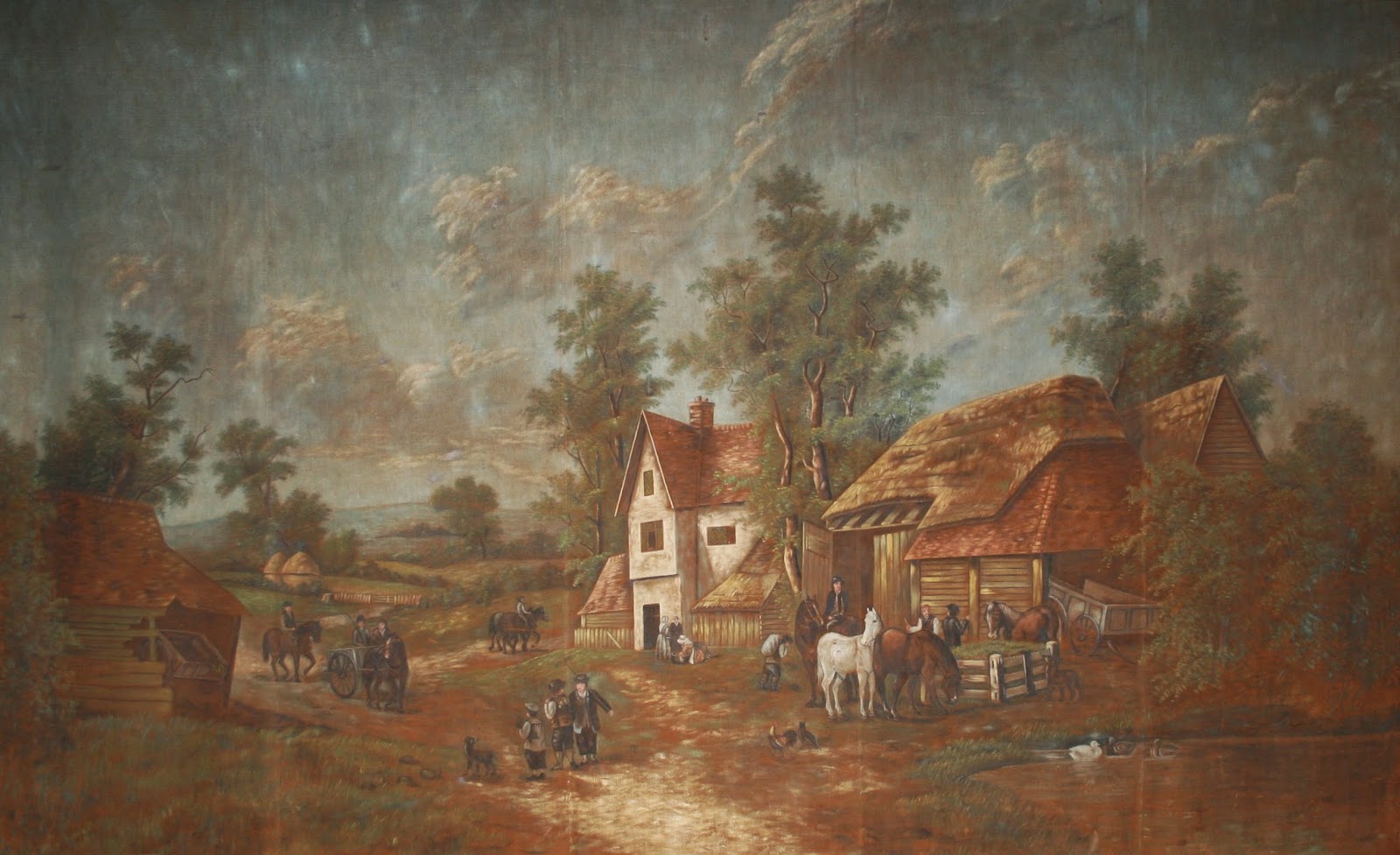
Treatment of a 100 year-old textile and a magnetic mount for display

Fredonia Grange is the first grange in the United States and is therefore designated appropriately as Grange #1. But what is a grange?  Most people have heard of the term, but are not clear about what a grange is and what a rich history this group has.

The formal term is "The National Grange of the Patrons of Husbandry" and the group traces its birth to the time following the Civil War when the U.S. was feeling the economic damage from the war (particularly in the Southern states). But it was not just the ravaged farms and plantations in the south that were suffering, farmers everywhere were having troubles. Under the direction of Andrew Johnson a representative was sent to the south the survey the conditions. This man, Oliver Kelley was a northerner and not readily welcomed by southerners. But when Oliver Kelley revealed he was a Mason, fellow southern Masons spoke with him freely. From these conversations, Kelley felt that there was a way to revive agriculture and build the trust and cooperation among farmers, and Kelley knew that supplying food to the nation was dependent on this. Upon his return to Washington DC, Kelley and some fellow Masons decided that a secret organization (much like the Masons) for farmers and people living in rural areas could be a fraternal group that would promote cooperation and unite farmers everywhere, regardless of their Civil War affiliation. And so on April 12, 1868 with the establishment of Grange #1, the first farmers advocacy group was formed.

Poster from the Library of Congress promoting the Granges.

Fredonia Grange #1 was formed on April 12, 1868.  In 1915 their current building was constructed and this year they will celebrate the 100th anniversary of its completion. The grange has a long history, and one of their wonderful artifacts recently came to the studio at Spicer Art Conservation for some much needed treatment.

restoration of 100 year old textile, art conservator, antique, Fredonia Grange, before treatment
The textile before treatment. 

The curtain had hung from a wall for nearly 100 years and was quite dirty from years of cigarette smoke, a coal fired furnace and any other debris that had settled onto its surface. It had hung is a way which allowed for the surface to billow in spots, just like a curtain, and those areas were no longer lying flat, hence the painted image was not clearly readable in these areas. Additionally, testing showed the presence of oxi-cellulose in the cotton, and an area of white bloom was visible in areas of the paint. A large tide line at the bottom of the textile showed where it had been wet at some point.

The curtain required cleaning, stabilization and a sturdy method to display it, as the Grange was quite eager to put it back on their wall.

Serving New York and the World, Spicer Art Conservation is an expert in the care and repair of antique textiles, object and works of art on paper.
Both sides of the curtain were quite soiled, even the wall facing side.
(Above) it is cleaned with soot sponges; the side in the foreground has
been cleaned,  while the background has not - and it shows!

Textile conservator, restoration and correction of old repairs, antiques and artifacts
Here is a detail of a repair made to the curtain.

The curtain is made of 5 panels of fabric and is quite large, with an overall measurement 8 feet high, by 11.5 feet wide. The fabric is cotton and the image is painted in oil.  The image was created by a member of the grange who painted it specifically for the 1915 building (see the information plate below).


This image shows the gentle undulation that was in the textile while it hung at the Grange.

The Grange had this tapestry as a focal point in their main assembly room, and desired for it to be returned to the space for which it was created. They did not want to alter the way it had been displayed, other than to make the mounting system more efficient and the textile to hang evenly, without waves. A magnetic hanging system was devised for the textile (below). Note that the cotton webbing sleeve is affixed to the upper edge of the textile.
Magnetic mounting system designed by art conservator, Gwen Spicer
¾” disc N42 Neodynimium magnets with counter-sink hole are screwed to a 
“L”-shaped aluminum bar. The magnets are spaced about 4” apart. The lower 
lip holds the 22-gauge steel that is secured in the sleeve and attached 
to the textile. The magnets keep the steel sheet back against the support.

After Conservation by Textile Conservator, repair and restoration, antique textiles, tapestry, curtain, wall hanging, painting
The Grange curtain after treatment

At Spicer Art Conservation, whenever an artifact has a magnetic system designed for its treatment, display or storage, we carefully document the system in a way that can be universally understood. This language for describing magnetic systems is helpful for anyone who will treat or care for the artifact in the future. The above mount was quite simple and is described as follows:

[Aluminum "L" strip, *N42, disk shape with countersunk holes, 3/4" diameter x 1/8", cotton webbing, steel plate (22-gauge), cotton webbing], cotton textile with oil paint.

The mount description is in brackets and begins with the layer furthest from the artifact. The artifact is listed in italics and if any internal structure is placed within the artifact, it follows within the braces (aka {squiggly brackets}).

Here are some guidelines:
  • The position of the magnet is indicated by an asterisk. The grade and size of the magnet is in parentheses and follows the asterisk: *(grade, shape, size)
  • The ferromagnetic material, is underlined, it's gauge and/or thickness follows in parentheses.
  • The gap layers are in bold.

More information about Fredonia Grange #1 can be found on their Facebook page.
_____________________________
Gwen Spicer is a textile conservator in private practice.  Spicer Art Conservation specializes in textile conservation, object conservation, and the conservation of works on paper.  Gwen's innovative treatment and mounting of flags and textiles is unrivaled.   To contact her, please visit her website.

Learn more about magnets and their many uses in the new publications Magnetic Mounting Systems for Museums and Cultural Institutions. Available for purchase at www.spicerart.com/magnetbook.

Wednesday, March 18, 2015

The conservation of an unusual Civil War Battle Record textile

This past autumn, an unusual artifact was delivered to the studio. It is simple in construction, basically a long width of cotton fabric, and on it painted a list of words in basic black paint. So far nothing so amazing, until the words that were so carefully and beautifully written in very different fonts were read.

before treatment image of Civil War record banner, 136th New York Volunteers, art conservation of textiles by professional textile conservator and flag expert Gwen Spicer
The banner before treatment.

Each line of text was a separate battle that the 136th New York Volunteer Regiment had been engaged in during the Civil War. In essence, this width of simple cotton fabric was the regiment's war record. Such "battle honors" are more standardly recorded and seen on both National and Regimental flags of a regiment, often recorded on the stripes (see image below). Whereas this type of simple and utilitarian artifact was quite different. Why was such a piece created?

repair and framing of civil war flag, textile conservator, expert, Museum storage and exhibit, historic battle flags
Detail of another NY Regimental Flag. Here the battle honors are recorded onto the stripes, this was a common practice and is the way battle honors are typically recorded.

The regiment was mustered into service in September of 1862 and composed of men from Allegheny, Wyoming and Livingston counties. The banner was clearly locally made. The banner is signed, "Made by the Nunda Sign Co." (Nunda is a town in Livingston County). Interestingly, the war record as written in the memoirs below (see more at NYS Military Museum's webpage), states the battles to be far more than those recorded on the banner, and the battles on the banner do not quite match those in the record, why would that be? (Also of note is that "Kulp's Farm is called "Kolb's Farm in Confederate records).

…"fought its first battle at Chancellorsville, losing a few men killed, wounded and missing; and was heavily engaged at Gettysburg on the first two days of the battle, losing 109 in killed, wounded and missing. In Sept., 1863, it was ordered to Tennessee with the nth and 12th corps and was engaged the following month (November 1863) at the midnight battle of Wauhatchie, Tenn., losing 6 killed and wounded. It was active at Missionary ridge in the Chattanooga-Ringgold campaign, losing 11 killed and wounded. When the 20th corps was formed in April, 1864, it was attached to the 3d brigade, 3d (Butterfield's) division of that corps, moving on the Atlanta campaign early in May (1864). It was active at the battles of Rocky Face ridge, Resaca, Cassville, Dallas, Kennesaw mountain and in the siege of Atlanta. Its heaviest loss was incurred at Resaca, where the casualties amounted to 13 killed, 68 wounded and 1 missing. After the fall of Atlanta it remained there until November (1864), when it marched with Sherman to the sea, engaged in the siege of Savannah, and closed its active service with the campaign through the Carolinas, in which it was engaged at Fayetteville, Averasboro, Bentonville, Raleigh and Bennett's house, losing 45 in killed and wounded in the battles of Averasboro and Bentonville. After the close of the war (April 9, 1865) it marched with its corps to Washington, where it took part in the grand review, and was mustered out on June 13, 1865, under command of Col. Wood, who was later promoted to bvt. brigadier-general and major-general. The regiment lost by death during service, 2 officers and 74 men, killed and mortally wounded; 1 officer and 91 men, died of disease and other causes, a total deaths of 168".

The banner may make mention of just the campaigns (Atlanta for example) rather than naming the individual battles (Resaca for example was a battle within the Atlanta campaign that lasted from May 13-16 of 1864). For a detailed timeline of 1864 (and any other year) go to historyorb.com.

The banner was in brittle condition when it arrived to us, it was mostly intact but very dirty, had several tears, and had a very sticky tape applied to the reverse side. Therefore, the treatment of the banner involved several things: cleaning, repairing the tears, removing the tape (see image directly below) that had been applied to the reverse side hems at both the top and bottom, and mounting the banner along with it's original rod and rings. As mentioned above, the banner was quite dirty when it arrived (see second image below). And amazingly, the banner was still paired with its original rod and brass rings (see third image below).


old repair to civil war banner, art conservator needed, preservation repair and conservation of historic textile
Detail of the reverse top of the banner showing the tenacious tape that had been secured to the top and bottom hems.
cleaning of antique textile artifact, American civil war historic battle honors textile banner, 136th NY Vol, art conservator at work, preservation of flags
Dirt removed from the banner following the wet cleaning 

Detail of the original rod and one of the brass rings (safety pin not original).

With some some simple searching, it was found that after the war, the Regiment dutifully returned their Regimental, National, and guidon flags back to New York State. The assumption could be made that this banner was created out of a local desire to commemorate the efforts of this regiment in the absence of the flags.

civil war textile, banner, war record, conservation, repair, framing, collection, museum
The banner, after treatment, mounted and hung. 

Surprisingly, the exact date this banner was made is not readily known. Perhaps it was made soon after the 136th was mustered out of service, or maybe years later as a commemorative item for an anniversary of the 136th returning home? Perhaps at the close of the war? 

To see more about this banner, visit the website for the Livingston County Historical Society, where the banner is on display as part of their Civil War exhibit.
_____________________________
Gwen Spicer is a textile conservator in private practice.  Spicer Art Conservation specializes in textile conservation, object conservation, and the conservation of works on paper.  Gwen's innovative treatment and mounting of flags and textiles is unrivaled.   To contact her, please visit her website.

Thursday, March 5, 2015

Women want to vote! Conservation of artifacts from the Women's Suffrage Movement.

The most important way I can think of to celebrate International Women's Day on Sunday, March 8th is to honor the women who fought tirelessly to secure the right to vote. The Women's Suffrage Movement is one of the quintessential time periods in women's history; and to imagine that the 19th amendment is just 95 years old this year is amazing. How far we have come, and how far we need to go.

The Finger Lakes region of Central New York was an active place in the nineteenth century. So many of us are familiar with the stories of Susan B. Anthony and Elizabeth Cady Stanton and the town of Seneca Falls, New York; birthplace of the Women's Suffrage movement. But less than 25 miles away there was a hot bed of activity in Sherwood, New York, which then, like now, is just a dot on the map with no traffic light, only cross roads.


In 1837 Slocum Howland (1794-1881), a Quaker, abolitionist, prohibitionist and suffragist, built the Howland Stone Store Museum in Sherwood, a crossroads between Cayuga and Owasco Lakes to the west and east and the cities of Auburn and Ithaca to the north and south. Cayuga Lake gave it easy access to the Erie Canal.

According to the museum, "The Howland family, particularly Emily (1827-1929) and her niece, Isabel (1859-1942) were prominent in important reform movements throughout the nineteenth and early twentieth century, particularly in the abolition of slavery, education, and women's suffrage. A prized Museum possession is an Underground Railroad pass brought by two slaves who escaped from Maryland and came to Slocum Howland seeking freedom in 1840 (image is below. the display mount is two-sided). Emily Howland first taught in schools for free blacks in Washington, D.C. in 1857. In addition to building a school in Sherwood, she founded and financially supported fifty schools for emancipated slaves, teaching in several of them."


Both Emily and her niece, Isabel were active in the local, state and national women's suffrage movements. The sign below, is from the collection at the Museum and is a clear message. The sign was treated here at SAC last year. The tears in the canvas, as well as the cracking paint, were all quite pronounced. The top image is before the treatment, while the bottom image was taken after treatment.

Women's Suffrage sign repaired, textile conservator, before treatment

Women's Suffrage sign repaired, textile conservator, after treatment

Patricia White, director of the Museum and a descendant of the Howland family said Emily Howland first met Susan B. Anthony in 1851, and maintained a close friendship with the woman throughout her life. Although her sympathies always remained with the fight for equality (and her unending desire for education for anyone, regardless of their color), Howland started to get more heavily involved in the national movement for suffrage in 1891.


That year, Howland started the Cayuga County Political Equality Club (image above with the "5315" sign in the foreground), and organization. White said the politically active group, housed on Auburn's Exchange Street, was comprised of both men and women who carried around and collected petitions (which, I would imagine from the image above, were signed by 5,315 women!).


And although women didn't earn their final goal until 1920, White said Howland and her colleagues
won small victories along with way — such as the right for men and women to share joint legal
custody of their children, and finally changing the law to allow women to inherit property from their
husbands.

But eventually, the petitions, speeches and marches paid off. And at age 92, Emily Howland
headed to the polls and, for the first time, legally cast her vote.

Recently, our SAC studio manager's 9 year-old daughter had the opportunity to play with her third grade basketball team on the "big court" at a local college just prior to the women's basketball team taking the floor for a game against a rival university. They quickly realized there was a big event also taking place on the campus, a "Woman's Expo". As they neared the door, the 9 year-old looked up at her mother and asked, "what is a woman's expo anyway?". The reply from mom was that she hoped it was about leadership and decision making and equality and the amazing things women are capable of, and do, each and every day!

Sadly, it was focused on shopping and make-up. UGH!
_____________________________
Gwen Spicer is a textile conservator in private practice.  Spicer Art Conservation specializes in textile conservation, object conservation, and the conservation of works on paper.  Gwen's innovative treatment and mounting of flags and textiles is unrivaled.   To contact her, please visit her website.