Flag conservation

Flag conservation
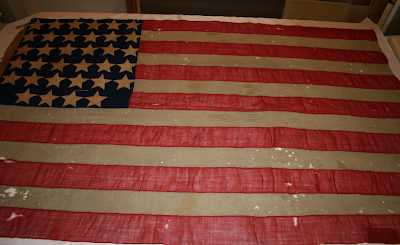
Textile conservator, Gwen Spicer of Spicer Art Conservation at work

Saturday, June 14, 2014

Flags of the United States Colored Troops

While flag day probably conjures up images of our National Flag, perhaps it is also a day to shed some light on the rich history of flags created for military regiments, namely the United States Colored Troops (USCT).

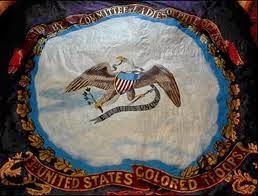
A few years ago Spicer Art Conservation treated an unusual National Flag from the 4th United States Colored Troops (USCT) belonging to the Maryland Historical Society. The treatment was the topic of a presentation and paper given at the August 1-5, 2011 Washington Flag Congress. [The concurrence of the 45th annual meeting of North American Vexillological Association & the 24 International Congress of the Fédération Internationale des Associations Vexillologiques ]. The 4th USCT is a spectacular flag with a double sided canton. The flag, composed of silk and hand painted on both sides, had many areas of tearing and shattering. Following treatment the flag was to be mounted with a window on the reverse side to view the obverse of the canton.

historic flag conservation, repair, restoration, textile conservator, civil war, USCT Maryland
The 4th USCT of Maryland before treatment

Treatment of the 4th USCT flag sparked interest in knowing the whereabouts of other surviving flags of colored troops. African American men fought in the Revolutionary War, War of 1812, and Spanish American War; however, these men were not limited to segregated units. The USCT only refers to the troops serving in the Civil War conflict and the Regular Army’s segregated troops that were created in the wake of the success of the USCT. It is not until 1954 when the formal desegregation of the armed forces was completed with the abolishment of the last segregated unit in the wake of President Truman’s 1948 Executive Order 9981.

And while each Civil War unit had their own flags, it is the USCT flags are special because of the individual and unique sentiments often expressed on them, often stylized to represent the unit and what it was fighting for. Many of these flags were hand made and painted by the community from which the unit came. Many of the flags featured a different image on each side.

Their are few flags of the USCT that remain. The New York Military Museum has two from the 26th NY regiment, others are in historic societies or belong to the state from which the regiment originated. But mysteriously, there are several other flags that are mentioned as existing, yet these flags are lost to us in that their current whereabouts is unknown.

26th USCT – New York Military Museum -

Research shows us that the Civil War USCT regiments consisted of: 7 cavalry, 13 artillery (light and heavy), one battery, 144 infantry, and 2 brigade bands. While it is unclear if each of these units had a locally made flag, we know that per regulations, each unit should have received a Regimental and National color or standard and with guidons and flank markers where appropriate. What we do not know is how many of these flags have survived; where are they located and what was their design?

This is not a history, but rather an attempt to locate and create an inventory the surviving USCT flags. Any assistance with providing missing information, particularly of the flags that are thought to be lost or lack any information, would be of great help. It is apparent that these flags are of great interest in flag collections, but appear to be focused on separate groups, often isolated and difficult to locate. Here we hope to be able to have a place to gather images and locations of all the surviving flags. We welcome your help in this project.

The first documented flag created specifically for black troops was the “Bucks of America” company color, which was presented to a militia of free black men in honor of their valiant service in the Revolutionary War. This particular flag is not the flag these men carried in battle; instead it was a presentation color, given to the unit in recognition for their service. It appears in the book Standards and Colors of American Revolution by Edward Richardson (1982).

"Bucks of America" flag, from the Massachusetts Historical Society.  See the
link above to go to MHS site to read more about the flag and the Bucks.

During the War of 1812 there does not seem to be any record of an African American unit. Instead they served in the regular army, in mixed regiments, but primarily in the 26th Infantry which boasted 247 black enlistees. There were not any specifically segregated units. Conversely, there is abundant evidence that the fledgling U.S. Navy was desperate for sailors and many of the African Americans who served were simply incorporated onto the ships they were needed on, regardless of color. Visit PBS to read more on the story of the black sailors and soldiers of the War of 1812 and watch the video link there. Link: http://www.pbs.org/wned/war-of-1812/essays/black-soldier-and-sailors-war/

It is during the Civil War when most of the exclusively black units were created. In 1863 The United States Department of War created the Bureau of Colored Troops. Most well known of these units is perhaps the 54th Massachusetts Volunteer Infantry whose story was the basis for the award winning 1989 movie “Glory”. But the 54th is just one of 175 regiments that were organized in 1863. So how many flags from these units still exist? Some sources say less than 25. 

Prior to the USCT there were State Volunteers and the Corp D’Afrique, many of which were federalized into USCT units. An example is the 12th Corps that became the 84th USCT; a flag survives from each period. All of this makes identifying flags more confusing.

12th Corps with reinactor. The flag is owned
by the US Army.
Image of the 84th from the collection of NMAH

A sad discovery is the apparent loss of the flags from regiments from Pennsylvania, which had 11 USCT Regiments. Their beauty is known by the surviving black and white photographs, copies of which are located at the Library of Congress. David B. Bowser, an African American artist, painted several of these.

3rd United States Colored Infantry regiment:
Front of 3rd USCT flag

Back of 3rd USCT flag


6th United States Colored Infantry Regiment  – both sides 
Front side of the 6th. Only these black and white
images exist and they are located at the LOC.
For more information about the 6th go here: http://www.usgennet.org/usa/mo/county/stlouis/ct.htm 

22nd U.S. Colored Infantry Regiment
Front and back of the 22nd, this is the black and white image that had
 been colorized.  Its accuracy of course is unknown because all that
exists are the photographs from the LOC.
24th U.S. Colored Troops – both sides
Front of 24th USCT flag, image from the LOC.  It reads,
"Let Soldiers in war be citizens in peace"
25th U.S. Colored Troops
Front of the 25th.  Image from the LOC.
45th U.S. Colored Troops. Only an image of the front exists.
Front of the 45th.  Image from the LOC.
127th United States Colored Infantry Regiment. Only an image of the front exists.
Color reproduction of the 127th.  It reads: "We will prove
ourselves men"
The lost Pennsylvania flags are the 8th, 32nd, 41st, and 43rd U.S. C.T.
for more about Pennsylvania's commemoration of the Civil War.

Richard Sauers wrote in his book, Advance the Colors! Pennsylvania Civil War Battle Flags that many of the USCT flags made their way from the State Mustering office in Philadelphia (where a flag was held for safe keeping) to the War Department for storage. In 1906 they were transferred to the Museum at West Point. Documented in this transfer are the flags of the  22nd, 25th, 32nd, 43rd and 127th USCT.  By the start of WWII storage had become an issue, and the condition of some flags had become so poor that they were discarded. Sauers mentions that only one flag identified as a Pennsylvania USCT remained in the museum in 1940, but he does not state which one.

Besides the USCT flags of the State of Pennsylvania, not many flags are as well known or documented. The following list is what is known to have survived (listed in order of Regt. Number) and its location. Where possible, a photo is included.

2nd USCT, Owned by the Pennsylvania State Museum
4th – Headquarter Bridgade Flag – Private collection
4th HQ Brigade Flag, image from Zaricor Flag Collection.
Visit the site for more information:
http://www.flagcollection.com/itemdetails.php?CollectionItem_ID=2941
Note: the 4th Regiment National flag is the first flag we discussed,
which belongs to the Maryland Historical Society.
5th Regiment U.S. Colored Troops – (3) Ohio Historical Society - 
Flank Marker of the 5th United States Colored Troops. (Flank Marker of
 the 127th Ohio Volunteer Infantry.), Ohio Department of the Adjutant General. 
27th Regiment U.S. Colored Troops, owned by Ohio Historical Society
The above two images are guidons from the 27th USCT.  They
belong to the Ohio Historical Society.
Regimental Colors of the 27th USCT. This flag also belongs
to the Ohio Historical Society.
28th Regiment, U.S. Colored Troops, War Memorial Museum
National colors of the 28th Regiment, USCT. Two images of the same flag.
29th Regiment Connecticut Volunteer

Regimental with the Connecticut seal.

The Kansas Historical Society has six flags from the First and Second Kansas Colored infantries. This is one of the largest collections of surviving African American Civil War flags in the nation.

1st Kansas Colored Infantry Regiment (79th United Stated Colored Infantry Regiment) has three flags, a Regimental, National and a National from Company F


2nd Kansas Colored Infantry Regiment also have three flags.
Two Regimentals for the 2nd Kansas.

The Confederacy did have units that included or were composed of blacks, working in a range of capacities but none are known to have had distinctive flags, and the only 1865 period press description describes the Confederate national flag. We would be interested in knowing about these.

After the Civil War, specifically black infantry and cavalry units were raised. These units served with distinction during both the Indian Wars & the Spanish American War, and the Philippine Insurrection. They were often referred to as “Buffalo Soldiers”, an appellation originated by the Native American Indians as a tribute to their fighting prowess. One surviving flag is the 10th Cavalry, located at Fort Sill, Oklahoma.


Twentieth century flags are more standardized with less variation in design and construction than those of earlier centuries. Examples of the surviving colors include: 

157th Red Hand Division (American Regiments under French command)
http://www.pbs.org/opb/historydetectives/investigation/red-hand-flag/

366th US Infantry
http://www.wiz-worx.com/366th/366_flag.htm

369th US Infantry (15th regiment NY National Guard)
http://dmna.ny.gov/historic/btlflags/infantry/369thInfReg.htm
http://www.freerepublic.com/focus/vetscor/853018/posts 

In WWII
761st Tank Battalion (guidon)  - photo 
http://chnm.gmu.edu/forloveofliberty/items/show/144 

92nd Division 
http://www.apathtolunch.com/2011/04/liberation-day-and-liberation-of.html 

WWII – Are there any flags from the Tuskegee Airmen?


Further research about individual USCT soldiers can be found here
http://www.archives.gov/press/press-releases/2013/nr13-98.html - This is the National Archives press release and info about the 100% complete records of every USCT soldier. An impressive undertaking and an unparalleled resource for listing each individual from the units who served. If only it came with images of the flags for each unit. The link provided on this page is to the site: http://www.fold3.com/browse.php#268|. This is a fee based subscription site owned by ancestry.com if you wish to research the individual soldiers who were part of any USCT unit.

UPDATE September 2014:
This beautiful flag is currently on display (but sadly only until 9/7/14) at the National Museum of American History.
Image from the National Museum of American History
_____________________________
Gwen Spicer is a textile conservator in private practice.  Spicer Art Conservation specializes in textile conservation, object conservation, and the conservation of works on paper.  Gwen's innovative treatment and mounting of flags and textiles is unrivaled.   To contact her, please visit her website.

Friday, June 6, 2014

Russian artifacts nearly lost

While it is not a secret, it is probably not widely known that the Foundation of Russian History is located in Jordanville, New York, a small pastural community in central New York. The Foundation is a unique place in that it contains not only the museum, but Jordanville is also home to the Holy Trinity Monastery and Russian Orthodox Church as well. The Foundation's Museum holds in its collection some interesting items, many of which made their way from Russia at a time when so few objects survived. The Foundation of Russian History has trusted Spicer Art Conservation, LLC to treat many of their artifacts, particularly those which are now on display at their exhibition "The Russian Word and Image: Four Hundred Years of Books and Art".

The Holy Trinity Church in Jordanville on a spectacular day for the opening of the eagerly anticipated exhibit of the Foundation of Russian History.

Inside the exhibit: The Russian Word and Image.

Among these artifacts are some remarkable items which surprisingly survived following the fall of czarist Russia.  Perhaps most recognizable, Romanov family items are now part of the exhibit highlighting these and some of Russia's rare historic objects.

The artifacts SAC treated for the exhibit included both paper and textiles. The paper based items included a menu from a celebratory dinner of the Coronation of Czar Nicholas II (often referred to as "the last Czar") and a set of illustrations of the coronation. Before they arrived in our studio, many items had been painstakingly preserved by well-intentioned individuals who knew that these items were rare. Many paper based items had been glued to poster boards with rubber cement, and some had been placed in very acidic environments. Other items, like the print below had been "touched up" by painting areas where there was great loss.  With perseverance, SAC was able to remove the prints from their boards and conserve each of the paper items.

Historic print, glued to backboard, art conservation, repair, archival framing, Russian artifact, museum collection
One of a set of four prints celebrating the coronation of  Nicholas II.

The textiles we treated in this collection were magnificent. The flags and banners in particular were each richly and heavily embroidered with intricacy and unbelievable detail. The embroidery was often 3-dimensional. Such an artifact treated for the exhibition was a double-sided standard (image below) elaborately worked with metallic threads and silver discs. At the center, the image incorporated enameled metal for the face and hands of St. George who appears in the still richly red colored center of the double-headed eagle's crest all on a silk damask.

Expert conservation of historic flags and banners, Russian flag historic, antique, artifact, czar
1856 St. George Standard of His Imperial Majesty's Own Escort. This double-sided and elaborately embroidered  standard was awarded by Alexander II to the Chernomorski Cossack division in recognition of extraordinary feats in battle.  The flag, composed of silk and embroidered in metallic threads and elements is quite stunning, even in its present condition.

Many of the items are so rare simply because of the consequences of the changes that took place in Russia as the Socialist and then Communist parties controlled the government.  During this time of great change, monasteries were closed, priests were murdered or jailed, it was forbidden to teach children religion or to publish religious literature.  Museums and their contents were deemed "not necessary"; therefore much of the art, history, and culture of Russia was lost in the effort to make everything the same and free from religion or the rule of the past. However not all was lost. Miraculously, objects were rescued and brought out of Russia to the tiny town of Jordanville where they would be safe from destruction.

"The Russian Word and Image" exhibit sheds light on 400 years of Russian art and books, covering the time periods of the Muscovite czardom, through the reign of Catherine the Great to Nicholas II, to the civil war to the life of Russians abroad. If you are able to go, it is just a beautifully presented exhibit.
_____________________________
Gwen Spicer is a textile conservator in private practice.  Spicer Art Conservation specializes in textile conservation, object conservation, and the conservation of works on paper.  Gwen's innovative treatment and mounting of flags and textiles is unrivaled.   To contact her, please visit her website.

Monday, May 26, 2014

A high school sweater goes to war

by Barbara Owens, SAC staff

Recently SAC was asked to treat a high school sweater. While that may not seem terribly remarkable or interesting, this was no ordinary sweater. As with most artifacts that seem ordinary, it is the story that accompanies the artifact that makes it unique, special or irreplaceable.

This particular sweater had been on display for roughly 80 years, and in that time the once blue and gold sweater had faded significantly to a dull purple from light exposure, it had also been feasted on by insects. Accompanying the sweater was a black and white photograph of a young soldier, who was the original owner of the sweater.

Art conservation, light damage to fabric textile,
The light damage to this sweater is quite severe, even the original blue which composed the body of the sweater is no longer visible at all.  You can see exactly how the arms were folded forward, and below the "N" is where the photograph of Walter Allison was affixed.

The sweater had been well worn and required some compensation where the holes had created weakness. It was also in need of proper support and protection from light.

The owner of the sweater, is the Newburgh Free Academy High School, located in Newburgh, New York where it will be on display in a new case at the entrance of the school. It had been on display for about 80 years outside the Athletic Department and brought out at every memorial service and the story is told to the students.

The sweater belongs in such an honorable place because the owner of the sweater, 20 year-old and recent high school graduate, Walter Allison packed his wool Newburgh Academy football sweater into his pack as he left for his tour as an enlisted soldier in the US Army, arriving in France on May 23, 1918. The United States had entered World War I in April 1917, and many young men were shipping off to Europe to serve their country. Many of these soldiers knew that they were going to be fighting in areas where harsh winter conditions would exist, and that the uniform they were provided with might not be enough to keep them warm. Hence, Allison brought along his wool varsity sweater in the hope that it would help insulate him against the freezing winter.

Walter Allison 1898 - 1918

Walter Allison was awarded the purple heart for his courageous service. His award was given posthumously following the battle of the Hindenburg Line, where he was killed in combat. The conditions of war are harsh. As you can see first hand when you visit the Purple Heart Hall of Honor, their display of war is encompassing of imagery that displays an up-close encounter with the realities of war.

Company roster from the 107th, Walter Allison is listed in the lower left as a private first class, killed in action, September 29th.  The losses the 107th endured that day were numerous, as can be seen from this page.  For more information about the 107th, please see the website: http://www.oryansroughnecks.org

When a soldier died, the items he left behind were often recycled back to soldiers on the battlefields who desperately needed them. One such thing, was Allison's football sweater. When it reached it's recipient, Chester Greatsinger, he recognized it immediately. By sheer coincidence, the sweater was passed on to Allison's schoolmate, and in that poignant moment, Greatsinger knew that Allison was dead and that the sweater, carried across the ocean from Newburgh, New York to the battlefields of France, was now his. Greatsinger completed his tour of duty and returned home with the sweater, where he presented it to Newburgh Academy Athletic Association in 1919.

Soon to be hanging at the Newburgh Free Academy, the sweater is conserved and will be able to tell it's story of bravery, the harsh realities of being a soldier, and how a sweater found it's way across the world and from one soldier to another and then back home again.

We at SAC hope you have a peaceful Memorial Day and that you keep in mind the men and women of the United States military and the sacrifices so many of them have made.

_____________________________
Gwen Spicer is a textile conservator in private practice.  Spicer Art Conservation specializes in textile conservation, object conservation, and the conservation of works on paper.  Gwen's innovative treatment and mounting of flags and textiles is unrivaled.   To contact her, please visit her website.

Tuesday, April 22, 2014

The making of a historic slipcover.


Early original furnishing textiles are rare. They were often recycled as tastes changed, or simply as they wore out. "Slip", "loose", or "protective" covers are examples of such textiles. Once upon a time they were a common item custom made for all types of furniture (not just upholstered seating furniture) often to protect the expensive fabric or surface that lay beneath. Leather coverings for tables were also made, as were covers for expensive carpets. Now, few of these coverings survive. A few museum collection's have them, with probably the fewest examples for easy chairs.

Boscobel House and Gardens has an early easy chair that originally was not upholstered, but instead protected with a slip cover. They wanted to recreate a slip cover in the historic manner. The problem was how would it have been created? Where did the seams lay? How did they work the cones? Was there a flounce? The questions and the "unknowns" were endless. What was known, is that it could not be created with a modern eye.

Reupholstery of historic furnishings is expertly done at Spicer Art Conservation. Before image of chair.
The "bare-bones" of the chair. This chair has a slip seat, under which,
 at center, is indeed an opening for a chamber pot to be placed below.

Historic illustrations, as well as small domestic and formal paintings of the time, are hugely beneficial and very useful in recreating a slip cover to accurately reflect the time period that Boscobel wanted to interpret. Such examples of historic illustration are by Ella Emory and Mary Ellen Best, two women who created many illustrations of interiors in the late 1800's. The amount of detail found in their illustrations is remarkable, as is their amazing detail. These sources can assist with identifying fabric type and indications of fabric direction and trimming locations.

However, questions of construction still remained.

The solution was to find originals. With the help of the Boscobel curator, Judith Pavelock, two were located. One from the collection of Historic New England, which was quite well known, being illustrated in several publications on slipcovers (Its accession record can be found here), it specifically comes from the Sayward-Wheeler House in York Harbor, Maine. 

The slipcover is made of chintz cotton fabric printed with columns of large scale
 undulating flowering vine flanked by dendretic vine/roots of blues and golds; 
off white ground. It is edged-hemmed with striped linen tape. It dates from the
1840's and was made for a 1759 chair; 1977.541A for an Easy Chair (1977.253)

The other is from Locust Lawn, an 1814 historic house outside of New Paltz, New York, that was shuttered in the 1880's, and so remained a time capsule of the early nineteen century.

Chair from Locust Lawn.

The two examples were both floral chintz with striped tapes. By blending solutions from the two examples, a plan for the new slipcover was developed. The fabric was selected as a white dimity with a small herringbone pattern. The tape was simple twill tape also in white, both woven by Thistle Hill Weavers.

The wing of the chair during the construction of the slip cover.

Dimity refers to a cotton, woven on a harness loom into a patterned fabric. It was originally imported from India, but soon was woven in Britain and in the Americas. The term dimity covered a wide variety of weave patterns, from figured, bird's eye, to stripes. Strips were the most common being the easiest to weave. Dimity was both sturdy and serviceable, being attractive for finishing and clothing.

Expert reupholstery of historic furnishings is done at Spicer Art conservation, the chair during treatment
Positioning the fabric around the arm and cone.

The historic chair after reupholstery in custom made reproduction fabric, textile conservator Gwen Spicer performed the work.
The completed slip cover.

Linda Baumgarten wrote in "Protective Covers for Furniture and its Contents", that "Checks and stripes were preferred for public rooms such as libraries or parlors, whereas printed cottons were favored for the bedchambers, where the slipcovers often matched the bed hangings". Her article goes on to talk about that at various times chairs were fitted with slipcovers to protect the finer fabric below.  And at other times the opposite was true for chairs that were covered with a simple linen, with the intention of    being covered. It is on chairs like the later, that the absence of nail holes for an outer textile can be observed, thus these chairs were made to always have a removable slipcover. She also discusses in great detail the use of covers for nearly all valuable property and furnishings, from beds to desks, to bookcases and clothespresses.

Read what you can about these textiles. Slipcovers are a fascinating and often overlooked textile.  Another great resource is "Furnishing Textiles" by P. Clabburn. Chapter eleven in particular is fully devoted to "case covers".

_____________________________
Gwen Spicer is a textile conservator in private practice.  Spicer Art Conservation specializes in textile conservation, object conservation, and the conservation of works on paper.  Gwen's innovative treatment and mounting of flags and textiles is unrivaled.   To contact her, please visit her website.

Monday, April 14, 2014

America had a 15-star flag when there were 18 states, and other flag trivia you might not know.

by Barbara Owens, SAC Staff

Maybe we've mentioned in a few of our posts, we treat a lot of flags.  And for us here at Spicer Art Conservation, LLC perhaps we think of it as common place that everyone else knows details of flag composition, types of flags, flag history, and what we like to think of as "flag trivia".  Not surprising, those details, as well as lots of flag trivia, are not known by many, save perhaps some of our friends at NAVA, aka the North American Vexillological Association.  We thought it would be fun to share some interesting flag facts and hope that maybe our blog readers will discover something they had not known before.

The first interesting flag fact that might not be known is that when some states became states, the number of stars on the flag did not increase automatically.  For example, the 13-star flag was the official flag when Vermont (the 14th state) and Kentucky (state #15) were both admitted to statehood.  Yet the 15 star flag did not become the new flag until nearly 3 years after Kentucky became a state.

This little tidbit of knowledge is handy when we talk about flags from the War of 1812.  And with the  200th anniversary of the War of 1812 upon us, we have received several calls and emails with photographs of flags that were thought to be War of 1812 flags.  A flag from the War of 1812 will be a 15-star AND 15-stripe flag, even though before the war even began in 1812, the United States consisted of 18 states; #16 Tennessee, #17 Ohio and #18 Louisiana. The most famous 15-star/15-stripe flag is the "Star Spangled Banner". 1818 marks the year of he next flag act.  It is here that the stripes are returned to 13 to represent the original colonies and it is suggested that a new star be added for each of he new states on July 4th following their admittance to statehood, we've been doing this ever since.

Large Fort Niagara garrison sized flag, conserved by textile conservator Gwen Spicer
This is the 15-star flag from Fort Niagara.  It is a "Garrison" flag, meaning it is made to be so large that it will be easily seen by the enemy when flown from a fort or garrison.

Which numbered star flag existed for the shortest amount of time?  Hmmm...this is a tricky bit of trivia because of the official status of flags as described above.  So even though a state had officially become a state, it was a flag act that created a new flag with accurate star count.  And this only happened on July 4th.  But that said, certainly it did not stop the good citizens of those states from making their own unofficial flags with the number of stars sewn upon it to represent their new statehood.  Great examples of this and the answer to which amount of stars existed for the shortest amount of time is the 10 day jump from 38 to 42-stars (these are unofficial flags of course).  North and South Dakota are made states on the same day on November 2, 1889.  North Dakota is first (the 39th) so technically a 39-star flag exists for  the shortest duration, but that is not to say it is the rarest.  However, South Dakota (#40) is followed 6 days later by Montana (#41) and two days after that, Washington becomes #42.  Washington stood as the final state for about 8 months and just as soon as people were comfortable stitching a 42-star flag, Idaho became #43 the day before the next official flag resolution was passed on July 4, 1890.  Officially however, the answer is that the 20, 21, 25, 27-29, 32, 43 and 49-star flags were only official for one year each.

Interesting for us from the conservation point of view is that an early Revolutionary War era flag might appear in as good, if not better, condition than a flag constructed 100 years later.  See the flags below, each is a 34-star flag, constructed in the same time, yet the conditions are quite different.  This of course is due in part to the materials it is composed of, how it was stored, what it was exposed to and how much time it spent exposed to those conditions (excessive light, weather, water, etc)

before image of 34 star flag undergoing conservation treatment at the studio of Spicer Art Conservation
This 34-star flag was improperly stored and suffered a tremendous amount of mold damage. 34-stars flags were official from July 4, 1861 (Kansas #34) to July 4, 1863 when West Virginia became # 35.

Expert Flag conservation, historic flags, repair, framing and mounting, Spicer Art Conservation
This 34-star flag suffered insect damage.


Textile conservator, flag repair expert, 34 star flag, historic, artifact, deterioration of silk
A 34-star flag with yet another creative star pattern.  This flag was in the most deteriorated condition of the three 34-star flags we are showing here.
Another fun fact is that the original proclamation about flag construction simply dictated how it should be composed, but not what it should actually look like.  The resolution adopted by the Continental Congress in Philadelphia on June 14, 1777, read: “Resolved: that the flag of the United States be 13 stripes alternate red and white; that the Union be 13 stars, white in a blue field, representing a new constellation.”  When you look at the two 34-star flags above you can see that they differ in the way the stars are positioned on the canton.  Not to mention the 33-star flag (Oregon #33) below and its beautiful canton with 32 stars encircling a slightly larger 33rd.  It was not until 1912 that the canton arrangement design was made official, and now of course flags have a government specification and are produced according to exacting standards.

flag conservation
This 33-star flag is in remarkable condition, having been stored properly and cared for  continuously.


Another interesting fact is that our current 50-stars is the longest continuous design in our history.  This past July 4th marked the 53rd year of its use.

We are often asked which is the rarest flag that has ever been treated at Spicer Art Conservation.  This is a tough question to answer as some flags are historically important, while others are one-of-a-kind, some are incredibly old, and some are privately owned and belong to extraordinary and remarkable collections.  Rare, I suppose, is in the eye of the beholder.  What I do know is that each flag that enters the studio is unique and often is accompanied by a great story which often teaches us something, adding to our own flag trivia.

To see more flags treated by Spicer Art Conservation go to our website.  If flags make you think of Betsey Ross, find some flags and trivia in another recent blog post here.
_____________________________
Gwen Spicer is a textile conservator in private practice.  Spicer Art Conservation specializes in textile conservation, object conservation, and the conservation of works on paper.  Gwen's innovative treatment and mounting of flags and textiles is unrivaled.   To contact her, please visit her website.

Wednesday, April 2, 2014

The Forster Flag, and the conservation of a Revolutionary War textile

by Barbara Owens, SAC staff

Conserving precious artifacts from important moments in history is exciting. And SAC has had some pretty exciting pieces come through the studio doors. It is impossible to say which one is the most exciting, but if ever there were a contestant for that title, the Forster Flag is it. Certainly we treat many flags, we also treat a lot of very unique items, but this one is a standout.

Pre revolutionary war flags, textile and art conservator, expert conservation care
The Forster Flag

If you've missed some of the fervor in the flag community, or the excitement from Revolutionary War buffs, then you have not heard that the Forster Flag was set to be auctioned after years of being privately held by the Forster Family descendants.

There are very few Revolution era flags in existence. What's more, is that all of these flags are held by public institutions - except one. The Forster stands alone in that it has been passed down through the Forster and Knight family generation after generation. The flag has been cared for by this family since its patriarch, Samuel Forster, lieutenant, Manchester Company of the Essex County Militia of Massachusetts responded with his fellow minutemen to the "Lexington Alarm". While the Manchester Company never made it to Concord to respond to the alarm, the story of the flag being flown by the Manchester Troops has endured through history and has not been refuted.

Charles Willson Peale's portrait of Washington at Princeton, 1779, clearly shows the symbolism of the time period.  Notice the British ensign flag at his feet, as well as the other flags heaped against the cannon, while the flag symbolizing 13 stars on a blue field, flies proudly in the background.

The Forster flag arrived at the SAC studio in 2013. As far as we know it is the first time the flag had been conserved.  The images below are the illustrations prepared following the examination of the flag.


The flag is unique in many ways, but a source of intrigue and much discussion is the replacement of the canton from a British Ensign to a plain field of red and the addition of 13 stripes - 6 on the obverse, 7 on the reverse. The photographs below show the details of this replacement and some detail of stripe placement.  

So why would the Manchester Company alter their flag? Many historians pose the explanation that for the minutemen to carry an ensign into battle with British troops who are carrying the same ensign, would be awfully confusing. It makes sense that the minutemen would begin to make their militia colors less British and more reflective of the feeling of a national symbol, rather than a symbol of region or colony. After all, they are patriotically standing up for themselves as a new independent nation.

Gwen Spicer flag conservator, pre-revolutionary war, framing mounting and repair of historic flags
Closeup of the canton area, the photo is oriented so that the hoist edge is at the bottom.

A compelling argument for altering the Union Jack canton is that Manchester is a coastal town, they would have been well aware of the British as a naval superpower simply from the sheer number of ships that sail in and out of nearby Marblehead and Boston Harbor. Flying from each of these ships is the British Ensign, it is a clear symbol. If you look into early colonial life, this same flag served the colonists as their symbol. And as you might suspect, as thoughts of revolution blossomed, having a flag that is the exact same flag as the one your enemy is carrying is going to cause problems. George Washington himself famously wrote about the confusion the flag caused on January 1, 1776 when he ordered it flown from Prospect Hill to commemorate the first day of existence of the Continental Army:
"We gave great joy to them (the red coats I mean), without knowing or intending it, for on that day, the day which gave being to the new army, (but before the proclamation came to hand) we had hoisted the Union Flag in compliment to the United Colonies; but behold! it was received in Boston as a token of the deep impression the Speech had made upon us, and as a signal of submission…"

Pre-Revolutionary war Flag, Forster, 13 stripes, flag conservation and repair Spicer Art Conservation
The stripes that "straddle" the replacement canton and the original field.  

The canton of "The Monmouth Color". The width and length of the white stripes are similar to those we see on the Forster. Also, each corner of the canton has 3 white pieces, for a total of 12 pieces, to make 13 you would have to "piece" together what was left. Does this give more plausibility to the possibility of the stripes being "repurposed"
from the original Forster Union Jack canton to the stripes of the Forster Flag we see today?

Here is a detail photo of the pieced stripe before conservation. This particular stripe is made of two pieces. Many pose the argument that it is pieced from the original white stripes of the Union Jack canton that was later removed.

The lowest stripe of the Forster Flag. Here you can see the stitching for the 13th stripe on the reverse.

We love when an artifact arrives with intrigue, and honestly, many items have some bit of historic uncertainty to them, because not all aspects of every single event or item in history is documented. The things that do point wholeheartedly to period authenticity are the things that are still tangible, the weave of the fabric, the stitching and composition of the flag for instance. These things are unmistakable and they are unchanging, ad most importantly they are evident by simply looking at the artifact.

The following table analyzes some of the important early flags, showing how their sizes are similar as is their construction and often their origins as British ensigns. It is important to point out that early flag making was at the makers whim in that many flag makers were seamstresses or tailors who made the flag from descriptions or drawings. There was no "central government source" to procure a flag from.


Early American Revolutionary Era Flags

Flag (date)
Owner
Origins
Height (inches)
Width
Canton (Height)
Canton (Width)
Seams in field
Forster Flag (ca. 1775)*
Flag Heritage Foundation
Red British Ensign, canton replace, white possibly reused. Has associated tassels and cord. Complete.
61
65
19
22
Central horizontal seam
Monmouth Flag (1778 captured)
Monmouth County Historical Association, Freehold, NJ
Yellow British Ensign, however, red silk is damask and blue is moiré. Flag is not original size. Hoist is missing.
56
61
21
20
Four horizontal seams. Intact, 15” width of fabric.
Proctor’s Flag, Westmoreland Flag, 52nd Battalion of PA (1775)
State Museum of PA, Harrisburg, PA
Red British Ensign, later painted in field with rattlesnake. Complete.
76
70
20
22
Central horizontal seam
Dansey Flag (1777)
Delaware Historical Society, Wilmington, DE
Canton of seven red and six white silk stripes whip stitched together. Remains of fringe at the fly edge. Has associated tassels and cord. Complete.
47 1/2
47 1/2
17 ½
17 ½
Central horizontal seam, 24” wide fabric.
Philadelphia Light Horse (1774-75)
Museum of the First Troop Philadelphia City Cavalry, Philadelphia, PA
Yellow British Ensign, with stitched applied stripes covering the Union Jack.
33
40
9 ½
11 1/2
Horizontal seam.
New Bedford Flag (1758)
Fort Bedford Museum, Bedford, PA
Red British Ensign. Red field uses a damask silk fabric. 2” hoist sleeve. Complete.
70 ½
80 5/8
23
24
Horizontal seams.
Brandywine Flag, 7th PA Regt. (1776)*
Independence National Historic Park, Philadelphia, PA
American-made.
51 ½
53 1/2
26
26
Horizontal seam, near lower edge. Fly edge is a selvage
Liberty (1774)*
Schenectady County Historical Society, Schenectady, NY
American-made. Applied lettering. Hoist has been opened.
43 ½
40
No canton
No seams
* = These flags has been personally examined and treated by conservator, Gwen Spicer.

The proceeds of the auction of this flag will benefit the Whitney Smith Flag Research Collection at the University of Texas, Austin.
_____________________________
Gwen Spicer is a textile conservator in private practice.  Spicer Art Conservation specializes in textile conservation, object conservation, and the conservation of works on paper.  Gwen's innovative treatment and mounting of flags and textiles is unrivaled.   To contact her, please visit her website.