Flag conservation

Flag conservation
Textile conservator, Gwen Spicer of Spicer Art Conservation at work

Friday, May 31, 2013

Ferrous Attraction and The Science Behind the Magic

by Gwen Spicer

At AIC's 2013 annual meeting in Indianapolis, Indiana, I presented a hands-on session on the use of magnets in conservation. Art conservators have been using magnets for many years, but mostly in a very limited way. Perhaps because a system has not been fully understood or described in literature, perhaps because it is not part of our training, or perhaps because it is a practice that is too new to be embraced. This session's purpose was to change all that and give conservators hands-on experience with my favorite things - MAGNETS!!!

parts of the jig system for testing magnetic systems in display of artifacts. Art conservator Gwen Spicer is a recognized expert in the use of magnets to treat, mount and display artifacts.
Parts of the jig.
jig from the AIC 41 conference hands-on session using rare earth magnets, presented by Art Conservator, Gwen Spicer, expert in the use of rare earth magnets in the conservation treatment and mounting of artifacts and textiles
The jig put together.

testing rare earth magnet systems for use in conservation and artifact display. system designed by conservation magnet expert, Gwen Spicer
Jig with a "system" in place. The wooden block is one side with a magnet, the metal behind is the other part. The red clip will hold a cup which will be filled with ever increasing weight until the system fails.

The focus of the session was for participants to learn and understand the parts of a magnet system so that they may use this knowledge in their own practice. Each part of the magnet system works in tandem in order to achieve the best combination for the artifact. The three parts are:

  1. The strength of the magnet
  2. The ferromagnetic material
  3. The gap or space between the two

These three parts, in various combinations, were experimented with during the session.

Groups were divided into five puzzles or combinations of magnets and ferromagnetic materials. All of the groups were given the same materials to use to create various gaps. The jig works like so: weight is added to the system and then recorded when the system fails. (we are focusing on sheer strength of the magnetic system).

The goal of the session is to become acquainted with the diverse variables of a magnet system. A range of magnets of both Neodymium and ferrite flexible magnets were selected. The ferromagnetic material is also a range that includes several thicknesses of steel plate and preparations of iron powder.

Below is a table that describes the various tests. The Neodymium magnet for all cases were disc, grade N42 and 1/8" thick in a range of diameters. The poles were axially oriented.


Team
Receiving side
Magnet
Green – Local
Fender washer
Thicker washer
Metallic cups, ½” and
1” in cups
½”,
½” in cup,
1”
1” in cup
Blue – Iron Powder
Iron Powder “Magnetic” paint
-       Painted on surface
-       Mixed with Epoxy
-       Embedded into Batting
½”,
½” in cup,
1”
1” in cup
Orange – Steel gauge
.001,
.025 (24 ga),
½” in cup
¼”,
½”,
½” in cup,
Red – Flexible magnets
Foil tape (.001)
.01
Steel (24 ga)
Flexible magnet (0.06)
Flexible magnet (0.03)
(0.06)
(0.125)
Yellow - Velcro alternative idea
“Slat” Side
Steel (24 ga)
3/4” dia attached to aluminum
Empty cups
Removable Side
• Webbing sleeve with pockets for magnets ½”
• Steel (24 ga), powder-coated
• 2 webbing sleeves

Several of these tests have been described in couple conservation publications. They were included for participants to see how not only how they worked, but more importantly, how they could be altered for another situation.

Each group recorded their findings using a real-time internet-based document. Then at the end of the session we discussed the findings. Click here for the final summary of results.

Time will tell, but I am sure once anyone has seen first-hand the power of magnets and can appreciate the ways in which they can be used, they will be as big a fan as I am. On a side note, if you want to see the use of magnets in a conservation project, be sure to check out the most recent edition of the AIC Journal which features a paper from yours truly demonstrating the use of magnets in an upholstery project with a Hunzinger chair.

Special thanks to SmallCorp, Inc who generously made all of the jigs and components for the session.  This session was only made possible because of them. My very deep gratitude goes to everyone there for being so helpful and supportive in making this session a reality.

_____________________________
Gwen Spicer is a textile conservator in private practice.  Spicer Art Conservation specializes in textile conservation, object conservation, and the conservation of works on paper.  Gwen's innovative treatment and mounting of flags and textiles is unrivaled.   Her current research focuses on rare earth magnets and their use in conservation. To contact her, please visit her website.

Learn more about magnets and their many uses in the new publications Magnetic Mounting Systems for Museums and Cultural Institutions. Available for purchase at www.spicerart.com/magnetbook.

Saturday, May 25, 2013

Trapunto banners are Memorial textiles

by Gwen Spicer and Barbara Owens

As we approach Memorial Day and we remember the men and women who have died while serving in our military, I wanted to talk about artifacts that we have treated that best demonstrate how our soldiers have been remembered from the Revolutionary War until recent conflicts, such as WWII , Korea, or Vietnam. This was a harder task than I had thought it would be. Veterans, families of soldiers killed in action, collectors, and museums all value items which commemorate specific conflicts or military events and we have treated a variety of items from flags to uniforms, hats, swords, and saddles of cavalry units, to name a few. But perhaps the most interesting, are the Trapunto banners from the United States Navy's Great White Fleet's stop in Japan in late October of 1908.

Trapunto banner, WWI, Great White Fleet, Teddy Roosevelt, art conservation, repair of historic textiles, memorabilia, mold damage
A detail of a trapunto banner before treatment. Even though this banner had been
 exposed to moisture and suffered mold damage, what is not diminished is how 
intricate and beautiful the stitching is.

For all of those textile people out there, I need not tell you what trapunto means. But for those readers who are unfamiliar with this term, "Trapunto" is an italian word that refers to a method of stitching where the fabric is "stuffed" with a padded layer beneath and then embroidered with beautiful heavy couching stitches on the top to create an image of very high relief. The trapuntos from Japan come almost exclusively from a company in Yokohama called the George Washington Company. The company sold many silk items as this was a popular commodity that navy men sought while in Japan,  But, their specialty was beautiful banners made of silk in trapunto style with stunning colors of thread and a space to insert a photograph of the sailor. Many of these  featured the image of an eagle, or  flags, an anchor, the ships of the fleet, perhaps a dragon, and often were titled with something like: "In Memory of my Cruise Around the World" and some featured the phrase: "E. Pluribus Unum".

A beautiful and symbolically typical example of a Trapunto banner from Yokohama. The sailor's photo is inserted into the life ring at the center, below that the eagle attacks the dragon, this is probably to to depict the "Boxer Rebellion" of 1900.  Other flags run along the edge, these can differ from one trapunto to the next, and may be representative of countries which had imperial interests in this area of the world.

Here is the history lesson that goes with these trapunto banners: President Teddy Roosevelt has built a formative navy and wants to show it to the world. He sends his 16 warships out to circumnavigate the world from December 16, 1907 to February 22, 1909. The ships are quite a sight with each of their hulls being painted bright white, hence the term "Great White Fleet". (Side Note: True, this voyage was a peacetime mission and certainly no servicemen died in any battle, but I am writing this blog for Memorial Day to remember this important and fairly unknown part of history and the amazing textiles that came from it!)

Route of the Great White Fleet courtesy of Wikipedia and map author: "TastyCakes"

The above and below image are two banners of the same design. This seems to be the largest of the trapunto banners that was available for purchase. It contains a large amount of detail and information. Not only could the sailor have his photo inserted, it also came with photos of President Theodore Roosevelt, and Admirals Sperry and Evans. The above banner is in good condition but notice the loose threads of the outermost red stripes. The banner below was acquired by a museum and is in poor condition from lack of proper storage, but has not yet been able to undergo conservation treatment.
Trapunto banner in need of art conservation

The first of the above photos, as well as others from the Great White Fleet's journey, can be found at the Navy's Naval History and Heritage Command website. It is a great place to learn about The United States Navy and its history. The image below is also from their website and shows another beautiful example of this type of textile.


Each time a trapunto from this time period comes in to our studio, I am struck by how fantastic these textiles are, and I am amazed at how popular these must have been among the sailors and marines. Think about how few sailors and marines made this trip (14,000 of them according to the US Navy) and how many of these trapunto banners exist. These must have been valued by the sailors and it is clear that these were not seen as just a simple souvenir, but instead were kept as a memory and cherished. For their age, many of them are in good condition because they have been cared for.

To read more about the voyage of the Great White Fleet go here: https://en.wikipedia.org/wiki/Great_White_Fleet.

And if you still want more, the Navy Library page has a very detailed article about the voyage and you can find the link here: http://www.history.navy.mil/library/online/gwf_cruise.htm

From all of us at Spicer Art Conservation, Happy Memorial Day!
_____________________________
Gwen Spicer is a textile conservator in private practice.  Spicer Art Conservation specializes in textile conservation, object conservation, and the conservation of works on paper.  Gwen's innovative treatment and mounting of flags and textiles is unrivaled.   To contact her, please visit her website.

Tuesday, May 21, 2013

Conservation of objects and textiles that are actively degrading

by Gwen Spicer

While it may seem like just yesterday, much time has gone by.

Don't we often find ourselves saying this? Think of when you see the child of a friend and you are shocked at how much they've grown. But for the parents of that child, the change was so subtle and so gradual that it was almost invisible.

My thoughts turn to artifacts in collections and how gradually they can change, whether it be damage from light, humidity, temperature, improper storage, etc. I particularly think of artifacts that you may have had the opportunity to examine only to see the item again in 10, maybe 20, years and the change is profound. I cannot help but wonder what caused the change that was invisible day to day but from "then" until "now" is stunning.

textile conservator, repair of tear, conservation of artifacts,
The first time I examined and treated this artifact, there were several tears and structural
problems all near the lower section of the curtain. Over the years this tear developed. 
tear in textile to be repaired in the Spicer Art Conservation studio

Recently we treated a 250+ year-old, organic object from a museum that was kept in storage in a temperature controlled setting. The humidity was correct, the object was covered. However, the artifact had begun to crumble in several locations on its surface. I remember seeing this item about 10 years prior. Only a decade ago it was not nearly as vulnerable as it is today and so the questions is: What happened?

Art conservation of organic objects, powder horn, 1760, Albany New York
A detail of a powder horn from 1760 in great condition. The intricate images
 are clear and the horn is 100% intact.  
Art conservation of organic objects, powder horn, museum collection care,
This horn is nearly the same age as the horn above, but its condition could not
 be more different. The images are at risk for being lost and areas of "crumbling"
are scattered over much of it. These items are in the same collection and have
been in the collection for about the same amount of time, housed in the
same way. So what happened to this one?

Here is a little background: The object is not handled regularly, it is not exposed to light, and it is housed properly. This information tells us that the object is currently cared for properly, but what about prior to this time? Is it being affected by something it was exposed to 50 years ago? Is it sulfur dioxide in the air? Or is it just a natural progress for an organic item of this type?

The radical change to an object can also be predictable. I recently treated a Theater curtain that had been used in a theater in a very small town. The theater is also the hall where town meetings occur, and it serves as a space for community events and gatherings. The space is not heated in winter, nor cooled in summer. When I first saw the backdrop about 4 years ago, it was not in terrible shape, but it clearly needed treatment before the rips and tears became more damaging. When the item was finally approved for treatment, the change that had occurred over four short years was substantial.

When I compare these artifacts for what they have in common, I begin to get a clearer picture. Perhaps what is wrong is that I am stuck on the "why" of the degradation. What I should be paying attention to is that objects of different composition change differently over time, and sometimes the change can be put into high gear despite our best efforts and knowledge. So perhaps the important thing is not to let time slip by.

Think of kids again. Each school year they are photographed, and if you put 1st grade next to kindergarten, the change is not terribly shocking. But put 1st grade next to 8th grade and you may be hard pressed to identify the subject as the same person.

So perhaps certain objects should be photographed more often, maybe once a year is a good time for certain things, like furnishings. But maybe items made of shell, bone or horn need to be photographed every 6 months? Perhaps artifacts are only photographed once each decade until they are 50 years old, then photographed more frequently as they age? My guess is that no single formula will fit all items.

art conservation of harness racing silks, historic sports uniforms and garments repair and restoration
The above cap was worn by a harness racer (horse), it is made of silk, and 
was falling apart. Compare it with the image below: cap worn by a harness 
racer but still held together fairly well. Both caps were worn for the 
same sport and housed in the same collection.
art conservation of silk textiles, harness racing silks, repair restoration of historic garments,

Volumes have been written on the subject, and the view of changes and how they should be described or recorded is subjective based on who you are: conservator, scientist, curator. I recently reread a few sections of "Risk Assessment for Object Conservation" by Jonathan Ashley-Smith. The amount of information available to determine what is (or could be) causing damage is almost too much to comprehend, but each possible contributing aggravator has the potential to produce a negative change, whether it be radical or slow and subtle.

The bottom line: Things change. Change is undeniable and unavoidable. This is not what we want to hear as conservators, curators, or custodians of objects that we are trying desperately to maintain. So my  question is; while we are busy constantly trying to avoid changes that will cause degradation of artifacts, are we missing the things that are happening invisibly under our noses?

_____________________________
Gwen Spicer is a textile conservator in private practice.  Spicer Art Conservation specializes in textile conservation, object conservation, and the conservation of works on paper.  Gwen's innovative treatment and mounting of flags and textiles is unrivaled.   To contact her, please visit her website.

Wednesday, May 1, 2013

The conservation of textiles belonging to Thomas Edison

By Gwen Spicer

It seems like in the last year, everywhere I have been looking, Thomas Edison has been appearing.  I recently visited the Schenectady (NY) Museum, now called miSci, and there he his. Really no surprise given his roll in the founding of General Electric, originally headquartered in Schenectady, New York. But then I watched a PBS program on Henry Ford and learned that he too had spent part of his early career working at the Edison Illuminating Co. and was a close friend of Edison. Then later, I found that Nikola Tesla himself worked for Edison as well, after arriving in the United States.


So why, do you ask, would this matter to me? And why so keen on Edison and his continuous legacy? And WHAT does this have to do with object or textile conservation?

It all started when miSci approached me to work on a curious piece they inherited from the GE Museum when it left Schenectady. The piece was a tinfoil from 1878 that was used to demonstrate Edison's phonograph. Discovering the history of this tinfoil, and then following it through to the revelation of the words actually captured on it was quite a journey.  To read more about this amazing treatment and the unbelievable outcome go here:
http://insidetheconservatorsstudio.blogspot.com/2012/04/0-false-18-pt-18-pt-0-0-false-false.html
then here for the second part of the story:
http://insidetheconservatorsstudio.blogspot.com/2012/08/update-edisons-tinfoil-can-sounds-on-it.html
and here to read the conclusion:
http://insidetheconservatorsstudio.blogspot.com/2012/10/edisons-tin-foil-lost-recording-now.html

Tin foil wrapped around an early Edison phonograph


The tinfoil was my first exposure to Edison.  Then, a short time after the conservation of the tinfoil made national news, I was contacted by a curator from a historic site who had in their collection several more Edison tinfoils needing treatment. And then, as if Edison was not prominently "on my radar", I received the contract to treat a few items at the Edison National Historic Site in West Orange, New Jersey. The items included: his laboratory coat, a United States Flag presented to him by Ediphone Distributors in 1920, and the projection screen from his library, believed to be the oldest projection screen in the world.  To read more about this treatment see the blog entry: http://insidetheconservatorsstudio.blogspot.com/2012/12/vacuum-vexations-and-victories.html 
Edison, projection screen, textile conservation, on-site treatment by art conservator
The projection screen, fully unrolled in Edison's library.

Even with all of this Edison exposure, and the opportunity to work on some of his very own items, and spending time in his workshop where he experimented and worked and thought and invented; I am still astounded at his life and accomplishments. Each time I read something about him I learn something new (for example, there is an asteroid named after him). And each time I am impressed and wonder how one person could accomplish so much?
Edison's lab coat before treatment by Art Conservator and historic textile expert, Gwen Spicer
The coat in its storage box at Edison NHP.  Imagine that in the early days of this site as a Park, the coat simply hung on a hook in his Chemical Room and would sometimes even be modeled by well-meaning tour guides.

The most recent Edison item I treated was his laboratory coat which he used in his Chemical Room.  This was the coat he wore during his later years and it was during this time he was spending considerable time experimenting with batteries. As you can imagine the coat is remarkable. It is covered with holes from acid and staining from a variety of substances, and it is beautiful. Beautiful because to me it really shows that Edison was clearly not afraid to get dirty as the coat appears to have barely saved his skin from his caustic experiments. There is not one square inch of clean fabric left on this coat, Edison used it heavily and it shows.
Edison's lab coat, conservation treatment and rehousing of the coat for storage done by Spicer Art Conservation
The coat before treatment as it arrived in our studio.
Edison's lab coat, textile conservator Gwen Spicer, conservation treatment, Historic site New Jersey
The coat after treatment, and before re-housing.


One of the stabilized holes from the previous treatment. Tiny tight stitches
 are used along the perimeter of the hole. The white fabric seen at the center
 is the heavy weight muslin lining fabric that covers the entire reverse of the coat.

From the textile conservation standpoint, the coat is in an interesting condition in that it has seen treatments that date back many decades. (remember that Edison died in 1931, so the coat is roughly 100 years old).  As I look back at some of the patching that had been done, or the full lining to the coat with tight herringbone stitches, I think of the textile conservators who have gone before and how their treatment, at the time, was thought to be the best the "industry" had to offer. I wonder if they, like Edison in his work, knew that there was always a better way that just hadn't been figured out yet? I wonder what I am doing now that in 100 years will be looked at as an "interesting old way of textile conservation"?


_____________________________
Gwen Spicer is a textile conservator in private practice.  Spicer Art Conservation specializes in textile conservation, object conservation, and the conservation of works on paper.  Gwen's innovative treatment and mounting of flags and textiles is unrivaled.   To contact her, please visit her website.


Friday, April 19, 2013

Opening Pandora's Frame

by Gwen Spicer

Just the other day I was removing a wonderful silk embroidery from its frame. The embroidery was worked by the owner's great-great-great-great-grandmother in 1818. The embroidery had several wonderful features that make these types of textiles so individual and special. 

I have seen a fair number of embroideries and lots of methods of framing, yet I was still hardly prepared for what I found inside this one.  The first surprise was that the owner's grandmother had written in pencil on the upper back edge of the frame the name of the person who did the work in 1818. The name of the owner's great x4 grandmother was "Betsy Rosman".  This was exciting as the embroidery was not "signed" and no one knew the name of the embroiderer.  The owner had speculated that the last framing was done by his grandmother around the 1930's and that is when she wrote the name. 

As I said, I've seen many embroideries.  Textile conservators often work with family heirlooms such as embroideries or samplers, and so I have also heard many amazing stories that accompany such textiles. Sometimes a great deal is known about a particular piece, and sometimes the piece is nearly a mystery. This particular piece was a bit of both.  The owner knew some details, but as the history went back further and further, less was known (remember this piece is nearly 200 years old...that is a lot of history).  

Great care was needed to remove the numerous small nails for this particular embroidery. The silk was quite fragile near the acidic materials, and over glue was present for the attachment of the backing paper.  The browned corrugated board seen from the back was quite plain and so I was not prepared for the next surprise.  Below is the image of what I found on the reverse side of the board, which had been in direct contact with the silk since c. 1930!

backing board on embroidery, historic textiles, found behind frame, art conservation
Hidden behind a school girl's embroidery.

The board that supported this embroidery for so many years had a post mark for 1926.  It came from a box that had an earlier purpose, which was to ship 31 pounds of sweaters from New York City up the river to Hudson, New York.  Over the years I have seen many reuses of board, but for some reason, this was unexpected.  Perhaps it was the extreme nature of it.  And upon closer inspection, the board was telling another story, completely apart from the 1818 embroidery.  What is interesting is that the box was clearly used to serve a purpose at that time and that purpose was not to be a glimpse into history, as was the purpose of the embroidery.

With help from others, we found that Peckham-Foreman Inc, was a company which made knitted goods.  Among their products were swimsuits for men and women, and sweaters for men. I wondered what might these sweaters have looked like in 1926?  A quick search indicated that the fashionable "Travelo" sweater was a big seller for this company and might very well have been what was in the box.
TRAVELO 71224927
This appears to be a popular sweater, or at least we found many advertisements for this sweater. It appears to be a moderately to more expensive priced sweater at around $8.00.  Clearly with all of the pockets, this was a more complex sweater to produce.  And the wording of the advertising suggests that it is "great for yachting".


 "Travelo" an elastic knit jacket, that first appeared on the market in 1914. It was begun being manufactured in NYC in 1918 at the north east corner of Park Avenue and 130th Street.


The Travelo was sold at stores all over the United States and is one of the items listed in the center panel as  "Nationally Known Merchandise of Quality"
I wish I could read the fine print, perhaps we would learn why the woman uses a megaphone and why the man lounges in his swimsuit AND a long-sleeve sweater.

Besides the Travelo, Peckham-Foreman were also known for swimsuits - made from a blend of nylon and WOOL.

So, back to the card board backing of the box of sweaters.  I cannot help but wonder why, or even how, did it become part of this embroidery. Was the owner's grandmother associated with The Mens Shop in Hudson New York?  If yes, how?  The addressee on the package, "H.R. Deacon" appears to go on to be the City Clerk of Hudson in 1941, but no other information exists.  So many questions, and sadly very few answers.  And perhaps that is what makes this unexpected surprise so fascinating and so much fun to look into.


_____________________________
Gwen Spicer is a textile conservator in private practice.  Spicer Art Conservation specializes in textile conservation, object conservation, and the conservation of works on paper.  Gwen's innovative treatment and mounting of flags and textiles is unrivaled.   To contact her, please visit her website.


Friday, April 12, 2013

The conservation of Zouave uniforms

by Gwen Spicer

Much has been said about Col. Elmer Ellsworth, the first officer who achieved posthumous celebrity status after being killed in the Civil War. He is in fact considered by many to be the first fatality of the Civil War. Col. Ellsworth's uniform coat, which he wore when he was fatally shot is housed at the New York State Military Museum, and 152 years after his death, the uniform remains in good condition. But how does one conserve the coat of such an icon and ensure that it remains stable for years to come? It is a question many conservators grapple with when faced with treating a piece of history and making it stable, but not changing any part of that which makes it historically significant.

Elmer Ellsworth is perhaps the most notable New Yorker to serve in the Civil War. Born in Malta, Saratoga County, New York, he later moved to Illinois and joined a volunteer militia. It was in Chicago where Ellsworth met French military tactician Charles DeVilliers and was inspired to create his own private militia modeled after the French Zouave (pronounced "zoo-av") style that had been the standard style of the Crimean War. Ellsworth loved the Zouave style of brightly colored uniforms, pantaloons and silk sashes.

An important turn of events for Ellsworth is when he studied law in the offices of Abraham Lincoln. The two men became friends, and with the age difference he perhaps was felt to be more of a son or younger brother to Lincoln, but was held in great regard and affection by Lincoln.

Ellsworth supported Lincoln in his campaign for president and then later for troops to defend the Union.  His first attempt to recruit was in NYC, and was directed towards the fire companies. He organized the 11th New York Volunteer Infantry, known as the 1st New York Fire Zoauves, because they recruited from volunteer fire companies and wore uniforms designed to look like those of French North African Troops. These uniforms were in true Zouave style: flamboyant and unique.

zouave uniform, conservation of military uniforms and historic garments, Art Conservator
The Zouave uniform worn by Corp. Brownell of
 Troy, NY.  Brownell is often called "Ellsworth's Avenger"
Ellsworth's promising career came to an end on May 24, 1861 in Alexandria, Virginia. With a small party, including Corp. Francis Brownell of Troy, Colonel Ellsworth climbed to the roof and cut down the oversized Confederate flag flying defiantly over the Marshall House Hotel. The true events are sketchy, but the end result is that during their descent Ellsworth and his party encountered Jackson, the inn keeper, armed with a shotgun. Gunfire ensued, Jackson shot Ellsworth and Brownell avenged Ellsworth by stabbing Jackson, leaving both Jackson and the 24 year-old charismatic Ellsworth dead. 


The coat below is what Ellsworth was wearing when he was shot. His death for many marks the opening of the Civil War and Ellsworth is made famous for his heroics and his sacrifice.  His story inspires the North, and he is an instant hero.


Col. Ellsworth's gun shot wound, uniform, repair and conservation of historic textiles and military items by art conservator
Col. Ellsworth's jacket after treatment. The bullet hole is still quite prominent, what has faded significantly is the blood from his fatal wound.

The remains of the large, 14 x 24 foot, Confederate flag, now known as 
the Marshall Flag.  It is so large that it was easily seen from across the 
river, in Washington, DC where it was considered a sign of aggression.


Following his death, Col. Ellsworth became cult-like in the eyes of the Union. Poems, songs, sermons and memorial envelopes lamented his loss, and parents named their babies after him, and streets and towns used his name. 

As is clearly seen in the above image, Col. Ellsworth was shot in the chest. The bullet created a large hole that affected all of the layers in the front of his uniform. One of the brass buttons was also damaged. (His uniform is more conventional, then his Zouave designed uniforms of his troops. Only his pant legs had an extra stylish stripe.) 

It is common in textile conservation for textiles to be supported with patching or lining. The added fabric adds strength to the weakened area. But in this case, the museum clearly did not want the hole to be patched. They wanted the area to still show the hole due to its historic significance, while also being stable. Smaller holes that have occurred due to time, insects, and/or perhaps less careful handling, were stabilized locally with patching. But the hole left from the gunshot was not patched, rather the surrounding edges of each layer were individually secured with stitches in order to prevent continued, or future fraying. Fabrics which are used for patching are a wide range of fabrics and weave structures, mostly selected to blend with the artifact. 


Handling of artifacts has changed greatly from above, where in 1961, a well-meaning historian models Ellsworth's jacket for a newspaper photographer. The uniform coat of Col. Ellsworth remains part of the collection of Civil War items in the New York State Military History Museum, along with most of the enormous Confederate flag that Ellsworth took down at the site. Following his White House funeral, Ellsworth’s body laid in state at City Hall in New York City and at the State Capitol in Albany, respectively, before being buried in Mechanicville. The Marshall House flag accompanied Ellsworth’s body home to New York state. Relics connected to Ellsworth’s death became prized possessions, including pieces cut, or “souvenired,” from the Marshall House flag (hence the condition of the flag in the above photograph).  


The image above is a bit grainy, (The image is a double image) This is a photograph from an exhibit of items associated with Ellsworth (c. 1865). The large stripped item in the front is most probably the Marshall Flag. Visible in the center is Ellsworth's uniform. 


An unbelievable amount of information is available about Ellsworth. Some great places to visit are the websites for the Smithsonian as well as the NYS Military Museum.

_____________________________
Gwen Spicer is a textile conservator in private practice.  Spicer Art Conservation specializes in textile conservation, object conservation, and the conservation of works on paper.  Gwen's innovative treatment and mounting of flags and textiles is unrivaled.   To contact her, please visit her website.

Friday, March 22, 2013

It's Spring! And it's dry? Relative humidity is perhaps the most important factor in storing collections.

by Gwen Spicer

April showers, warm temperatures causing snow melt, and streams flowing up to the edges of their banks.  Each a sign of dryness.  Counterintuitive?  That may also be so, but it is true.  Even with all this water, Spring is actually the driest time of year, and if you have a collection of artifacts to care for, this is an important piece of information.

Creating a sympathetic environment is important in both display and storage areas to assure the long-term preservation of any collection.  The ideal environment includes controlled temperature and relative humidity, clean air with good circulation, controlled light sources, and freedom from biological infestation.  This can be difficult in historic structures due primarily to absorption of moisture during the winter heating months that is then not lost during the summer months.  However in simple terms, it has been found that by keeping a slightly wider window of acceptable humidity levels, and controlling the fluctuations, the collection and structures can remain well preserved.  The conservation and museum fields are slowly learning that one needs to find a HVAC system that meshes well with the building.  And of course there is a broad spectrum of needs.  What about historic homes that are closed through the winter?  Or museums that have separate storage, but have artifacts on display in a warm dry humanly comfortable display area?  Lots of dynamics, each one different, but at their core they all must serve to preserve the artifacts within.

A constant environment is the first means of preservation.  In addition to temperature, fluctuations of relative humidity (which lead to continual dimensional changes), can damage both organic and inorganic substances.  Recent research has found that it is more important to maintain constant relative humidity than it is to maintain constant temperature.  A material's dimensions respond to the relative moisture content in the air rather than to the absolute temperature.

The downside to this is that the environment might not be the most comfortable for humans. It is slightly chilling in the winter and warmer in the summer, such that the relative humidity remains stable.


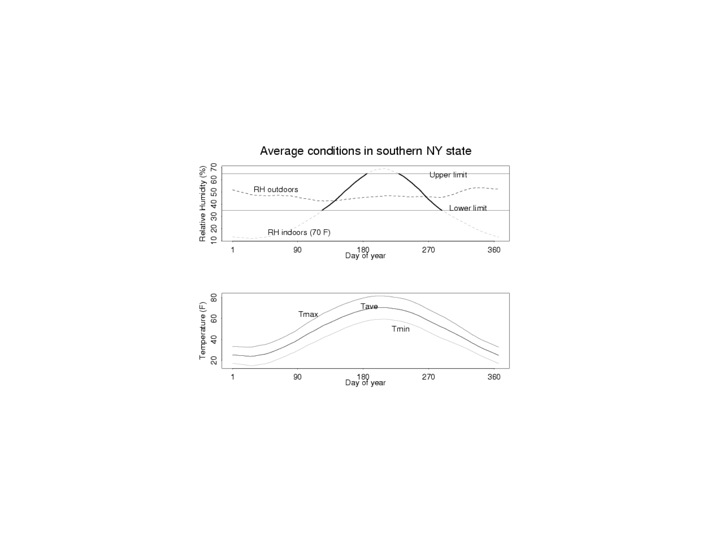
The graph above compares the range of indoor and outdoor temperatures throughout the year with the corresponding relative humidity (RH).  Without heating, the relative humidity stays within the range limits of a safe environment. This graph represents southern New York State, but can be representative of the Northeast and many other similar areas in the country.

Below, various climates are plotted onto a hydrothermograph.  The cross hatched region represents the human comfort zone in both summer and winter with the ideal environment for artifacts highlighted in the orange area.  This is a visual representation to show how these areas intersect, but also diverge.


Why write about this now?  Because this time of year just happens to be the exception. The ground might be muddy, but actually the trees and other plants are doing their utmost best to absorb all of that extra moisture and then some, all in order to leaf out.  In the Northeast US, where there is a great deciduous forest, the evaporation climate goes from that of the Sahara to that of the Amazon Forest over the period of leaf emergence, which is sometimes as short a period as two weeks. Hence, it is the driest time of the year.


To see a wonderful animation of Spring making its way north along the east coast of the United States, please visit: http://sequoia.asrc.cestm.albany.edu/jrgroup/ Choose "Spring!" from the left margin, and then click on the first animation - the maximum temperature.


_____________________________
Gwen Spicer is a textile conservator in private practice.  Spicer Art Conservation specializes in textile conservation, object conservation, and the conservation of works on paper.  Gwen's innovative treatment and mounting of flags and textiles is unrivaled.   To contact her, please visit her website.