Flag conservation

Flag conservation
Textile conservator, Gwen Spicer of Spicer Art Conservation at work

Wednesday, April 2, 2014

The Forster Flag, and the conservation of a Revolutionary War textile

by Barbara Owens, SAC staff

Conserving precious artifacts from important moments in history is exciting. And SAC has had some pretty exciting pieces come through the studio doors. It is impossible to say which one is the most exciting, but if ever there were a contestant for that title, the Forster Flag is it. Certainly we treat many flags, we also treat a lot of very unique items, but this one is a standout.

Pre revolutionary war flags, textile and art conservator, expert conservation care
The Forster Flag

If you've missed some of the fervor in the flag community, or the excitement from Revolutionary War buffs, then you have not heard that the Forster Flag was set to be auctioned after years of being privately held by the Forster Family descendants.

There are very few Revolution era flags in existence. What's more, is that all of these flags are held by public institutions - except one. The Forster stands alone in that it has been passed down through the Forster and Knight family generation after generation. The flag has been cared for by this family since its patriarch, Samuel Forster, lieutenant, Manchester Company of the Essex County Militia of Massachusetts responded with his fellow minutemen to the "Lexington Alarm". While the Manchester Company never made it to Concord to respond to the alarm, the story of the flag being flown by the Manchester Troops has endured through history and has not been refuted.

Charles Willson Peale's portrait of Washington at Princeton, 1779, clearly shows the symbolism of the time period.  Notice the British ensign flag at his feet, as well as the other flags heaped against the cannon, while the flag symbolizing 13 stars on a blue field, flies proudly in the background.

The Forster flag arrived at the SAC studio in 2013. As far as we know it is the first time the flag had been conserved.  The images below are the illustrations prepared following the examination of the flag.


The flag is unique in many ways, but a source of intrigue and much discussion is the replacement of the canton from a British Ensign to a plain field of red and the addition of 13 stripes - 6 on the obverse, 7 on the reverse. The photographs below show the details of this replacement and some detail of stripe placement.  

So why would the Manchester Company alter their flag? Many historians pose the explanation that for the minutemen to carry an ensign into battle with British troops who are carrying the same ensign, would be awfully confusing. It makes sense that the minutemen would begin to make their militia colors less British and more reflective of the feeling of a national symbol, rather than a symbol of region or colony. After all, they are patriotically standing up for themselves as a new independent nation.

Gwen Spicer flag conservator, pre-revolutionary war, framing mounting and repair of historic flags
Closeup of the canton area, the photo is oriented so that the hoist edge is at the bottom.

A compelling argument for altering the Union Jack canton is that Manchester is a coastal town, they would have been well aware of the British as a naval superpower simply from the sheer number of ships that sail in and out of nearby Marblehead and Boston Harbor. Flying from each of these ships is the British Ensign, it is a clear symbol. If you look into early colonial life, this same flag served the colonists as their symbol. And as you might suspect, as thoughts of revolution blossomed, having a flag that is the exact same flag as the one your enemy is carrying is going to cause problems. George Washington himself famously wrote about the confusion the flag caused on January 1, 1776 when he ordered it flown from Prospect Hill to commemorate the first day of existence of the Continental Army:
"We gave great joy to them (the red coats I mean), without knowing or intending it, for on that day, the day which gave being to the new army, (but before the proclamation came to hand) we had hoisted the Union Flag in compliment to the United Colonies; but behold! it was received in Boston as a token of the deep impression the Speech had made upon us, and as a signal of submission…"

Pre-Revolutionary war Flag, Forster, 13 stripes, flag conservation and repair Spicer Art Conservation
The stripes that "straddle" the replacement canton and the original field.  

The canton of "The Monmouth Color". The width and length of the white stripes are similar to those we see on the Forster. Also, each corner of the canton has 3 white pieces, for a total of 12 pieces, to make 13 you would have to "piece" together what was left. Does this give more plausibility to the possibility of the stripes being "repurposed"
from the original Forster Union Jack canton to the stripes of the Forster Flag we see today?

Here is a detail photo of the pieced stripe before conservation. This particular stripe is made of two pieces. Many pose the argument that it is pieced from the original white stripes of the Union Jack canton that was later removed.

The lowest stripe of the Forster Flag. Here you can see the stitching for the 13th stripe on the reverse.

We love when an artifact arrives with intrigue, and honestly, many items have some bit of historic uncertainty to them, because not all aspects of every single event or item in history is documented. The things that do point wholeheartedly to period authenticity are the things that are still tangible, the weave of the fabric, the stitching and composition of the flag for instance. These things are unmistakable and they are unchanging, ad most importantly they are evident by simply looking at the artifact.

The following table analyzes some of the important early flags, showing how their sizes are similar as is their construction and often their origins as British ensigns. It is important to point out that early flag making was at the makers whim in that many flag makers were seamstresses or tailors who made the flag from descriptions or drawings. There was no "central government source" to procure a flag from.


Early American Revolutionary Era Flags

Flag (date)
Owner
Origins
Height (inches)
Width
Canton (Height)
Canton (Width)
Seams in field
Forster Flag (ca. 1775)*
Flag Heritage Foundation
Red British Ensign, canton replace, white possibly reused. Has associated tassels and cord. Complete.
61
65
19
22
Central horizontal seam
Monmouth Flag (1778 captured)
Monmouth County Historical Association, Freehold, NJ
Yellow British Ensign, however, red silk is damask and blue is moiré. Flag is not original size. Hoist is missing.
56
61
21
20
Four horizontal seams. Intact, 15” width of fabric.
Proctor’s Flag, Westmoreland Flag, 52nd Battalion of PA (1775)
State Museum of PA, Harrisburg, PA
Red British Ensign, later painted in field with rattlesnake. Complete.
76
70
20
22
Central horizontal seam
Dansey Flag (1777)
Delaware Historical Society, Wilmington, DE
Canton of seven red and six white silk stripes whip stitched together. Remains of fringe at the fly edge. Has associated tassels and cord. Complete.
47 1/2
47 1/2
17 ½
17 ½
Central horizontal seam, 24” wide fabric.
Philadelphia Light Horse (1774-75)
Museum of the First Troop Philadelphia City Cavalry, Philadelphia, PA
Yellow British Ensign, with stitched applied stripes covering the Union Jack.
33
40
9 ½
11 1/2
Horizontal seam.
New Bedford Flag (1758)
Fort Bedford Museum, Bedford, PA
Red British Ensign. Red field uses a damask silk fabric. 2” hoist sleeve. Complete.
70 ½
80 5/8
23
24
Horizontal seams.
Brandywine Flag, 7th PA Regt. (1776)*
Independence National Historic Park, Philadelphia, PA
American-made.
51 ½
53 1/2
26
26
Horizontal seam, near lower edge. Fly edge is a selvage
Liberty (1774)*
Schenectady County Historical Society, Schenectady, NY
American-made. Applied lettering. Hoist has been opened.
43 ½
40
No canton
No seams
* = These flags has been personally examined and treated by conservator, Gwen Spicer.

The proceeds of the auction of this flag will benefit the Whitney Smith Flag Research Collection at the University of Texas, Austin.
_____________________________
Gwen Spicer is a textile conservator in private practice.  Spicer Art Conservation specializes in textile conservation, object conservation, and the conservation of works on paper.  Gwen's innovative treatment and mounting of flags and textiles is unrivaled.   To contact her, please visit her website.

Friday, March 7, 2014

Organizing, or "Ode to Embroidery Floss"

It had recently become apparent that some of our supplies needed serious re-organizing. The candidate to start was the cotton embroidery floss.


Here at Spicer Art Conservation, we use floss extensively. It comes in a range of colors and has a gentle twist that blends well with historic textiles. We might not have all of the colors that are produced, mostly due to the fact that we use more of the duller, aged colors (i.e. sadly, neon green rarely shows up in ancient textiles). But some of the brighter colors are just as much a challenge when grouping…where do you put the bright rose pink from that 1910 embroidery? Should it go with the reds, or maybe the purples? Should we put them in ordered sequence the way they are numbered according to DMC, or J&P Coats? Decisions, decisions.

art conservator supplies, conservation of textiles, studio equipment, organization
Floss grouped by color family, placed into bags linked together by a ring.

Over the many years since the business started, any effort at reorganization of the ever-growing collection has not been made. The original "system" was started at some time in the mid-1990's when similar colored floss was placed in zip-lock bags with rings punctured through the corners to keep the group together. Then as the collection grew, they were bundled by color and placed into drawers. A somewhat simple system, and it worked quite well for a while. But as color choices increased, and with many individuals working on various projects (or one big project), our volume of floss was quickly getting out of hand. For some colors (from smaller projects) we had only one skein, but others with many colors or several skeins of the same color (think of very large projects), things had really gotten chaotic. It was becoming difficult to find various shades that would best work with the artifact that was being treated, simply because the choices seemed endless!

Some of our most used floss are from this color family, often I reach for a blue, only to find what I really need is a gray, or sometimes even a green.  Thankfully there are many shades of each to choose from. 

An updated solution was desperatly needed.

What worked: the clear bags were good, they kept the thread skeins and loose threads together. Plus we could easily see the colors. And for the most part, the color shades stayed together.

What did not work: Color shades did not stay in sequence. Newly purchased skeins were placed with similar skeins, but due to the sheer number of them, they often were not grouped in the bag which already held exactly the same color. Instead, skeins were just placed in the larger box. When returning from travel and performing on-site treatments, colors removed for the trip were not returned to the bag they originally came from. But this is understandable, we all get busy and getting the work done is what is on the "to-do" list, not the reorganization of your floss collection.

In hind-sight, I realize the bags were too small, and as they became crowded, the skeins had to be bent to be placed inside, which created added bulk when the bags got too full.

An example of our "before" organization. It doesn't seem bad, does it?  Except that this is only 2 of the boxes, we had many more, and each was completely filled with floss.

A solution was desperately needed, yet looking at the solutions available resulted in no solution at all. How one organizes a supply or material that is used, is really dependent on how it is used. When I am reaching for a blue, it is not any shade, but one that must blend seamlessly with the artifact. This might be a shade that is far from my minds idea of blue. And it is only when it is placed near the artifact will it be known. The "blue" I am looking for might end up actually being a gray or green. Therefore the colors need to be organized so that one can easily and quickly move from one shade or sequence to another. (And alas, this is always against the assigned numbers of the colors.)

I looked into using pre-divided boxes, but they were often not the correct size. I had also tried some of the newly designed "stitchbow holder" that DMC sells. They are very nice, but I am a creature of old habits, and I prefer to pull the thread from the skein, not unwrap it. This also eliminated the smaller cardboards where the thread is wrapped around. I guess it is true, you just can't teach an old dog new tricks.  So what to do?

Stitchbow holders - sadly, they did not work for us. But how wonderful that they include an area to label the skein! 

I knew what I wanted: 

  •  The skeins should lay flat within the storage unit.
  •  I need to be able to separate out the various shades and assigned numbering systems.


What I found were clear plastic boxes created for 4"x 6" photographs. These boxes are thin, allow the skeins to lay flat, and they have lids. They allow for the zip-lock plastic bags to still be used, allowing for loose threads to be kept together with skeins. These boxes allowed for greater flexibility. I know that any organization is not static, but instead in a working business, it is a work in progress (even though Martha might want us to think otherwise). And most importantly, others need to be able to use it easily.

Art conservation supplies and tools, studio organization, archival materials
4"x6" boxes of floss "families" neatly placed into a large case with handle - easy to carry and to store.

So the colors were all layed out and were found to fall neatly within small groups that could easily fit within the lided boxes. Each box was labeled with the colors's numbers and threads. To make it even better, the 4x6 boxes are made to fit within larger boxes (see image above and below).

16 boxes fit perfectly into the larger case. They can be removed easily, and
perhaps more importantly, they can be put back easily.

A smaller test box had been purchased which we have already determined will be great for travel. That's right! Now when we need to go on the road, we can grab the colors that we think we might need and we are off. And then upon return, they can easily go back!

Ah, a perfect solution. Now, what to do about all that sheer netting?

_____________________________
Gwen Spicer is a textile conservator in private practice.  Spicer Art Conservation specializes in textile conservation, object conservation, and the conservation of works on paper.  Gwen's innovative treatment and mounting of flags and textiles is unrivaled.   To contact her, please visit her website.

Wednesday, February 26, 2014

Wha does a date mean when found on a artifact?

by Nicolette Cook, with Barbara Owens, SAC staff

What does a date mean when it is found on an artifact? It could be the date when the work was completed, or it could also be a commemorative or anniversary date of a particular event. Dates and what they "really" mean was a recent topic of discussion at the Spicer Art Conservation studio when we received an interesting 19th Century Chapeau de Bras dated "1812".


War of 1812, Chapeau, art conservation, repair, dating of artifacts and antiques
The front of Buffalo History Museum's Chapeau de bras featuring ribbon detail and brocade work.

On objects such as prints, paintings, embroideries, and samplers, if a date is present it typically represents the date when the work was completed. But with commemorative items, that certainty is not the case. One example that most people are familiar with is the specially minted commemorative coin. These coins are often re-struck at a later date but bear the date of the event they are commemorating. In some cases the coins are engraved with the event they are celebrating, but in other cases they are simply a copy of an original historic coin. So, it begs the question, if the item is an old reproduction, how can we tell it is in fact a reproduction and not from the original time period?


Don't these look old? These are reproduction pieces of Greek coins.  The website http://www.catbikes.ch/helvetica/owlcoins.htm#copies says that these are probably from the 1950 or 60's.


The same question can be asked for many prints and posters of significant events, such as newsprint posters from the day President Lincoln was shot. There are many reproduced and fabricated items from that time, and a reproduction will have the same typeface and the date of original publication. But that doesn't mean the artifact is from that time, or even original for that matter. For you history channel watchers out there, how many times have you seen the show, "Pawn Stars" where item is brought in with a date on it and the owner swears up and down that the date is real? The answer is: too many times. And usually they don't trust the item as authentic until an expert has checked it out. Likewise, the date on the chapeau cannot be fully trusted without investigation. As textile conservators, it is important to be aware of the various materials and construction techniques of a multitude of time periods. Luckily for us, we have an extensive library of the history of textiles throughout the ages. We are especially well-stocked on books dealing with military uniforms, which came in handy with this hat. 


Detail view of the nap of the silk.  The board layer can be seen where the silk has thinned.


The artifact in question, a bicorn military Chapeau de Bras from the Buffalo History Museum (BHM) is a hat that was designed to allow it to be easily folded and carried under the arm as part of official and ceremonial dress when it was not worn on the head. The literal meaning of "chapeau de bras" is "arm-hat." The brim is turned up on two sides to cover the crown and form two corners or ‘corns’, hence bicorn. During our first examination, the hat was found to be constructed from a beige cotton board material. This base layer is covered in a woven, pile fabric on both sides attached with an adhesive. The weave is brown cotton and the pile is a black shiny material, possibly silk. The crown of the hat is lined with two glazed cotton fabrics. The vertical interior of the crown has a beige and white stripe fabric and the top has an embossed plain weave white cotton fabric. On the middle of the crown lining is a printed label, which reads, “N, N. Weaver, No. 16 Genesee Street, Utica”. There is a leather sweat band around the internal rim of the crown. 


Dating artifacts and antiques, war of 1812, art conservation, conservator of textiles and objects
Detail view of the embroidered date.

But the most unusual detail of the hat was that the date "1812", which was stitched to the proper right outside of the chapeau in metal thread braid. The braid was stitched in position with small black thread stab stitches. At first I was willing to believe the date was affixed at a later date, but that it was in fact a hat worn by it's owner in the war of 1812. Just a few months before, I had worked on a War of 1812 military sash, which also came from the BHM, and had consulted many of the books illustrating uniforms from that war. The hat looked to be similar to the style, but was not an exact match. I was to learn later that the original owner of the hat was Major General Elias W. Benson (1796-1874) of Syracuse, NY. But then I learned that he was not a top-ranking officer during the war of 1812. He in fact served during the War of 1812 as an 18 year-old drummer boy for just less than a month, from October 27th, 1814 to November 21st, 1814. This hat was not the hat of a drummer boy. However, Major General Benson would later rise up the ranks of the NYS Militia and later was appointed Commander-in-Chief of the Veterans of the War of 1812. However, according to BHM, the chapeau dates from the 1820s-1830s. If that was the case, then why was "1812" stitched to the cap?

Sean Pekar, a former staff member at SAC, who now works at Fort Ticonderoga, was able to shed some light on the mystery. He immediately recognized that the style of the chapeau was not that of the War of 1812 and inferred that this chapeau de bras was worn in commemoration of the U.S.'s victory over the English during the conflict beginning in 1812. Thus for that reason the date would have been stitched to a later style military cap.


Example of a commemorative date, as opposed to the actual date of manufacture.  This image from the Smithsonian and the Project Gutenberg ebook: "American Military Insignia 1800-1851, by J. Duncan Campbell".  The paragraph below is an excerpt from Mr. Campbell's book discussing commemorative dates


J. Duncan Campbell wrote in his above mentioned book: "An example of this commemorative military wear is the above pictured insignia from The State Fencibles of Philadelphia who were originally organized as "Sea Fencibles" in 1812 for duty at the port of Philadelphia. This cockade, with brass eagle, was first worn about 1840 and it continued in use for many years thereafter. Dates incorporated as parts of devices are generally the original organizational dates of the units concerned—as is the case in this instance—and bear no necessary relation to the age of the badges. Some Militia cap plates bear the date "1776," and there are waist-belt plates bearing organization dates of 100 years earlier than the dates at which the plates were made."

Pekar had valuable insight on the construction of the chapeau as well. Confirmed by subsequent fiber analysis, Pekar identified the plush pile that covered the pasteboard core was silk. He pointed out that the use of pasteboard and silk plush had become common place in the 19th century because the cost of beaver felt (castor) was steadily rising. The rising cost was of course due to the rising demand of beaver fur in Europe, to the point that the animal was almost hunted to extinction on the American continent. In the 19th century the style of military caps changed, getting larger overall, thus the use of silk and pasteboard was the more economical option.  


This particular chapeau de bras is shown in its hat box.  This hat is featured on the website: navalswd.com, where they indicate it is in fact made of beaver pelt.


The chapeau de bras, and later the chapeau (made more rigid and therefore not to be flattened, hence the drop of "de bras") existed in military attire for approximately 120 years before they were finally phased out in the 1930's.  As you would guess, this style of hat changed quite a bit over those years.  Here is a great page from pinterest showing various expressions of the chapeau de bras: http://www.pinterest.com/mgcoste/chapeau-bras/

This image from Parks Canada is wonderful.  Re-creators show the uniforms worn, highlighting the two chapeau de bras in the front.  Wow, they are large.

The above images are illustrations from the site thelordz.org.  These 4 uniforms are those worn in New York State during the war of 1812.  Notice the hat is worn with the "corns" oriented front to back.


It seems totally plausible that this hat is a local militia officer's chapeau de bras that was worn in commemoration of the victory over the English during the War of 1812. And honestly it does not matter much whether it was worn in 1812, or in 1820 or 30, it is nonetheless a very old hat. Which means for us, from a conservation standpoint, our treatment approach will not differ. What was invaluable information, was learning about the silk covering, made to look and feel like fur. Having this knowledge would shape the way we approached the treatment of the hat.  

With that in mind, it leads to the simple fact that authenticity does not have much footing when it comes to the treatment approach. Regardless of the owner, or the war, this hat is an approximately 200 year-old hat composed mainly of cotton and silk and needs to be treated as such.  


_____________________________

Gwen Spicer is a textile conservator in private practice.  Spicer Art Conservation specializes in textile conservation, object conservation, and the conservation of works on paper.  Gwen's innovative treatment and mounting of flags and textiles is unrivaled.   To contact her, please visit her website.


Friday, January 17, 2014

Conserving a Vaudeville contortionist costume, certainly a one-of-a-kind textile

by Barbara Owens, SAC staff

The Maine Historical Society is perhaps not the place you would expect to find contortionist costumes from the Vaudeville circuit of the late 1800's, but is in fact the place you will find just such a collection.

Items in this group are associated with Charles Cheltra who was born in 1859 in Ashland, Massachusetts and lived and later died in Portland Maine in 1933. The items are from his career (from about 1881 to 1888) as a “contortionist” who traveled the northeast performing his craft.
Cheltra in one of his contortionist costumes.  Photo courtesy of Maine Historical Society.

Sometime around the age of 21 Charles performed as a contortionist in theaters, dime museums, and with minstrel and vaudeville shows. Early advertisements labeled him “the India Rubber Man,” and in 1885 he was listed as a Champion Heavy Weight Contortionist of America. During this period, Cheltra appeared throughout the northeast – mostly from New York to Boston. The last notice of performances is around 1888 – when Cheltra was 29 years old.

Charles Cheltra is listed here in this advertisement from Geneva New York in 1883.  Under his name it reads: "The wonderful India Rubber Man in his astounding feats".


Not many items exist from contortionists of the vaudeville era.  Harvard's Houghton Library, New York State Museum, and the Witte Museum in Texas are only a few of the institutions who hold artifacts like these in their collections.

When The Maine Historical Society contacted SAC about treating some of the costumes belonging to Cheltra, we were so excited. First of all, because we had never treated contortionist costumes, secondly, costumes of this era are so interesting. The colors are often bright and decorated with interesting embellishments, and the contortionist outfits belonging to Mr. Cheltra are just as interesting.

Cheltra shows off his flexibility.  Photo courtesy of Maine Historical Society.

In all ancient civilizations the "bender" was a present figure. Evidence of contortionists exists in both pictorial and sculptured forms from ancient Egypt, Greece, and Rome. This evidence makes it clear that the art existed from the very beginnings of civilization.

Yoga may be a more familiar "modern" form of contortion. Yoga is from the Hindu religion where, during daily meditation the Yoga practitioner assumes various contortion poses.  Each pose, if done correctly, provides mind and body benefit, but most importantly, a spiritual fulfillment.

Modern contortionists appear to be able to bend in a way that may suggest they are free of bones, and in fact, the only limitation in the art of contortion is the natural range in flexibility of a contortionists back bone. Contortionists are divided into to categories: the frontbenders who can easily bend forward at the waist and the backbenders who can bend the spine backward in what appears to be an unnatural way. In fact, photographs of modern contortionists show some back benders with there heads resting on their feet. Apparently you cannot be in both categories, as it is nearly impossible of to find a contortionist that is both a frontbender and a backbender.  Each takes tremendous preparation and a theatrical costume to accommodate each move.

The modern contortionist is probably most familiar to many of us in the ubiquitous Cirque du Soleil. In the image above, the performer is portraying a bug and the costuming is extraordinary. While the art of contortion has been around for centuries, the costuming continues to evolve (Above Photo: OSA Images). Compare the above image, c 2011 to the below image c. 1911 

New York State Archives is home to the collection of the husband and wife contortionists, Harry and Friede DeMarlo.  Above Friede poses in her frog costume, she is billed here as "The Original Frog Lady".  (Photo from New York State Archives). 

Cheltra is not just part of Maine's collection. He is also mentioned in the Kattenberg collection, which is  perhaps the largest collection of contortionist memorabilia (including a large costume collection), and is housed at the Houghton Library at Harvard. Looking at the costumes in their catalog, many are similar to the Cheltra costume we are treating here at SAC. Unlike modern costumes made of 4-way stretch lycra, the costumes from Cheltra's time were often created from wool, and the sequins of yesteryear are small disks of metal.  Wool costumes of course come with the possibility of damage from insects, and the metal disks dull over time.

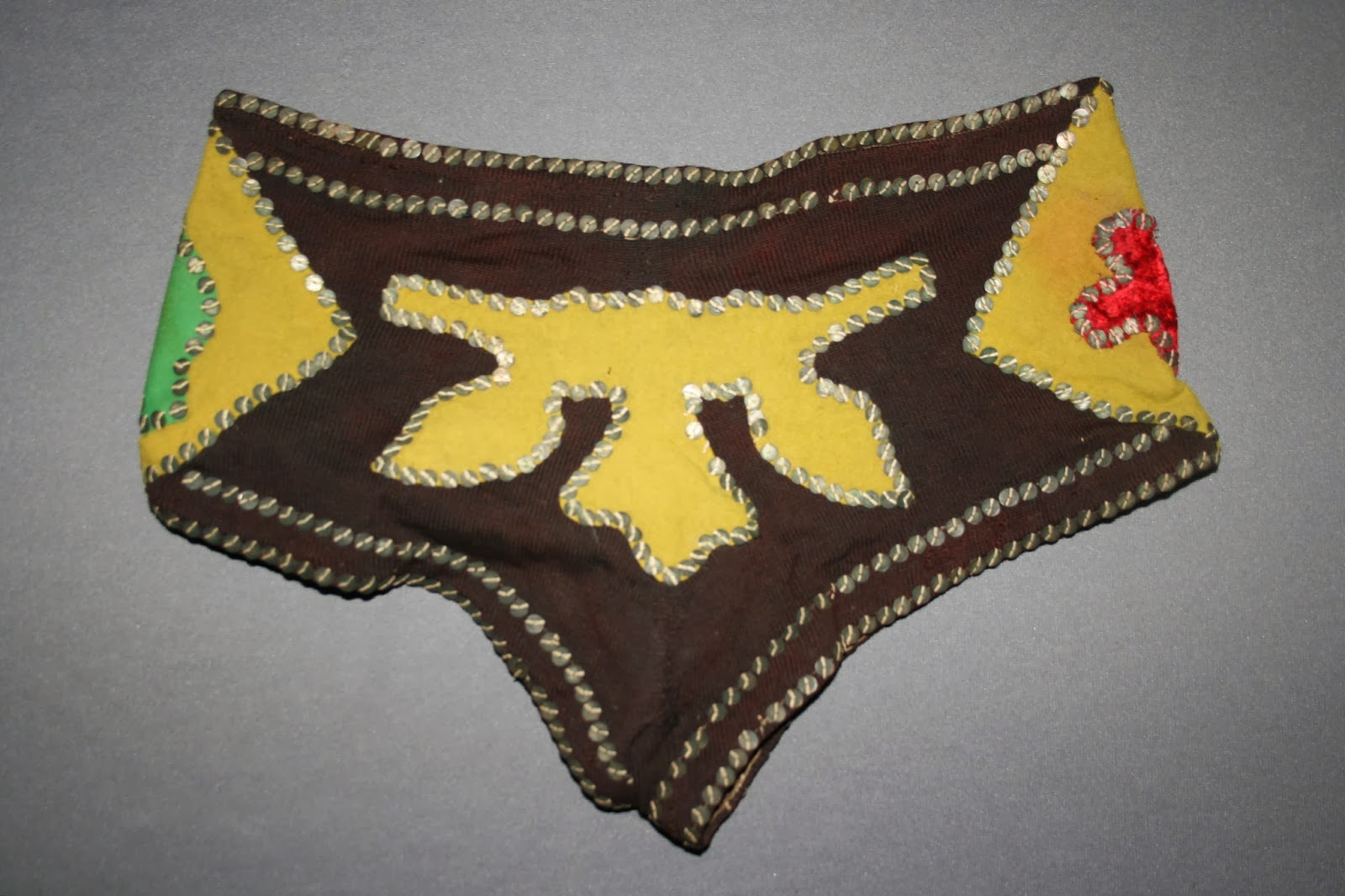
Below are the Before Treatment images of the Cheltra Costumes as they arrived at SAC. While the colors may have faded slightly, the dramatic effect of the bold lines and bright hues is still evident. The other obvious feature one notices when examining these costumes is that they were well used. Cheltra worked hard in these costumes. These particular items are all hand made, mainly composed of wool with velvet inserts, and are in good condition. Clearly the Cheltra family, who donated them to Maine Historical Society, cared for these items and kept them carefully, an important factor in the keeping of any textile.

Art conservation of historic costumes, textiles and garments, repair and restoration, Maine Historical Society
The before treatment photo featuring the body of the Cheltra "Black Costume". This top is beautifully
decorated with inserts of bright velvets, set on gold colored wool flannel. At the bottom, a safety pin
remains attached. The red  ribbon in the center was attached front-to-back, and kept the shirt in the trunks.

Front of the Black Costume.

Obverse side of the Trunks  from Cheltra's "black costume". This costume is a
bit more elaborate, with felt and velvet inserts. The metal sequins are
blackened near the leg openings.


Textile conservation of historic garments and costumes, contortionist, 1890's, hand-made, Cheltra
Before treatment close-up of  Cheltra's green trunks. The green "body" of the trunks are wool knit, while the red insert is wool felt, the metal sequins are hand stitched. (photo: SAC)
textile conservation of historic garments and costumes, contortionist, 1890's, after treatment photo
After treatmentclose-up of Cheltra's green trunks. 

Cheltra and others worked hard at their craft and clearly they worked hard at making costumes to be noticed in. We are so excited to treat these 3 amazing pieces from what remains of his costume collection.

vaudeville contortionist costume, textile repair and restoration, museum storage, padding out folds, archival materials
The after treatment photo of all three pieces, complete with their padded supports.


_____________________________
Gwen Spicer is a textile conservator in private practice.  Spicer Art Conservation specializes in textile conservation, object conservation, and the conservation of works on paper.  Gwen's innovative treatment and mounting of flags and textiles is unrivaled.   To contact her, please visit her website.


Monday, December 30, 2013

Modern materials and conservation

By Gwen Spicer, with Barbara Owens

With the New Year upon us, 2013 will become history. What items from this year will be in a conservator's studio generations from now? We at SAC spend so much time with artifacts from the distant past that we often do not think about modern art materials. That is, until recently.

Several things occurred at once: I was preparing to go to the NATCC (North American Textile Conservation Conference) in San Francisco where the focus at this conference was on "topics that concern modern materials"; I was also listening to Alternative Radio on NPR where the speaker talked about items which were purposefully engineered to fail (i.e planned obsolescence); and finally an article appeared in the newspaper about an artist who's medium were items which were non-permanent, i.e. they are meant to disappear. Coincidence? I think not!

This delicate bowl is created by Dutch artist, Geke Wouters, who made this paper-thin bowl from vegetables. The art created by this artist is meant to wilt. It is by nature, and her design, temporary.

I fully understand that art which is intended to "disappear (like the bowl pictured above or the dust drawings below), is not art to be conserved, that after all, would be the opposite of the artist's intentions.

Scott Wade is the artist who creates incredible works by utilizing the dust that coats car windows where he lives. His work is only a rain storm or wiper blade away from oblivion. See this image and his other works at the artist's website:  www.dirtycarart.com

What I am mostly thinking about is the conservation of modern art made of materials that are non-organic, these are the items which will be brought to the studios of future conservators. Particularly art made from objects that are considered "disposable". For instance, when does styrofoam, like the cup below, need to be conserved? After all, we are told that decomposition will occur in 1,000,000 years, but in the meantime, what kind of degradation might occur and can we perform preventative conservation treatment to slow it? What other possible breakdown is it subject to? And how long will that take?

When we talk about non-organic materials that have a "life span" of 500 to 1 million years or longer, in this respect, some modern materials perhaps should be thought of as the complete opposite from disposable art, after all, these materials have real "staying" power. It is ironic - we refer to disposable items as things that do not last, or are intended for limited use, yet the materials which comprise these items can last nearly forever.

Art on a styrofoam cup.  The artist is Cheeming Boey and the drawing on the cup is done in ink.  You can see more of his cups at his website www.iamboey.com

For conservators, we must carefully consider the idea of modern art and how to approach modern non-organics. Some ingenious art is being created right now, many are created from non-organics as a comment on our disposable lifestyle, our unnecessary waste, and the damage it causes our environment.  All of these non-organics will require specific conservation methods and techniques.

A garbage dump filled with discarded appliances. Many artists comment on our mass produced refuse, our mass consumption and the careless disposal in our society.  

If you are interested in hearing an artist talk about his work and the social consequences of the enormity of our culture, please listen to Chris Jordan's TEDtalk at www.ted.com. One of his artistic mediums is large format long-zoom artwork, meaning you are looking at each piece from a far distance, and as the image gets closer it begins to change until you are suddenly up-close and it becomes perfectly clear what it is on a small scale (visit his website here and see them for yourself: www.chrisjordan.com).  Each of his pieces is a statement on our society, our waste, and each piece is eye-opening.


"Lion" by artist Yong Ho Ji.  This, as well as other sculpture created by the artist, is made entirely from tires.  How will conservators approach the treatment of petroleum based products as they age?

I read in an article recently that film is considered completely obsolete as an artistic medium, and those who continue to use it as the medium for their art are finding themselves in the minority. Here is great story from 2011about Artist Tacita Dean and her struggle with obsolescence: http://www.artnews.com/2011/10/18/planned-obsolescence/. On the heals of this story is the work by artist Erika Iris Simmons, aka iri5. She takes obsolescence in the form of film and cassette tape and makes it into wonderful works like the one below "Ghost in the Machine - The Beatles." See more of her work at her website: http://iri5.com

Erika iri5 creates art by cutting and placing film and cassette tape (among other things) into iconic depictions of the famous. 

Modern art items, composed of modern materials, they are the true challenge. But after all, with challenge comes opportunity…

In an age of object disposal, it is a juxtaposition of ideas when art is created from that which was cast away as valueless, and beauty is created from the ugliness of our mass consumption. Conserving these non-organics as they become artifacts will bring change to the practice of conservation by way of new techniques, methods, tools and solvents. So much will change just as it always does. Each year brings change, and each year brings another era of history for art conservators.

So cheers to the New Year!  Happy Conserving!  And Happy 2014 to all!

_____________________________
Gwen Spicer is a textile conservator in private practice.  Spicer Art Conservation specializes in textile conservation, object conservation, and the conservation of works on paper.  Gwen's innovative treatment and mounting of flags and textiles is unrivaled.   To contact her, please visit her website.