Flag conservation

Flag conservation
Textile conservator, Gwen Spicer of Spicer Art Conservation at work

Wednesday, November 1, 2017

Why do polyester fibers attach so well to wool?

Here at Spicer Art Conservation, LLC, we are finishing the treatment of several wool uniforms from several military conflicts. The uniforms were stabilized, then mannequins were custom made for all of them. As all conservators do, we keep our work space clean and tidy, vacuuming on a regular basis. However, no matter what we do, those pesky polyester fibers find themselves on the surface of the wool uniforms. And to make matters worse, they are not easy to remove. Why is this?

White polyester fibers on black wool. Why do they attach so well!?

Well, with my research on magnetic systems, I have been investigating various issues regarding the materials that are frequently placed and used within the magnetic system, other wise known as the "gap". How these materials behave is related to many things, the topography, friction, cohesion, and static charge of the materials. All have an additional influence on how the magnetic system functions. In the mentioned scenario, several of these things have a role.

Where I am going with this, is that when materials are in contact with one another, they share electrons, which assists with the cohesion of materials to one another. The amount of sharing from one material to the other is related to their placement on the Triboelectric series.

The Triboelectric series? What is that?

Well, it is a ranking of materials in the order of their propensity to gain or lose electrons. It is based on the conductivity of the individual materials as seen in the table below. How it works is if two materials in contact are neighbors on the scale, there is less exchange. But if they are far apart, no matter where they lie on the scale, exchange occurs.

Schematic of electron exchange when two different materials are in
contact and then separated. The extent of this exchange is based
on the materials placement on the Triboelectric series.

To go back to the wool uniform and polyester fibers: referencing the chart below, notice how wool is neutral, close to cotton? It is not too often that I find myself trying to remove cotton fibers from wool. But, polyester is far away from neutral on the scale!

So the next time you find yourself complaining about the challenges of polyester fiber removal, do not blame the wool, blame those electrons!
Table: Material order of the Triboelectric series.

Charge
Material
Notes
+++
Air


Polyurethane foam


Hair


Nylon, Dry skin
Dry skin has the greatest tendency to give up electrons and becoming highly positive in charge.

Glass


Acrylic, Lucite

 +
Leather


Rabbit's fur
Fur is often used to create static electricity.

Quartz


Mica


Lead
Surprisingly close to cat fur.

Cat's fur


Silk


Aluminum


Paper


Cotton
Best for non-static clothes

Wool

NEUTRAL


Steel
Not useful for static electricity

Wood
Attracts some electrons, but is almost neutral

Amber


Sealing wax


Polystyrene


Rubber balloon


Resins


Hard rubber


Nickel, Copper


Sulfur


Brass, Silver


Gold, Platinum


Acetate, Rayon


Synthetic rubber


Polyester


Styrene & Polystyrene
Why packing peanuts seems to stick to everything.
 -
Plastic wrap


Polyethylene


Polypropylene


Vinyl, PVC


Silicon


Teflon
Teflon has the greatest tendency of gathering electrons on its surface and becoming highly negative in charge.

Silicone rubber

- - -
Ebonite


_____________________________
Gwen Spicer is a textile conservator in private practice.  Spicer Art Conservation specializes in textile conservation, object conservation, and the conservation of works on paper.  Gwen's innovative treatment and mounting of flags and textiles is unrivaled.   To contact her, please visit her website.

Learn more about magnets and their many uses in the new publications Magnetic Mounting Systems for Museums and Cultural Institutions. Available for purchase at www.spicerart.com/magnetbook.


Tuesday, October 24, 2017

Conserving, Storing and Mounting Hats, Caps, and Various Headgear

By Barbara Owens, SAC staff

Hats and head coverings are a broad category. They can be large like a chapeau, tall like a shako, tight like a fez, slouch like a beret, have a brim like a kepi, be rigid like a helmet, have a display of feathers like a headdress, and have all sorts of composite accessories, like metal buttons, leather straps, plumes, silk lining, wool tassels, or grosgrain ribbons, to name a few. The conservation of a hat is a complex task; hats can be composed of many materials, and have very different purposes or uses.

This blog entry will focus on a few military style hats, which Spicer Art Conservation recently conserved and mounted at for storage or for display in an upcoming exhibit. Each hat required a problem-solving approach to address various concerns, including:
  • Recreating a 3-dimensional hat from a flattened hat 
  • The sometimes excessive and "mixed media" decoration on hats
  • Weak and vulnerable areas of hats, many naturally occurring along folds or creases
  • Accessory pieces, like plumes (which are a separate artifact), but are displayed together
  • Creating exhibit mounts and storage mounts to fit the needs of the individual artifact

Before treatment photo of military chapeau. The hat would be conserved by textile expert Gwen Spicer at Spicer Art Conservation. SAC conserves and preserves military antiquities, collectibles and memorabilia
Before treatment photograph of a very flattened chapeau. The hat itself was quite compressed with weakened areas in
the wool at the pointed ends. The decorative embellishments, particularly the ribbon at the front were also quite
flat and creased from their previous method of storage.

Decorative elements:
Hats, particularly those worn by military officers, feature decorative elements such as metal pins, insignia, or embroidery. Some hat decoration is intended to represent the wearer's military branch, company or unit. These decorative elements can be considered mixed-media, composed of various types of fabric materials, metals, or metallic thread.

Close-up of before treatment photo of military chapeau c. 1810. The hat would be conserved by textile expert Gwen Spicer at Spicer Art Conservation. SAC conserves and preserves military antiquities, collectibles and memorabilia
A detail image of an Officer's Chapeau, c 1810, shows the various materials involved in its
construction; silk ribbon, wool, braided elements, ribbon with metallic thread, metal eagle.

The hat below (an officer's chapeau circa 1832) composed mainly of beaver pelt is complex and highly decorative. The front, or cock, of the hat features taffeta ribbon, grosgrain ribbon ruffle, thickly embroidered knotted braiding and embellished pieces (including unique horse shoe shapes), metal button, and gold-toned metal eagle with a banner pin above, which reads: "E Pluribus Unum". At each of the cocked ends (not visible in photo) are thick tassels of metallic thread.

Before treatment photo of military chapeau c. 1832. The hat would be conserved by textile expert Gwen Spicer at Spicer Art Conservation. SAC conserves and preserves military antiquities, collectibles and memorabilia
A detail image of the complex decoration. During cleaning of the metal elements,
the other fabric decorative pieces must be protected with a barrier material.

Hats, as 3-Dimensional artifacts almost always require that they be conserved and stabilized simultaneously. The mount of a hat therefore should provide overall support to the hat, especially any accessory item or overhanging piece, like a brim. Hats should not only be placed on 3-D mounts for display, they should be stored as a 3-D artifact as well.

Each hat that is conserved at SAC is custom fitted with an internal support created from carved ethafoam and covered with pre-washed 100% cotton stockinette. The hat with its internal support are placed on a handling tray. It is the tray that moves in and out of the storage box, therefore reducing or eliminating the handling of the hat itself (see photo below).

After treatment photo of military chapeau and it's custom made archival storage box. The hat was conserved by textile expert Gwen Spicer at Spicer Art Conservation. SAC conserves and preserves military antiquities, collectibles and memorabilia
The chapeau, on its handling tray, easily slides in and out of its
 archival storage box. The box is custom made and features smooth fabric
covered ethafoam blocks strategically placed to provide gentle support and
stability for the chapeau while in its box. The box is not only a
great storage container, but is perfect for travel.

Plumes:
Plumes are a hat accessory that often accompany shako or chapeau style hats. The plumes are created from feathers, but can also be more of a long flowing item, created from horse hair. When these plumes were originally part of the hat, they were originally fastened to the hat by being slid into an applied sleeve located at the brim, hat band area, inside the crown, or sometimes tucked behind the decorative elements at the front of the hat. Artifact hats, especially those that are quite fragile, are no longer able to support the plume as they once did. Plumes that are original to the hat, like the one featured in the image below, can be quite rare. These fragile items require their own treatment and stabilization (see image below).

Plumes, feather, horsehair, conservation of military artifacts, antiques and collectibles, textile conservation, object conservation, Spicer Art ConservationPlumes, feather, horsehair, conservation of military artifacts, antiques and collectibles, textile conservation, object conservation, Spicer Art Conservation
(LEFT) This feathered plume from an officer's chapeau, circa 1810, was quite fragile. The plume requires its own stabilization and encapsulated in a fine net to secure the small brittle ends of the feathers that were prone to breaking off. It will also be supported with a custom made Vivak mount to hold it in the proper position and angle (RIGHT). The accompanying hat (see below) was no longer able to support the plume as it had originally been inserted into a fabric sleeve on the reverse of the hat's front. 

Display mounts to provide optimal support and incorporate accessories:
As mentioned in the above section about plumes, accessories which were original to the hat, may not be able to be incorporated as they originally were intended. The plume discussed above had been held onto the hat with a fabric sleeve (see photo below).

Conservation of Military collectibles, antiques, artifacts, uniforms, hats, accessories, civil war, war of 1812, revolutionary war, WWI, WWII. Conservation, preservation, stabilization, display, storage.
Before treatment photograph highlighting the sleeve that originally held the base
of the plume. Both the sleeve and the hat could no longer perform its original
function of supporting the plume. Also, the plume could not be held on the hat
in such an unsupportive way. Another method to display the plume and hat
together needed to be found. Also notice the fragmented
pieces of the feathers, indicating their easy breakage.

The sleeve had been sewn to the hat with threads that were now loose and quite fragile. Placing the plume back into this sleeve would weaken the sleeve and place the the hat at risk for tearing, and the plume at risk for falling, therefore causing potential damage to both artifacts. (Additionally, the plume could no longer be displayed with such minimal support to its base).

The solution was in the mount. The creative mount for the plume to be seamlessly displayed with the chapeau was fabricated by BRIGID MOUNTMAKING. The unique, custom mount would address the display of the two artifacts together, the full support of the hat (both inside the crown and the weak pointed ends), and the delicate plume, which required encapsulation in a fine net to minimize the loss of the breaking barbs of each feather, but also required a custom made Vivak cradle to hold and support it in the proper, supportive, position. Vivak is a polyethylene terephthalate glycol (PETG). It is clear and is easily bendable with low heat, perfect for subtle shaping needed for such purposes as this.


custom mount designs, Brigid Mountmaking, conservation of military memorabilia, artifacts, antiques at Spicer Art Conservation
The wooden base and body of the plume is supported by the custom made
display mount. The lower curved portion of the plume mount is designed to
wrap around the edge of the chapeau and fit directly into the support mount
constructed for the  chapeau. Once placed, the plume mount is secured with a
metal screw. The gold colored portion of the mount will slide into a receiving
portion, placed within the hat display mount.

Custom made display mount for chapeau and plume exhibit. Brigid Mountmaking, Spicer Art Conservation provides conservation and preservation services for textiles, objects, upholstery and paper repair
A close-up view of the junction of the plume mount and the hat mount. Here, the
lower portion of the plume mount is shown as it fits into the hat mount and is
secured with a screw. The black fabric is wrapped around a custom made ethafoam
form, which will provide support when the hat is placed onto the display mount.
Inside, the square receiving end has been built into the mount.  
Custom made display mount for antique, artifact and collectible military style c 1810 chapeau. Conserved conservation conservator Spicer Art Conservation
The two display mount pieces: the hat mount (before the hat has been placed on it)
and the plume mount, as they fit together. Now, the two-piece mount is ready
for the Chapeau and ready for exhibit!

The two-pieces of the display mount work in synchronicity. The internal body of the hat is supported by the cotton stockinette covered portion, which fits directly inside of the chapeau. The black display fabric covered base will provide the support to the fragile pointed ends of the hat.

Once the hat has been placed on its display support, the plume mount is slid into its receiving end and secured. The plume mount, while placed close to the hat, does not rub or rest on the hat in any way, and is not distracting to the viewer. The hat is now ready for exhibit.
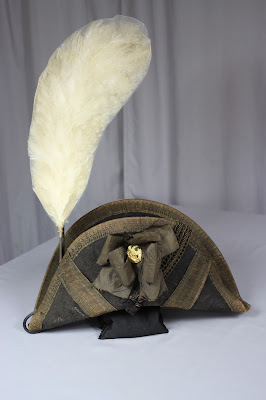
Exhibit mount to display chapeau and plume together. each mount is separate, yet works together. Spicer art Conservation art conservator, preservation, repair, military collectibles, artifacts, antiques, textiles objects and paper conservation.
After treatment photograph of the exhibit ready
mounted hat and plume.


Material composition:
We have conserved hundreds of hats at SAC. The hats have been made from leather, wool, cotton, silk, beaver pelt, molded plastic, synthetic textiles, and every combination of fabrics. Each fabric behaves differently based on its age, its past use, the way it has been displayed or stored, and how much light it has been exposed to over time.

The hat below is an officer's foraging cap from the American Civil War, featuring a quatrefoil design applied with soutache braiding. The hat features a variety of materials including, leather, wool, silk, brass, metallic thread, and velvet pile fabric.

Forage cap conservation and mounting for stabilization using brim constructed of Vivak and covered with cotton fabric. Military artifacts are conserved, preserved and repaired at at Spicer Art Conservation, serving institutions and private owners

When a hat is composed of many different fabrics and materials, each piece must be considered individually when approaching the overall treatment of the hat and its needs for stabilization. For example, the close-up of the foraging cap (see below) shows where the crown, composed of wool, meets a decorative hat band of velvet, which is further embellished with a leather hat band with brass buttons. On the inside, it is stitched to a sweatband made of tanned leather.

Conservation of military hat cap chapeau, shako. Preservation and repair of collectibles, antiques and artifacts

A hat like this with its various parts must be mounted to support all of the pieces of the crown, but the mount must support the heavy but fragile brim. Below, the underside of the supported hat can be seen. Here the brim support, was mad using Vivak and then covered in black cotton fabric, is attached to the base of the mount. It is positioned just under the brim of the hat to provide stability and support (while always using only archival materials).

Custom mount making and stabilization. Spicer Art Conservation and preservation of military collectibles, antiques, and artifacts

Hat brims, whether they are just at the front of the hat (like a baseball style hat), or if they extend outward around the entire circumference of the hat (like a cowboy hat, or a sombrero) must have stability provided to this overhanging area. Without stability, the area of attachment of the brim to the hat grows weaker or in some cases separates from the hat entirely, such was the case with the leather shako hat below (see image below).

leather shako and brim conservation and stabilization, mounting for exhibit and storage. Preservation of military collectibles, artifacts and antiques
The shako and its brim; here in two pieces that needed reattachment
and increased stability. There are times when treatment alone is not sufficient.  

The 200+ year old leather shako and its leather brim required a reunion. But how to keep them together in a more supportive way? The shako had been mended before, but the weight of hat and brim and their precarious intersection were factors that would lead ultimately to a possible failure in the repair, especially if the hat was improperly supported during handling. The answer once again, was in creating custom formed full brim support of Vivak covered with black cotton fabric, and placing it under the brim, directly attached to the internal support materials (see photo below):
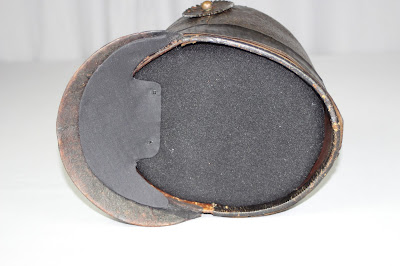
Conservation of circa 1810 shako. Military hats and other collectibles are conserved, preserved and repaired at Spicer Art Conservation, located in upstate New York, but serving clients in the US, Canada and Worldwide
The leather shako, circa 1810, the crown of the hat is fitted with a custom made
archival support to give dimension to the inside of the hat. The brim support is
made of Vivak, shaped to allow the brim sit as it naturally would, while relieving
 any pressure to the repair.

THINK HOLISTICALLY:
Remember that hats are 3-dimensional, and keep in mind that they can only achieve 3-dimensionality with support and must be properly mounted to maintain their shape. At Spicer Art Conservation we constantly strive to provide the best conservation of an artifact, which includes the repair or stabilization of the item, the best way to allow the item to be fully understood, studied or displayed, while keeping handling to a minimum. Our mounting methods, whether for storage or for display are holistically considered to provide full support of the artifact, enable minimal handling, and when possible enable seamless transition from storage to exhibit.

Read more about choosing the right filling materials for your hat in our former blog post "Supporting textile artifacts without tissue paper - save a tree!", where we discuss the downfalls of stuffing hats (and other 3-D artifacts) with tissue paper.

Make sure you visit Brigid Mountmaking's website to see the amazing work that they do.

Are there hats in your collection that need care?  Contact us by phone or email, we are happy to help.

______________________________________
Gwen Spicer is a conservator in private practice who is a recognized expert in the care of textiles, object, paper and upholstered artifacts.


Tuesday, September 12, 2017

The conservation and stabilization of a 19th century collection of children's leather shoes

by Barbara Owens, SAC staff

Recently, a large group of children's shoes (and one very small leather glove), many from the late 1800's, arrived at the studio to be conserved and prepared for archival storage or display.  The shoes had been stored in an area where they were exposed to water.  Many of them, constructed entirely of leather, or featuring leather components, showed liquid tide lines. In addition, the shoes were misshapen and several had evidence of insect activity.

Leather conservation, object conservation, collections, artifacts, repair, conservation, preservation, stabilization
The collection as it arrived at the studio. 


The private collection represented shoes for the very small child or toddler to a child of perhaps six or seven years old.  Several of the shoes had been padded or filled with old newspaper or other material that had compressed, yellowed, and ultimately provided a filling of acidic materials to the shoes in which they were placed.

Newspaper as a filling is a common material used to give shape to leather shoes and boots. Leather shoes that show signs of use and wear are more pliable, making the area at the ankle, or above it, more weak. This is particularly an issue for boot style shoes with laces or straps; and especially for shoes with a taller height, which are prone to slouching under their own weight.

The stabilization of these small shoes therefore required the construction of some very small inserts.  The inserts are each custom made for the individual shoe or boot. Each insert is made from archival materials and is intended to give stability and support of the entire shoe, but especially for the weak and vulnerable components.

Stabilization and preservation of leather artifacts. Conservation services of Gwen Spicer of Spicer Art Conservation.
The shoe outline and the ethafoam to be covered
in needle punched cotton batting and cotton fabric. 

Spicer Art Conservation provides repair, stabilization and preservation of textile, object and paper artifacts
The two-piece shoe insert, custom created for an individual shoe

Archival materials are necessary for the safe, long-term preservation of artifacts. Professional art conservation includes stabilization, repair, storage, and exhibit of heirlooms, antiques, museum collections, and historic artifacts.
The foot outlines and heal outlines with conservators double-sided tape to provide
conservation approved adhesion of the ethafoam foot support
Storage and stabilization of a Child's 19th century leather boot artifact with custom made archival insert. Professional conservator Gwen Spicer is an expert in the care of textile, object and paper artifacts at Spicer Art Conservation in Upstate New York. Exhibit, storage and safe handling.
A custom made insert and the very small leather boot it was created for.

When a collection is to be displayed, the artifacts require the best possible support to allow them to be seen fully. When possible, we design mounts or internal structural supports to also be used for storage of the object. This dual purpose allows for the best possible care of the artifact, while minimizing any handling of the object as the inserts never need to be removed for storage.

Many times we are asked about constructing supports and mounts and what materials are best. Conservators only use archival materials, which are supplies that have been tested and proven to be inert and to not cause harm to an artifact.

For a list of materials and to better understand what exactly is meant by "Acid Free", please see our blog entry, "What is Acid Free". For a list of archival materials, see our blog entry,  "Glossary for Safe Storage Materials" - here you can review a lengthy list of materials that are used for artifact storage and mount making.

_____________________________
Gwen Spicer is a textile conservator in private practice.  Spicer Art Conservation specializes in textile conservation, object conservation, and the conservation of works on paper.  Gwen's innovative treatment and mounting of flags and textiles is unrivaled.   To contact her, please visit her website.

Monday, July 17, 2017

The Conservation of Baskets

by Barbara Owens, SAC staff

At Spicer Art Conservation we specialize in textiles, paper and objects. "Objects" is a broad category, but for us it is typically an object made of organic material that is difficult to treat, and so we are contacted for its conservation. We treat objects made of uncommon organic items, like: bone, skin, feather, hair, porcupine quill, horn, bark and a variety of species of grass, to name a few. Baskets, of course, are typically constructed of grass, but are also often embellished with additional items (feathers, glass beads, quills) making them a compound object, which could make them particularly complicated.

Spicer Art Conservation, object conservation, preservation, repair, antique baskets, Native American art, artifacts, objects.
A basket surrounded with tools to clean, conserve, and create safe storage for it.

Baskets are often not alone in a collection, instead they exist in groups, sometimes very large groups.
A few years ago, Spicer Art Conservation and other conservators had a great opportunity to clean, rehouse, and condition a very large group of baskets. The collection of over 700 baskets were owned by the United States Department of the Interior.

Conservation, repair, preservation and stabilization of antique, historic and old baskets, Native American culture, heritage, department of the interior collection.
A small sampling of some of the baskets in the US Department of
the Interior collection.

The first portion of the DOI collection was gathered in the 1930's by the first Secretary of the Interior, Mr. Harold Ickes, who then gave them to the people of the United States. It is a little known collection, but with the now improved access and storage, more research on the collection will be made. What is evident is that within the collection are great examples of all types of baskets from North America.  Read more: http://www.doi.gov/museum/upload/Interior_Shelves_newsletter_2010_issue1.pdf

Baskets have been used by humans for 1000's of years and they have many characteristics: they are vessels, sometimes with a lid. Baskets are woven, coiled, stitched, braided, knotted or put together in creative ways which make them come together in a specific shape. Baskets are purposeful or decorative, exchanged in trade or tourism. Each of these qualities are what determines the conservation of the object.

Spicer Art Conservation of objects, including Native American antique baskets with glass bead embellishments, repair and preservation of old baskets, basket collections
The before and after conservation photos of a sweetgrass basket with glass bead decoration.
LEFT: The basket's lid had fallen into the top, the handles were insecure, threads were loose and the basket was quite dirty.
RIGHT: The basket's form is more readable, it has its shape and the entire surface of the sweetgrass and glass beads
have been cleaned of the accumulated dirt.

Many baskets come to us embedded with dirt. This is not surprising as baskets are incredibly dimensional with surfaces of "nooks and crannies". Baskets can loose their shape over time, slouching or warping below their own weight. These two concerns are addressed during the conservation treatment of a basket. First the basket is vacuumed with low suction and a brush attachment to release any loose dirt on the surface both inside and out. Next the basket is cleaned with swabs and a mild enzymatic cleaner. Stabilization occurs as the basket requires it; this can be in the form of a full internal support or refastening loose embellishments or handles.

Spicer Art Conservation, cleaning or glass bead embellishments of an antique sweetgrass basket, Native American objects, textiles, beaded artifacts.
The glass beads on this basket were encrusted, both in and outside
 with dirt. Custom-made fine cotton swabs were used to gently
remove the embedded dirt from each individual bead.

Spicer Art Conservation, Preservation and Conservation of objects, including Native American baskets, antique baskets and objects
Swabbing the lip of a basket to remove dirt. The swabs are created from
cotton batting to  custom-produce the best size and shaped swab for the job.
Conservation of objects, antiques baskets, Native American baskets
Some baskets come in very small sizes, but this makes them no less complex.
 The outside surface of this basket is completely covered in tiny glass beads.
While the inside is a tightly woven, and features a simple step design.  

Read more about basket conservation and how to create storage supports in a National Park Service "Consev-o-gram": Storage Supports for Basket Collections

Read all about SAC's conservation of an enormously large basket in our previous blog: "The After Life of an Enormously Large Basket", where we discuss the store and support of a basket on a very large scale.

Basket conservation, repair and preservation of antique baskets, basket collections, old baskets, Native American baskets, large basket
The "enormously large basket"
We are happy to help you with your basket or your collection of baskets.  Examples of basket conservation can be found on our website: spicerart.com, or on our Pinterest page devoted to basket conservation.

_____________________________
Gwen Spicer is a textile conservator in private practice.  Spicer Art Conservation specializes in textile conservation, object conservation, and the conservation of works on paper.  Gwen's innovative treatment and mounting of flags and textiles is unrivaled.   To contact her, please visit her website.


Wednesday, June 14, 2017

Conserving Patton's Third Army Flag

By Barbara Owens, SAC staff

Happy Flag Day 2017 and Happy 242nd Birthday to the US Army!  At Spicer Art Conservation we wanted to celebrate these two occasions by talking about the conservation of a historic American Army flag, General George Patton's Third Army Flag.

Conservation of historic flag, preservation, framing, mounting, repair, textile conservator Gwen Spicer of Spicer Art Conservation.
Patton's Third Army flag when it arrived at Spicer Art Conservation.
(Image courtesy of the Gen. Geo. Patton Museum of Leadership, Ft. Knox, KY).

This flag is quite unique in that it is a textile constructed as a flag, yet it was never meant to fly.  Instead, Patton's Third Army Flag is a commemorative piece containing insignia from each of the 56 Units and Divisions of Patton's Third Army, as well as several lengths of laurel embellishments, all overlaid onto an organizational flag of the third army.  The flag was created specifically as a commemorative piece and was presented to General Patton by Major General Robert Littlejohn (who was chief quartermaster of European Theater of Operations).  The flag was given to Patton just weeks before his death on December 21, 1945.  The image below is perhaps the only photo of Patton with the flag.

Littlejohn presents the flag to Patton.  (Photo from U.S. Militaria Forum). 

The flag features some insignia or embellishments that are not part of the 3rd Army or its regiments.  Several lengths of laurel radiate from the center and create a separation between the Unit patches.  These laurel leaves are "European" in character, but quite fitting for inclusion in Patton's flag as he commanded throughout Europe and perhaps more importantly, laurel symbolizes victory.  An appropriate symbol to include in a presentation to a celebrated General who had famously been involved in victories of the WWII, from North Africa to Germany.

Creating a pressure mount for Patton's Third Army Flag:
A pressure mount is a type of framed mount for the display of a textile or paper artifact to create overall pressure to support the artifact. For textiles in particular, a pressure mount enables the artifact to be placed on a mount but with few or no stitches placed in the artifact to secure it to the mount.  The mount begins with a support panel composed of a rigid archival material, such as a honeycomb aluminum panel. The support panel is then covered with soft base layers created from needle-punched polyester batting. The batting serves as a soft surface for the artifact to rest on. The artifact is then covered with UV filtering plexiglas and it is secured within an aluminum powder coated frame; the edges of the frame are sealed to prevent dust, debris and airborne pollutants from entering the frame.

Patton's Third Army flag had been previously framed and was stitched to a heavy piece of black polyester fabric. The previously used frame was not a sealed pressure mount and therefore dust and airborne particulate entered the back of the frame to settle on the mounting fabric (see image below).

Old flag mount, conservation, pressure mount benefits, textile conservator, flag conservation, preservation, repair
The previously used frame had allowed dust and airborne particulate to enter the back of the frame. Above, the reverse side of the mounting fabric shows the layer of dust.  Above, you can also see the extensive stitching in yellow thread used to attach the flag and fringe to its display fabric.

This flag is not flat:
A flag like this is unique in that the embroidery, insignia, and fringe create a 3-dimensional surface.  Additionally, the stitching of the various elements onto silk creates puckering between the patches and laurel.

Flag conservation, preservation, repair, mounting, framing, Patton Museum, textile conservator and flag care and preservation expert Gwen Spicer
This planar view of the flag's surface, shows the raised quality of the laurel embellishments.

The center area, where the large army "A" is located in an embroidered circle, is quite thick, with a round embroidered "A" being featured on both the obverse and reverse of the flag.  In fact, the large circle with the Third Army emblem is the only embroidery featured on the reverse side of the flag.

Paying attention to the raised embroidered areas of the flag is important for a number of reasons.  First, cleaning a surface that has texture and depth requires more attention to detail.  Second, when mounting the flag for display, if the raised areas are not supported, the weight of those areas can sag or shift as gravity takes its toll.

Building the Mount
Creating a pressure mount for a textile like Patton's Third Army Flag requires that the raised elements be supported consistently and overall with a padded surface as the base for the mount. If it had instead been placed on a hard, flat, base surface and Plexiglas was simply played over the top, it would result in the raised areas being crushed.  For a textile like this, the padding that covers the surface of the mount cannot consist of just one solid piece, instead the padding must be muli-layered, having areas cut-out of the padding to allow for the embellishments to rest into.

Textile pressure mounts for historic flags and banners are a specialty of conservator Gwen Spicer of Spicer Art Conservation, preservation, repair, conservation of antique, vintage and collectable flags.
While the pressure mount is being constructed, various layers of batting are
compiled to line up with the embellishments on the surface of the flag.  

The construction and building of the pressure mount is careful work.  The layers must align properly, and they must support, but create no additional bulk.

Textile conservation, preservation and repair of historic flags and banners. Pressure mount creation for textile.
The batting layers with the visible "wells" to accommodate the thicker portions of the flag.

Patton's commemorative patch flag features some interesting construction techniques.  The fringe is affixed to the outside of the flag, this indicates that the flag was a standard issue Third Army Flag.  The unit sleeve patches were affixed with care and thought; the red patches were stitched in a blanket stitch with red thread, the blue patches with blue thread, etc. (close-up image below).

Historic flag preservation, conservation, repair, framing and mounting, textile conservator, Spicer Art Conservation, George Patton Museum of Leadership
Close-up of some of the sleeve patches and the individualized
color stitching used to best match the patch.

Above, the close-up image reveals the close proximity placement of the sleeve patches, as well as the decorative laurel. The attachment shows the puckering or "undulation" of the silk as the heavy pieces are are stitched to silk - a slippery and unforgiving fabric!

As the pressure mount comes together, each component must work in synchronicity.  The layering of the batting must sit properly beneath the patches and embellishments. The Plexiglas must create the right amount of support and proper pressure, but not too much pressure as to be damaging.  The layers of the frame; the base support layer, the artifact, the Plexiglas, the frame itself, all must work together and house the textile in a way that will create the best possible mount for as long as the flag is framed within it.

Each year Spicer Art Conservation assists organizations and individual collectors with their flag conservation and mounting projects.  Our expertise in the preservation of these historic artifacts has given us the opportunity to work on some of the most unique and interesting pieces of history. We are pleased to be a recognized expert in flag preservation and wish all flag enthusiasts a very happy Flag Day!  We are additionally pleased to serve the US Army in the conservation of their collection of artifacts and wish the US Army a very happy birthday!
_____________________________
Gwen Spicer is an art conservator in private practice. Spicer Art Conservation specializes in textile conservation, and is a recognized expert in the care and conservation of historic flags and banners. Spicer Art Conservation additionally specializes in object conservation, and the conservation of works on paper.  To contact Gwen, please visit her website or send an email.

Thursday, May 25, 2017

What is Bondina? And how is it different from Reemay or Hollytex?

Visiting another art conservator is always a way to learn new things, but visiting an art conservator on another continent is always an adventure and often unexpected things are discovered. I spent a wonderful time with Carolina De Stefani at the London Metropolitan Archives in London, UK. You may know about Carolina if you have read about her involvement with the "Great Parchment Book Conservation". The reason for my visit to the Archives was to learn their technique of using magnets to flatten parchment. Their experience was broad and extensive, having many volumes of water and smoke damaged books containing pages of parchment.

In the research I have done on the use of magnets and how their use has entered the field of conservation, I have been so amazed by the fact that there were these various conservators, almost in the same year, who began to use magnets to flatten challenging parchment that could not be flattened by the more traditional methods. Each conservator had their challenges, and thus methods that resulted in developing their own techniques. However, each used resources, time allotment, and the tools on hand to solve their immediate issues. From each problem and solution found, we can only gain from their problem solving.

From my visit with Carolina, I also learned about a new material, called Bondina. I learned in my visit to both the Victoria and Albert and British Museum that this is a common material used by conservators in the United Kingdom and has many advantages.

At first impression Bondina seems to be like Hollytex, but then not. I will say it is a wonderful blend, that is somewhere between Hollytex and Reemay. Bondina, like the others, is also a non-woven material made of polyester fibers and comes in different thicknesses. 

Thick Hollytex (71g).  Photo from Conservation-by-Design.

Thinner Hollytex (34g).  Photo from Conservation-by-Design.

Bondina comes in three different weights (30, 71, and 100 grams), each with their beneficial uses. The thinner (30g) version, is very calendared and is not good for washing due to the high level of calendaring. But, it is great for covering surfaces under artifacts. Carolina used it to cover the metal surfaces when flattening the parchments.

Bondina "30" (30g).  Photo from Conservation-by-Design.

Bondina "100" (100g).  Photo from Conservation-by-Design.

The thicker version (photo immediately above), identified as "100", can be hot melted (as most likely the thinner version can be as well). This makes it good for making folders along with Mylar (Melinex). Carolina also uses it for a support with washing, very much like we would use Reemay in the United States.

I brought some Bondina home to the US. Now having samples and being able to really look at them more closely, Bondina really is an interesting "sister" of Hollytex and Reemay. I hope there will be distributors here in the US eventually.

Reemay (35g).  Photo from Conservation-by-Design.


_____________________________
Gwen Spicer is a conservator in private practice. Spicer Art Conservation specializes in Textile conservation, Object conservation, and the conservation of Works on Paper.  To contact Gwen, please visit her website or send an email.

Learn more about magnets and their many uses in the new publications Magnetic Mounting Systems for Museums and Cultural Institutions. Available for purchase at www.spicerart.com/magnetbook.


Friday, May 5, 2017

Great work Historic Woodstock!

It is at times like this that I truly love my job. 

I just returned from a visit to an amazing collection in a museum located in Woodstock, NY. Woodstock is known for many things, but less so for this incredible collection of artists' work consisting of paintings, prints, drawings, sculpture, textiles, photographs, books, manuscripts, film/sound recordings, antique tools, and an extensive archives of all the other arts organizations in the community.  This group had an early connection to the inclusion of artists into the WPA during the New Deal years. The Historical Society of Woodstock was founded in 1929 by a group of artists, writers, academics and local citizens. The Society maintains its link to the community of artists who are still at work in this community.

Over the years I have visited the museum many times. As early as 2008 they had already begun the project of renovating and modernizing their historic structure, the Eames House. At this time, their collection had mostly been moved to a secure location where organization and data recording was done. 

No large project like this is simple or straightforward. Always there are many moving parts. However, this dedicated group sought funding from local groups throughout New York State; NYSCA, Get Set, Ready, Go in 2009; and on the federal level, from the Federal Conservation Assessment Program (CAP) in 2010; and the National Endowment for the Humanities (NEH) in 2016. Each assessment was used as a building block that allowed them to fulfill the promise of earlier recommendations.

I want to share the great work they have done by showing a few before and after images.

Temporary secured space in 2008 and 2017, east view. Now this section is used for town archives.
Temporary secured space in 2008 and 2017, west view. Now used only for painting storage.
 Love these chrome-coated steel wire shelving!
Notice the clip boards hanging on the shelves. From the beginning they were keeping track of collection locations.
In 2008 inventory lists were handwritten and now computer generated in 2017.
One of the very early painting storage that had been used in the Eames House. In 2008, only the wooden racks were present.
The same corner is now used for boxed archival storage (2017).
Eames House storage room in 2008 and 2010. Between the visits the walls were
insulated and painted. Now there are new insulated windows and light blocking shades.

At each visit there was always noticeable progress. 


Eames House, home of the Historic Society of Woodstock, in 2009 and 2017. The
addition positioned in a vulnerable corner provided a handicap bath room and a small kitchen.
 Eames House suffered water damage at this corner due to the sloping of the landscape,
adding to the high humidity levels inside. With the new addition, french drains were installed. 

The CAP was performed with Tilly Architects who gave them great guidance for how to improve the historic building while keeping its integrity. 

The dedicated group who did so much!  What a team.


_____________________________
Gwen Spicer is a conservator in private practice. Spicer Art Conservation specializes in textile conservation, object conservation, and the conservation of works on paper.  To contact Gwen, please visit her website or send an email.