Flag conservation

Flag conservation
Textile conservator, Gwen Spicer of Spicer Art Conservation at work

Wednesday, October 23, 2013

How to store your flag, Part 3: Rolling

As stated earlier in "How to Store Your Flag, Part 1" proper storage is critical to the long-term preservation of any collection. Proper storage includes safe materials that are acid-free, a stable environment, protection from light, minimal handling, etc.

Rolling of textiles is an excellent option for flat, single layer, artifacts that are too large to be stored “flat”. Any rolled storage consists of four main parts: the tube, an internal support for the tube, the leader, and the outer wrapping. Specifically, for flag storage, the length of the tube is determined by the height of the flag, plus additional space for the securing of the outer wrapper. Remember that the hoist edge will run the length of the tube and will be rolled last. The tube and its textile is then supported on cradles, or in storage furniture.  Grouping your collection into standard sizes maximizes space and budget.

Illustration of the layers of rolled storage of textiles, art conservation, image property of Gwen Spicer
Illustration by Gwen Spicer of the various layers of rolled storage.

A paper, or muslin, apron is used to assist in the initial rolling of the textile. The textile can be interleaved with acid-free tissue, muslin, or cotton sheets for larger textiles like rugs. The textile is then covered with muslin or Tyvek and secured with twill tape ties.

The diameter of the tube needs to be considered with several factors in mind. The larger the tube, the better it is for the flag. However, there is always a balance among space, budget constraints, and the size of a collection. Unfortunately archival tubes are very expensive specialty items because tubes used for rolling textiles need to be made of acid-free cardboard, which is made from virgin materials.

A small lightweight flag can be stored on 2" diameter tubes. Medium size textiles are best on 3" diameter tubes, and heavier flags require even larger tubes, which may also need to be supported by metal rods. Part of the tube’s diameter selection is the degree of bend, or angle, that the fibers are required to conform. Over time, the fabric can have a memory of the curvature.

art conservator custom made rolled flag storage, carpet, rug and large textile storage, archival materials
Cutting tubes for a collection of flags.

Cradles are an integral part of rolled storage. If the rolled textile were allowed to rest on a solid surface, the point of contact between the surface and the artifact would result in stress, not just to the outside layer which runs the length of the tube, but to each layer beneath the outside layer. The weight of the textile and the storage supplies can easily crush and cause damage to fragile textiles. By raising the ends of the tube above the surface just slightly, this can be prevented. Cradles can be easily carved from Ethafoam. Ethafoam is a Dow Chemical Co. trade name for polyethylene, a thermosetting plastic. Ethafoam is a closed-cell foam with a smooth surface. The cut edges are softer than other foams, like Styrofoam. It is easily cut with knives, and wood working tools. It is best to look for Ethafoam manufactured by Dow. Other foams have been found to include additives and stabilizers that can cause problems and yellowing, these obviously should be avoided.

They can even be stacked, or with notches, placed in a row side by side. The cradles need to be positioned at the end of the tubes, away from the flag itself. Stacked cradles are useful when a small group of unusually sized tubes are needed, and it is cost prohibitive to purchase furniture for such a small collection.

art conservator Gwen Spicer create these cradles from ethafoam, which is archival safe for museum storage and ideal for  supporting large rolled textiles
Detail image of carved Ethafoam cradles for two flags.
large textiles storage, rolled flags, archival materials, proper rolling techniques of artifacts
The cradles were designed for the flags to be stacked. The locations
where the tube rests on the cradle is outside or beyond where the
artifact is located. The pressure of the cradle is only on the tube
and outer wrappings itself.
Shorter length tubes can be placed in boxes, or drawers supported with Ethafoam cradles to suspend the tube above the bottom surface. Care will be needed to ensure that the tubes are cut to accommodate the inside dimension of the drawer or box. This is especially true with long and bulky textiles that can become large in diameter as their length is rolled. Tubes within boxes or drawers can run either direction to provide more options for tube length. These shorter tubes do not require an internal metal bar for support like the longer tubes. Please note any cut end of tubing often needs to be sanded lightly.
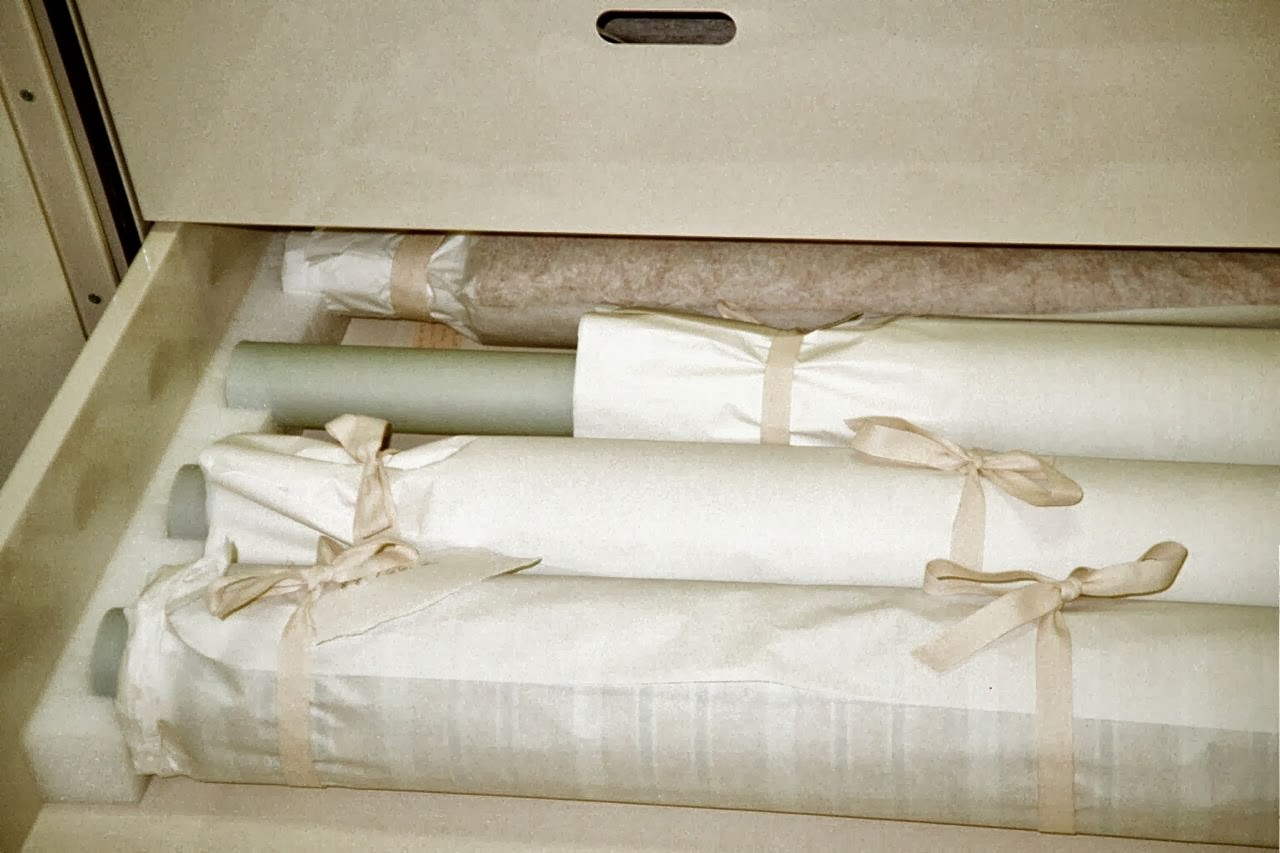
Art conservation, proper storage, rolled textiles, large textiles, flags, rugs, carpets
Rolled textiles suspended in the storage drawer with Ethafoam cradles.
art conservator, rolled storage for large textiles, archival materials, museum archives, collection care
Flags rolled and suspended on cradles that are positioned onto shelves.

On occasion, a longer tube is necessary. To make a longer tube, an insert is made from a scrap tube section approximately 8" or 10" long. A cut is made along the entire length. (For thick-walled tubes, the cut needs to be the thickness of both walls.) One half of the scrap tube is inserted into the tube and its extension. These longer tubes will also need more attention paid to placement within the storage room. Each tube will need to be maneuvered through the storage room's door, possibly around cabinets to its designated location. These heavy textiles will need to be supported by metal rods.

There are several collections that use Mylar with the prospect that the artifact can be seen through the storage covering. This is an advantage. However, there are two main disadvantages, one is the static-charge inherent in the Mylar and the other is the potential of fading in the exposed area. If plastic is deemed necessary due to pest concerns, then Polyethylene tubing as the covering is a better choice. There are many collections that use Mylar as their outer covering to aid in seeing the artifact, but this conservator discourages this choice.

It is important to note that Mylar would not be fitted into another tube as that it creates surface abrasion. In addition, if the receiving tube is too small, it can crush the flag inside. Other drawbacks are that there is limited access to the rolled flag, and, when it is slid in, one does not know if it remained smooth or if it is bunched.

Flag Storage has many facets, to this point we have covered several methods of storage. Many terms have come out of these reviews of storage, in the next posting we will include a full glossary of safe storage materials.
_____________________________
Gwen Spicer is a textile conservator in private practice.  Spicer Art Conservation specializes in textile conservation, object conservation, and the conservation of works on paper.  Gwen's innovative treatment and mounting of flags and textiles is unrivaled.   To contact her, please visit her website.

Wednesday, October 16, 2013

How to store your flag, part 2: The sink-mat

by Gwen Spicer

Welcome to part 2 of flag storage!  I find that often flag storage focuses around larger flags. We lament how much storage space they require, the sometimes inevitable need to fold them because of their size, and how to access or display them - again because of their size. But what about the small things like flag fragments or small parade flags or even artifacts like political ribbons and the like? It is these smaller things, and especially textured or unevenly surfaced artifacts, that will benefit from flat storage in sink-mats.

Storing a flag or other artifact is determined by many things as discussed in part 1 of flag storage. But determining storage needs can also be done in a very simple way, and that is by basing it on size. For smaller flags and related textiles, sink-mats are a perfect solution. Actually any small to mid-size textile can be stored, and then easily accessed from storage with this design. Such textiles might also include samplers, embroideries, printed textiles, etc. They allow for the smaller textile to remain flat, while being supported and protected. This is especially useful when one is trying to avoid the compressing of any delicate raised areas, fringe, embroidery, and similar. 

The design is very much a variation of "matting" used for prints and drawings. In fact, the first designs for textiles were window mats that were cut around the textiles. The design described here uses less materials and can be simply done and without special tools, such as a mat cutter. The design includes strips of acid-free board to accommodate the thickness of the textile with a board cover that is secured with twill tapes. The flag or textile can be tied to the board or sandwiched between muslin and tissue paper.


illustration of sink mat by Gwen Spicer, art conservator in private practice. Archival materials for safe storage
Illustration by Gwen Spicer of a sink-mat

The images below represent various sink-mat views. The first is overall, and then details of the design for a small silk ribbon. Protective covers can be easily incorporated into the design. 

archival storage for flat items in this sink mat designed by Spicer Art Conservation for the safe storage of museum collections, artifacts and heirlooms

sink mat storage for flat artifacts, protective lids keep them safe from damage, archival materials, museum collection storage, art conservator
Sink-mats can also be designed with protective lids.

The next two photographs are for a larger textile and its associated wooden rod. The same design is used, just with sturdier materials. Lincoln's banner is supported with double-walled corrogated blue-board. Larger sized sink-mats sometimes require thick flutted plastic, like Coroplast. This material can be sturdy and provide necessary support, while also remaining light-weight.

art conservator designed storage solutions for flat artifacts and their associated parts

The Lincoln campaign banner and the smaller parade flags retain their staffs. These too can be incorporated into the sink-mat design.

art conservator, sink mat storage of textiles, museum collection care
Drawer storage with several sink-mats.
sink mat for art conservation of textiles and other flat items, museum storage, collection care
Large sink-mat holding several associated artifacts in a single sink-mat.

Sink-mats are also often suggested as a best storage solution for photographic materials, like daguerrotypes as well as other photographic items. Sink-mats are desirable as a means of storage for a variety of objects simply because the result of their use is a collection that is accessible to researchers, and it can be viewed with very little handling. In addition, the items placed in sink-mats are free from the threat of compression.

Coming up next in Flag Storage we will discuss rolling. Look for the blog soon, or sign up in the right side margin and you will automatically receive the blog delivered to you via email.

_____________________________
Gwen Spicer is an art conservator in private practice.  Spicer Art Conservation specializes in textile conservation, object conservation, and the conservation of works on paper.  Gwen's innovative treatment and mounting of flags and textiles is unrivaled.   To contact her, please visit her website.

Tuesday, October 8, 2013

How to store your flag, Part 1

by Gwen Spicer

We have recently had many calls about how to store and care for flags.

Proper storage is a critical part of all collections housed in institutions, as well as those in private collections. Proper storage is really the best means for long-term preservation. The goals of storage are to provide proper support and environment. Flags and other types of artifacts deteriorate from poor handling and lack of archival materials, high light levels, mold, pests, temperature and relative humidity, and inherent vice. It is the role of proper storage to lower the effects of these modes of deterioration.

A useful way to approach any storage, whether archives, libraries, or museums, is to think of it as a “a box within a box with in a box” The first level of "box" is the building itself, then the room, then the storage furniture, and last is the possible boxes that contain each item. Each layer of protection enhances the environment of your collection. Large fluctuations in temperature and relative humidity are diminished with slower transitions; and pests are further prevented from getting to the flag. This is especially important for organic materials like silk, wool and/or cotton.


Museum storage, archival supplies, art conservator, artifact, collection care
Chrome-plated wire shelving from Metro-International used to store a
collection of banners from the Chautauqua Institution, Chautauqua, NY.
Care is needed when selecting materials used for storage. (See last weeks post, "What is acid-free?") As stated earlier, they can either assist in the preservation or deter. Poor quality materials can cause acidity, off-gas, and discoloring, among other effects, that deteriorate collections. To prevent these types of damage, good quality and acid-free material should be used.

The ideal method is to keep your flags as flat and fully extended as possible. Flags and textiles that need to be flat have several options that include: sink-mats, boxes, or shelves. In many circumstances, placing the flag on a full support is recommended. This is especially necessary with flags made of silk. Silk, as it ages, becomes less flexible and prone to splits and fractures. A contributing factor to the deterioration of silk is its past history, like its exposure to sunlight.


storage of textiles and artifacts, archival materials, museum storage collection care
Oversize shelving by Crystallization.

The supporting material can be muslin, or Tyvek (see earlier post "What is acid-free?"). For fragmented flags, placing a layer on top is also recommended. The support allows the flag to be moved and handled without damage. The material used for the support is determined by the conditions. The poorer the condition, the sturdier the material should be. The support should be continuous over the entirety of the flag.

Museums often have available space for large storage units. Also, many museums have the storage facilities to accommodate large units outfitted with full sized pullout drawers or shelves. The designs of these units vary in detail and perhaps construction materials. However, they all allow a flag to be fully extended and visible to the researcher. Since flags often come in standard sizes, standard sized storage units can be used.  However, when a collection consists of a variety of flag sizes, having a range of sizes of units utilizes the space efficiently. This can best be achieved with full knowledge of your collection and the dimensions of each flag in it. Units are designed both for the flags to rest in a pre-conserved state, or on their display mount after conservation. The later allows for easy rotation of the collection. Below, as well as the two photos above, are a sampling of flag and banner storage in museums.

reduction of handling of artifacts, art conservator, conservation of flags and historic textiles.
Mounted flags at the Maine State Museum, Augusta, Maine. Each flag was
secured to a prepared panel (aluminum honeycomb) and had a place within a
the rack. The panels and rack were made by SmallCorp, Inc., Greenfield, MA.

Determining appropriate storage for a flag can be done by answering questions about the object itself.  The following questions and their corresponding answers are meant as a guide. It is understood that specific situations exist that may not easily fit into these guidelines. These first 10 questions are about the flag and therefore suggest what kinds of storage to consider for an individual flag.

Q: What is the age of your flag?
A:  The age of the materials that compose a flag greatly affect the method of storage to select. Older flags need more protection and support. Therefore it is important to realize that the better the storage early on, the better the preservation in the long-term. Early flags that have been kept off display remain in far better condition than those that have been exposed to poor environments.

Q:  Is your flag made of silk?
A:  Silk becomes quite brittle with age, loosing its flexibility. Of the natural fibers, silk is the most dependent on its environment.  Flat storage is preferable for silk flags.

Q:  Is your flag made of cotton?
A:  Cotton is susceptible to moisture and mold growth.  Cotton flags benefit from being stored in a box or rolled.

Q:  Is your flag made of wool?
A:  Wool is most susceptible to insects, like webbing cloths moths and carpet beetles. Protection from these insects is critical. Boxing or rolling these flags is suggested.

Q:  Is your flag made of Nylon or other synthetic material?
A:  Many synthetic materials are easily degraded in sunlight, whose affect is not fully realized for several decades later. Caring for these flags now will only lengthen their preservations. Flags from WWII and the Korean War are deteriorating and are becoming weakened.  This type of flag benefits from rolling or boxed storage.

Q:  What is the condition of the flag?
A:  Being able to evaluate the condition assists the determination of the flag’s storage needs. The condition of the various materials that the flag is composed of is critical.

Q:  Has your flag been treated previously?
A:  Treated flags often have additional supporting layers that prevent the flag from being rolled. In additional, early treatments can contain materials where their aging properties were not well understood and are possibly brittle presently. Learn the date and materials used in the treatment. It is best to follow the instructions of the treatment.  These flags should be stored flat.

Q:  Are painted surfaces present?
A:  Paint layers, as they age and become dry are no longer flexible. When flexed they crack and are vulnerable to flaking.  These types of flags must be stored flat.


Next week look for the continuation of our discussion about flags and storage.  Rolled storage is an art all its own, we will take a look at it, and answer a few more questions and answers to determine when rolling is wise and when it should be avoided.
_____________________________
Gwen Spicer is a textile conservator in private practice.  Spicer Art Conservation specializes in textile conservation, object conservation, and the conservation of works on paper.  Gwen's innovative treatment and mounting of flags and textiles is unrivaled.   To contact her, please visit her website.

Wednesday, October 2, 2013

What is acid-free?

by Gwen Spicer

October is "Archives Month" and we at Spicer Art Conservation, LLC are celebrating the month by discussing some storage topics. In an earlier post we talked some about environment (see "It's Spring and it's Dry?").  This post will focus on selecting the materials which are within closest proximity to your artifacts.  Whether it be storage, support, or display materials, these materials will almost always be in contact with an artifact and should always be acid-free.  

Care is needed when selecting materials used for storage. The materials selected can either assist in the preservation or deter it. Poor quality materials can cause acidity, off-gas, and discoloring (among other effects), that deteriorate collections. The results of poor quality materials are not immediately observable and so their damaging affects will not be apparent until it is too late and the damage has been irreversibly done.  To prevent these types of damage, good quality and acid-free materials should be used.
archival materials,support of artifacts, art conservator, acid free storage, museum collection care
An acid-free box with "artifacts" waiting to be stored.  The tray is made of ethafoam, the lifting handles are made of twill tape.  All items are acid-free, of course.

So what is acid-free?  They are materials that are a neutral pH of 7.  There are two methods to reach this pH 7. One, is to begin with naturally, inherently neutral, pH materials, like 100% cotton fiber.  The second method is to begin with a wood pulp or other acidic material and buffer it until it reaches a pH 7. The disadvantage of buffered wood pulp or any other acidic material is that the buffering eventually becomes exhausted and then the product returns to being acidic. Buffering can be done in more than one way, yet each way will always result in temporary buffering. Calcium carbonate or other buffering agents can work, but how long do they last?  Is the length of its buffering ability effected by the environment that it is stored?  Too many unknowns exist in using this method, best to not use it at all.

Yes, archival materials are expensive, which is a result of their being made from pure-virgin materials. As framers, collectors, and other private owners of art become aware of the benefits of high-quality materials, the buying audience becomes larger, thus the price does drop. The down-side to true archival,  pure-virgin materials is that is not conducive to the new "green" society that we are moving to where recycling is encouraged. To find out more on sustainable practices read about it on the AIC wiki page by clicking the link.

But back to storage using archival materials. An important part of safe storage is using safe materials that do not cause further damage. For example, direct acidic contact causes yellowing and localized brittlement. The shelf that the box rests on, if wooden, can also affect the archival integrity of the box which houses the artifact over time.


pH indicator pens can be purchased from any archival supplier.
The use of a pH pen is a good idea for testing your shipments of archival materials or the materials you already own.  The reason for this is that one can not be sure of purity, particularly of archival materials that are old.  The paper and boards used are absorbent and over time are effected by their environment.  So, if an acid-free box is sitting on a uncoated wooden shelf, over time the bottom of the box will have absorbed the acidity of the wood and will no longer be acid-free. Even the inherently acid-free nature of cotton rag cannot stay acid-free in that environment.  Therefore, the pen will give you an indication of when boxes or other storage materials might need to be replaced. Unfortunately, no FDA or other “watch-dogs” exists for archival materials. So, it is the buyer who must beware. I always use the motto of “if it is too good to be true, then it is.”
Wood remains a common material in storage construction, due to its cost and ease of use. However, wood has inherent volatile compounds which off-gas and cause damage to organic materials. Each wood specie has a different rate, hard woods emit (especially oak, for example) more than soft woods. Newly milled wood emits more than older wood. But it is important to remember that wood emits acid throughout its life, until it is  fully degraded and no longer viable for any purpose. If new wood needs to be used, only Poplar is recommended. It is the lowest acid-emitting wood available. Wood is not just in furniture, be aware of it's use in other ways: the jacket below for example.

historic textiles, garments, art conservators, why to use padded hangers, wooden hangers are bad
The evidence of the wooden hangar that this coat hung from is unmistakeable.

As stated earlier, no liquid applied barrier fully prevents acid migration, only an applied film will do so. Mylar and Marlvelseal can easily be used to line wood shelves or the inside of wooden drawers.
Marlvelseal is a foil composed of layers of nylon, aluminum and polyethylene. It provides a good barrier that resists transmission of water vapor and gases. The polyethylene side or dull side can be heat-sealed and can conform to curved shapes with a tacking iron. Use Marlvelseal to seal questionable materials for display and storage.
Mylar is a polyester, transparent film, that is a strong, inert, and dimensionally stable film that is very clear. It comes in different thicknesses. Look for virgin polyester, type-D made by the DuPont Company. It is helpful to note that Mylar does create a static charge. It is most commonly used to encapsulate and separate materials by interleaving.

Marvelseal, archival materials, art conservation of textiles, prevention of acid migration,
A wooden drawer lined with a layer of Marlvelseal. It is a true barrier
 against the migration of acids from the wooden drawer. All of the
sides and bottom of the drawer are covered.  The tape used to secure it to the drawer is linen tape.

Now onto the drawer itself and the rest of the storage containers and furnishings. Whether you use drawers, shelves of a combination of both, the selection of materials for these units or any other storage furniture is performed with consideration of materials that do not off-gas or cause other damages to the collection. Safe materials for furniture include aluminum with a powder coating, anodized aluminum, and steel with powder coating.

proper storage of artifacts, heirlooms and collectibles, art conservation of objects.
Sometimes acid-free tissue is not enough. Compare the knives side by side above.  the one on the right was wrapped in acid-free tissue, the one on the left was wrapped in Pacific Cloth, a cotton-flannel with scavengers (more on scavengers later) which remove the sulfur dioxide from the air and prevent tarnishing.

Certainly not everything in a collection fits neatly into boxes, on standard sized shelves, or into drawers.  These items, rugs, large flags, tapestries, and large textiles to name a few, often require rolling onto tubes and storage of those tubes on acid-free supports. At times, acid-free tubes are not used due to budget restraints, in this case, a layer of Mylar or Marvelseal over the standard cardboard tube is required. Mylar is secured to the tube with double-sided d-tapes, (3M #415). Marvelseal can be heat sealed to any surface. These materials are barriers against the migration of acidic products from the standard tube to the artifact. A word of caution, while they may seem like a good idea and cost effective, liquid shellacs and paints do not sufficiently provide the same amount of protection, and should be avoided. Think of the old adage: "Do it right the first time".

art conservation using safe materials, decomposition of plastic over time, dry cleaning bags are bad for artifacts and storage of garments of historic costumes and textiles
An example of ordinary plastic dry-cleaners bags over time. These pieces are yellow
and a crumbling due to their brittleness. 

Above I mentioned a diversion from "green" practices, when we discussed virgin materials. I will make up for that here by suggesting a very green practice: Substituting acid-free tissue with washed cotton muslin or cotton sheets. Cotton sheets make excellent handling slings, they provide support and diminish the direct handling of an object during transporting. The benefit of their use as handling slings is that they can be washed and reused, whereas the tissue is just thrown out.

Another great material is Tyvek. Tyvek is spun bonded olefin which is a high-density polyethylene fiber bonded under intense heat and pressure, manufactured by DuPont. This product has many good qualities: it is strong, non-buffered, has resistance to water and mold. Tyvek both protects artifacts from dust while allowing for air circulation. It is smooth with no binders, fillers or buffers. It is low linting, and resistant to water and chemical-aging. It comes in a range of weights. The weight that is commonly used is Type 1443R. This material can be washed in the washing machine several times. It is good for dust covers and wrapping collections. Can be seamed or glued. However, while it is a good acid-free material, it is not a good barrier for preventing acid migration. Also, some solvents cause swelling. Tyvek used in archival applications should never be confused with Tyvek Housewrap, used in the building industry, as house wrap may contain ultra-violet stabilizers and coatings.

_____________________________
Gwen Spicer is a textile conservator in private practice.  Spicer Art Conservation specializes in textile conservation, object conservation, and the conservation of works on paper.  Gwen's innovative treatment and mounting of flags and textiles is unrivaled.   To contact her, please visit her website.

Wednesday, September 18, 2013

A Ukrainian Boudoir Doll

by Nicolette Cook, SAC Conservation Technician

Recently, while working on a striking Ukrainian doll, it got me thinking about the function of dolls and why they hold such fascination for many of us. The doll was affectionately named "Katya" by the current owner's grandmother. Her grandmother lived near the cultural center of Lviv in western Ukraine and was given Katya in the 1890s. Katya's cloth body joins together her head, hands and high-heeled feet of composition, a material made mostly from the mixture of sawdust, glue and wood flour. She is still wearing her original hand-embroidered traditional costume and is adorned with a beaded floral and velvet headdress with embroidered silk ribbons flowing down her back.
Repair and restoration of an antique historic doll, art conservation of clothing and doll. Ukranian doll, heirloom collection
Up-close of "Katya" before treatment.  The owner wanted the make-up substantially toned-down to be closer to the original that she remembered as a chi

However, according to her owner, the bold make-up she wore was not original, as she informed us the doll was restored in NYC in the 1960s. This was evident by the way the dark brown eyeshadow was inexpertly applied. Otherwise, she was in remarkable condition for an antique over 120 years old and only came to the studio to repair the garishly applied make-up as well as her detached foot.
ukranian doll in traditional dress, repair and restoration of dolls and clothes, art conservator in private practice, expert care.
Katya, after treatment.
repair and restoration of antique dolls, archival materials, professional art conservator, dolls and doll clothes, Ukranian doll
Close-up of Katya, after treatment.

Children have played with dolls and doll-like toys for millennium. The first were simple, vague figures made of clay, wood, stone, bone, cloth and other natural materials, presumably for ritualistic purposes. In contrast today, dolls are made out of modern plastics and porcelain composites and are barely more than commercial novelty products of a materialistic world. 

Unlike our conception of dolls today, especially the "baby doll", the oldest dolls were "lady" dolls representing well-dressed women, such as Katya. Not unlike the notion of dolls today, "lady" dolls were not only play things but were also meant to prepare young girls for their later roles as wives and mothers. However, beginning in the early 20th century, doll-making strayed away from the conservative towards the risqué, with the growing popularity of the boudoir doll. Before the 1900's, dolls wore the latest costumes and followed the fashionable trends of European courts and represented the proper European woman. They were not toys, but instead were carried by fashionable women of the time. They were posed on sofas, chairs, beds and carried at balls, dances and other social events.

http://media-cache-ec0.pinimg.com/236x/d8/13/e1/d813e1adb36b0f8b34c9c0721b13c440.jpg
Antique Boudoir Doll, Wax Over Composition
Lady Doll, Circa 1860's
Yet the traditional style did continue into the early 20th century. Consider the boudoir doll we treated in 2011. This example of a lady doll, also dating to the early 1900's, shows a figure in a conservative silk gown, but her hair and make-up are distinctly modern with dark red lips and bright blue eyeshadow. Though from an later era than Katya, this doll was in worse shape when she came to us. Her composite face was flaking away and several holes were present in her silk garment. We consolidated and inpainted her face, filled in where her hair had thinned and mended the tears.

boudoir doll repair restoration, professional art conservation by conservator Gwen Spicer
Boudoir Doll, Composite, silk and cotton,
early 20th C
Even though this conservative style survived into the new century, the modern woman, as well as her boudoir doll, was rapidly changing. The new contemporary aesthetic of shortening hairstyles and skirts, the freeing of the body from the constricting corset, as well as striking cosmetics, gave rise to the flapper and smoking dolls of the era. Their popularity grew as symbols of the provocative life of the 1920's when Prohibition was in full swing.

Flapper with her boudoir doll, circa 1920s
However while dolls in America were following the styles of the modern age, European dolls somewhat maintained their traditional roots. Like Katya, with her conservative dress and her bold make-up, the European doll did not reflect the temptations of modern society as daringly as their New World counterparts. Europe did not experience Prohibition, nor the economic boom that led to the excesses of the "Roaring Twenties." Europe was recovering after the Great War and the aesthetic followed the lines of art deco, which shared similarities to American 20s style. But Europe's dolls, in a limited sense, with their bold make-up, coquettish eyes and a provocative expression, also tested the boundaries of the ideal image of a proper lady. Despite their differences, modern boudoir dolls across the globe allowed even the everyday girl to vicariously live the lifestyle of a free modern woman.

Antique French Boudoir Doll, Composition,
silk, cloth, circa 1920s
_____________________________
Gwen Spicer is a textile conservator in private practice.  Spicer Art Conservation specializes in textile conservation, object conservation, and the conservation of works on paper.  Gwen's innovative treatment and mounting of flags and textiles is unrivaled.   To contact her, please visit her website.

Wednesday, September 11, 2013

September 11th and a flag that survived.

Image from The NY Times
by Barbara Owens, SAC Staff

What you may not know is that the New York State Museum in Albany is the largest repository of artifacts from the September 11, 2001 attack on the World Trade Center buildings in New York City. If you do know about it, and you've had a chance to visit, you have seen a poignant exhibit that covers the event, the response, and the recovery in a way which comprehensively tells the story of not just a single date, but the time that followed when artifacts were uncovered from a massive debris field. The exhibit tells the story of an event that none of us will ever forget.

Trade Center towers.  Image from Google images.

One object found in the debris was a United States flag.  While not the only flag found, this flag was one which flew from a world trade center tower, although which tower is unknown.


Finding a flag in the debris is truly amazing. Picture an unending amount of twisted metal, dust, dirt, and unknowable objects. Now imagine coming across a flag like this (see image below), virtually intact and minimally soiled.  It must have been an incredible find for recovery workers.


display of september 11th flag at NYS museum, art conservation of flag, historic flag
An overall view of the flag after it arrived at SAC.

The flag measured 7' 6" high and 11'6" in length. It had many scattered tears, the largest was 16"x5" located at the top white stripe. It had 40 mid-sized tears, and approximately 30 small tears. See the images below.

tear in flag from the world trade center, art conservator, museum display, September 11
The largest of the tears


holes in canton, historic flag, art conservator, stabilization of september 11th flag for display at NYS Museum
Holes in the canton


smaller tears


Unlike many flags that come through our doors, keeping the damage to this flag prominent and unaltered was the priority, yet equally important was making the intactness of the flag evident. How could a flag endure an explosion and a building falling on top of it? Imagine a thin nylon flag buried under tons of rubble, coming out of the dirt and debris with bright colors of red, white and blue, the flag damaged, but intact. The symbolism was not lost on rescue workers, and the effect was not to be lost on exhibit goers. Head Conservator, Gwen Spicer, knew this was an important juxtaposition. Her task was to conserve the flag, yet allow it to show all of its tattering along with its majestic color. The flag would be hung prominently at the center of NYS Museum's exhibit, so it would require a hanging system to allow it to flow freely, yet not create stress on the holes and tears it suffered that fateful day.
flag conservator, textile conservation, september 11th flag display.

The flag as it is seen in the exhibit at the NYS Museum.  Image from the Museum's web site.
You can see this image in a panoramic display of the permanent 9/11 exhibit here:
http://www.nysm.nysed.gov/exhibits/longterm/wtc/panorama/wtc3_flash.html

Twelve years has passed since that day in September, yet the objects and the memories of that day live on at the NYS Museum in their permanent collection and ongoing exhibit, visit it if you can.
If you are unable to visit this exhibit, the museum has made much of this information available on its website: http://www.nysm.nysed.gov/wtc/. Included are panoramic views of the exhibit space.

_____________________________
Gwen Spicer is a textile conservator in private practice.  Spicer Art Conservation specializes in textile conservation, object conservation, and the conservation of works on paper.  Gwen's innovative treatment and mounting of flags and textiles is unrivaled.   To contact her, please visit her website.


Wednesday, August 21, 2013

When good intentions go bad

by Barbara Owens

What were they thinking?  Not often, but more than we would like, we receive an artifact that has previously been "helped" by someone along the way. Sometimes the helping is in the form of well intentioned duck-taping to prevent a tear from further opening, sometimes it is another tape: masking or scotch, used to secure an embroidery or print to a frame or board many years ago. Or perhaps a textile has been washed and scrubbed. And other times, vacuumed (think shop-vac type). Antique flags are stitched together or cut and patched. More permanent intentions are the items that have been glued, or rubber cemented, to wooden boards or poster boards. These are the ones that make a certain conservator I know say, "oh, dear" while she shakes her head, undoubtedly feeling sorry for the poor textile or object.
old repairs, art conservator, former repairs to artifacts and antiques
Yard stick used to support an old frame.

As the photo above illustrates, one of the interesting things about some of these creative treatments of antique, cherished, or rare items is that they are often telling of the time period they received this creative treatment. So often with framed pieces, an old newspaper is sandwiched between the object and the backing board of the frame. And sometimes flags and other textiles have also come wrapped in old newspaper, or placed in a box with the newspaper to cushion it. In the photo above a yard stick was used as a support for this old frame. These items are a great glimpse into when the object was put away as an object to be treasured.

duct tape repair to textiles, art conservator,
The numerous holes in this hooked rug are held together with duct tape on both the front, as well as the back.

Of course we know each of these "helps" were applied with the intention of doing good. And luckily none of the applications of glue, tape, or creative stitching has been impossible to undo. Tenacious in its resistance and sometimes close to almost impossible, yes, but never impossible to remove, reduce or lessen!

old repairs to paper, tape, art conservator needed
This is the reverse side of a pastel landscape that had suffered a puncture and tears many years previously. The front actually didn't look as bad as the backing, shown above. The puncture is located under the masking and scotch tapes.  The tear lies beneath the scotch tape "x"'s. The pastel was also glued and taped to the board.  
art conservator treatment and repair, tape damage on paper
The back of the pastel after treatment.  The tape has been removed and the damage repaired.

I also imagine this scenario: it is sometime in the past... 25, 50, maybe even 75 years ago, and I am in possession of a rare and wonderful family treasure. Would I even have a clue that there were people working as art conservators who could help? It may not even cross my mind. But what is on my mind is: "what shall I do to keep Great Aunt Millie's girlhood sampler from falling apart?" Or the crumbling photograph of great-grandpa as a boy (see below)?


damage to old photograph, antique photograph tear, art conservator needed.
This photograph is being held together, and attached to cardboard, by various types of tape.  

In this scenario, drastic steps like glue might seem like an obvious choice. Who would have known the glue would change so much over the years, or that it would harm the fibers or paper? I imagine when they had completed their "treatment", the person doing the helping felt very proud of what they had done, and at that moment, the improvement was substantially better.

old repairs to paper, art conservator needed, before treatment photo of antique map, historic document repair
This map from 1807 was not only laminated, but also "framed" with combination of black "fabric" tape and an outer edge of green duct tape.  The plastic coating began to separate from the map due to water damage.
old repairs to historic documents, art conservation, maps, artifacts,
The well-worn, 206 year-old map that was hidden beneath the plastic and tape.
Some of my favorite stories come from individuals who have called the studio to "report" what they have done, and then look for advice on how to proceed. One such call came in recently, where a kind gentleman from Georgia had a 18' x 10', 48-star flag in his barn (history lesson: in 1912 the flag went from 46 to 48 stars with the addition of Arizona and New Mexico. It stayed at 48-stars until 1959 when Alaska made it 49). The gentleman said the flag had belonged to his grandfather and had been in the barn for at least 50 years, folded inside a garbage bag. When he took it out, it smelled really bad and so he laid it out on his gravel driveway and sprayed it down with the hose. Oh, dear.

So when I think about all the "oh dear's" we have seen, and how many more we will treat in the future, The answer to "What were they thinking" is quite clear:  They were doing the best they could with what they had, and above all, they were trying to "help" the piece.
_____________________________
Gwen Spicer is a textile conservator in private practice.  Spicer Art Conservation specializes in textile conservation, object conservation, and the conservation of works on paper.  Gwen's innovative treatment and mounting of flags and textiles is unrivaled.   To contact her, please visit her website.