Flag conservation

Flag conservation
Textile conservator, Gwen Spicer of Spicer Art Conservation at work

Wednesday, July 4, 2012

Textile Conservation of the Brandywine Flag

by Barbara Owens
Happy Independence Day!

The year is 1777, fourteen months have past since the Declaration of Independence was signed and the colonists fight for their freedom in America’s first great war.  The British have set out to capture Philadelphia.  Washington’s best defense against General Howe and the advancing British army lies at Brandywine Creek, approximately 25 miles southwest of the city.  Washington has strategically positioned his troops at vital crossings along the creek, choosing high ground at Chadd's Ford as his primary defensive position.

On September 11, General Howe pretended to launch an attack at Chadd's Ford, but in fact, the majority of his army had crossed the Brandywine farther north, surprising the Americans with an attack to their right flank.  Howe's strategy works and Washington orders a retreat, but the Continental Army remains intact.  The British take Philadelphia, but the rest, they say, is history. 

The Brandywine Flag, reportedly flown during this historic battle, was a banner carried by Captain Robert Wilson's company of the 7th Pennsylvania Regiment.  The company flag received the name after it was used in the Battle of Brandywine.  The flag is red, with a red and white American flag image in the canton.
Art conservation of the Brandywine Flag by textile conservator Gwen Spicer, historic flags, Revolutionary War, repair and restoration
Brandywine Flag 
Washington's coat-of-arms
As any good vexillologist will tell you, the 7th Pennsylvania Flag may have been one of the first American flags to feature stars and stripes.  It has been referred to as a flag within a flag or a canton within a canton.  Specifically, the flag shown in the canton of the Brandywine Flag uses a 4-5-4 star pattern.  As it is composed only of red and white, perhaps this was to reflect Washington's own coat of arms?

Canton of the Brandywine Flag, art conservation of historic textiles flags and banners
Close up of Brandywine canton
About 13 years ago, Spicer Art Conservation had the opportunity to perform the textile conservation of this very flag, and what an honor it was.  There is really something magical about an artifact that comes from a time period that defined the beginnings of what was to become the United States of America.  Flags of this era (and other wartime flags) are nearly always hand-sewn.  They exude pride.  These flags were made by wives and mothers who were sending their men into battle.  The men carrying them were not expected to come back, however the hope of their return was undying.

The flag survives today and is housed at Independence Hall in Philadelphia, where it will likely never be displayed again.  Why?  Light damage.  For 30+ years the Brandywine flag sat sandwiched in a display case with fluorescent lights imbedded into the frame.  These lights blasted the flag from two sides, in what is referred to as "raking light damage".  Imagine that the flag is not just being exposed to light from the front, but the light is intentionally directed to its surface horizontally from both the left and right.  This type of damage effectively cooked the Brandywine Flag to an irreparable state.  Light of this nature does not just fade colors, it chemically changes the material itself.  In this case, the Brandywine Flag is made of a plain balanced silk.  It is not terribly thick and the weave is not super tight, and silk, when exposed to unrelenting light, goes from being supple to becoming still flexible, but if touched, turns to a fine powder.  And so, while this piece of history lives on, it must survive in storage.

Treatment of this flag was a slow and delicate process.  The flag had been encapsulated between two layers of silk and was mounted on wool (can you say bug infestation?) with a fine filament line.   The wool and silk would have been a perfect feeding ground for a variety of insects, however, while the display box and its constant light caused damage, possibly it was this very box that kept the bugs at bay and saved the flag from being eaten by insects. 

This begs the question: Did the curators and conservators of thirty years past think they were doing anything that was damaging to this artifact?  Certainly not.  But in hindsight, they chose to display this flag in a way that was profoundly destructive.  Looking back through the history of textile conservation and the various methods in which textiles have been displayed, one can not help but wonder if the methods we are using now will be considered detrimental in the decades that follow?

_____________________________
Gwen Spicer is a textile conservator in private practice.  Spicer Art Conservation specializes in textile conservation, object conservation, and the conservation of works on paper.  Gwen's innovative treatment and mounting of flags and textiles is unrivaled.   To contact her, please visit her website.


Wednesday, June 13, 2012

The conservation of a 34-star American Flag

by Barbara Owens

Americans have always cherished and proudly honored our Grand Old Flag. But it was not until 1916 when President Woodrow Wilson issued a presidential proclamation to establish June 14th as national flag day. June 14th is significant as it also commemorates the same day in 1777 when, by resolution, the Second Continental Congress adopted the official flag of the United States. And of course the US army also celebrates their founding on this same day in 1775.

The flag has undergone a tremendous amount of change in the past 230 + years. Traditionally, each July 4th, the flag would be updated to incorporate any additional states. And so, as each state entered, a new flag with an additional representative star was born.

Rare 34 star US Flag from the Gettysburg Visitor's Center
Illustration of US Flag with 34 stars 1861-1863
 
Let me take you back to 1861. Lincoln is president, the flag has 34 stars, and it will remain this way for just two short years.  (sidenote: A flag with 34 stars is very rare and no two are really alike because the "rules" for flag making were pretty loose - does this sound like another blog entry - yes! look for "Flags, Flags, and More Flags", in the next few weeks). The United States battles within its own borders in the early days of the Civil War and each citizen is trying to do their part. Enter William Clark, owner of the steamship Oregon who tenders his boat free of charge to move the sick and wounded and transport soldiers up and down the Hudson River bound for New York or Albany. Clark’s daughters, Sarah and Clara, hand-stitch a flag of substantial proportions to fly from the Oregon. The flag, measuring 109” x  80”, now makes its home at the Columbia County Historical Society in Kinderhook, New York.

Flag conservation, historic textiles
Close up view of the Oregon flag's stripes
Flag conservation by conservator Gwen Spicer, historic flags, silk, damage
Close up view of Oregon's stars
By 2010, the flag was in tatters and desperately required conservation. The flag had two main challenges: its condition and its size.  Measuring over 9 feet in length, working on this flag was going to require a lot of room and some pretty big tables. As we laid the flag out, it was clear that it needed to be secured from shifting or moving, yet this had to be accomplished in the most delicate manner.


ENTER MAGNETS. Have I mentioned how indispensable magnets are in a conservator’s toolbox? (If you are not using them now in your treatments, you must start!) 


Flag conservation of historic flags and banners by textile conservator
Another view of Oregon's tattered stripes

Art Conservator at work, Spicer Art Conservation, rare earth magnets

While the normal course of action here would call for double sided tape, we opted for a smarter approach. The outside edges of each table the flag rested on (three tables total pushed together) were fitted with a metal strip (see photo below, metal strip has holes and is beneath the backing fabric). We then prepared 4-ply mat board strips by placing small, rare-earth, magnets at even intervals. The magnets were then secured to the mat board by wrapping them in framers tape (this process is illustrated in the photo above).  

Art conservation using rare earth magnets
The entire perimeter of the metal-edged tables were then covered with the mat board/framers tape strips. By sandwiching the supporting fabrics between the metal strip on the table and the magnetic strips, we were able to create a fully stable edge that caused absolutely no stress on the object. Amazing, right?

Flag conservation of historic and antique flags, textiles, banners, american flags
Flag conservation, historic and antique flags and banners, restoration and repair, mounting
Treatment complete and ready to go to the museum!
Ultimately, the flag was encapsulated using a custom-dyed nylon net. Utilizing this treatment enabled the piece to be conserved as the historical society intended it to be seen: allowing the original flag to be shown in its current state. The flag is now featured in a Civil War exhibit at the Columbia County Historical Society.


The use of magnets showed itself as invaluable in this step of the treatment as well. By placing the netting over the flag and then securing it in place with the magnetic “tape system”, we guaranteed the layers to be free from movement or shifting.  The net never had to be pinned to the already incredibly fragile fabric. Imagine the converse to this – hundreds of pinholes from the straight pins, which would have had to be used to secure the net to the flag! (Have we sold you on magnets yet?)

The use of magnets for an encapsulating treatment are an absolute necessity and we at Spicer Art Conservation, LLC will never do it any other way. Magnets are presenting their usefulness to us in a variety of ingenious ways, look for more examples in upcoming blog entries. In the meantime, check out our website –www.spicerart.com - to see how we used magnets to re-tuft a Hunzinger chair. 

rare earth magnets used in tufting of antique chair, historic furniture, museum collection, reupholstery, reproduction fabrics


Magnets and upholstery? You betcha!


for more information about the Oregon's flag, Visit the Columbia County Historical Society’s website at: www.cchsny.org and select "collections" from the left menu.

_____________________________
Gwen Spicer is a textile conservator in private practice.  Spicer Art Conservation specializes in textile conservation, object conservation, and the conservation of works on paper.  Gwen's innovative treatment and mounting of flags and textiles is unrivaled.   To contact her, please visit her website.

Look for Gwen's book, "Magnetic Mounting for Art Conservators and Museums",  available in 2018.

Wednesday, June 6, 2012

Versatile Mannequin Design for textile display

It is always a struggle.  Whether you are a conservator, costume professional, or a museum curator, displaying garments on a suitable display-form leaves you dissatisfied with the results and exhausted from the struggle.  History has produced a variety of mannequins and display-forms: from ready-made, to custom-built, dress forms in passive and molded buckram, as well as carved mannequins, just to name a few.  Yet, each was specifically designed for a specific situation, leaving the mannequin "pigeon-holed" in its purpose.  But not any more.  The mannequin, as we know it, has stepped out of the ho-hum and has evolved into the hot-diggity!

What if a mannequin could be as versatile as the entire collection it needs to display? What if a single mannequin could be used to display a mid-century taffeta gown, or just as easily, an 18th century military uniform?

These questions, along with a set of specific demands, led to the development of just such a mannequin.  During a project to create 33 mannequins for the National Air and Space Museum's exhibit, "America by Air", Spicer Art Conservation (along with the museum staff and SmallCorp) were able to come up with an easily dressed form for both male and female garments, displayed at various heights and positions.  This reliable and versatile form is easy to produce and easy to use.  It's novelty is the internal armature, known as "side-ways ladders"(see illustrations below: left: original drawing of mannequin; right: side-ways ladder embedded in foam)

custom-made mannequin for museum display, art conservator, conservation of textilescustom made mannequins for museum display of historic textiles and costumes, art conservation


Display of costumes for Air and Space Museum. Mannequins are custom made by art conservator
A display from NASM's 
Often it seems that conservators take on all steps of mannequin production.  But by allowing the metal armatures to be made by a metal smith, the conservator can focus on the careful shaping of the ethafoam forms.  The other benefit is "straightness on the base".  How many times has a conservator spent hours carving a form, only to have it inserted on an angle onto the metal display post?  (The answer: Too many times!).  With this design, the placement of the armatures ensures straightness on the base.  An added bonus is that the procedure is quite quick. Dressing a mannequin is made simple as all the parts disassemble.  What is more, is that the design is not limited to a specific fashion period, gender, or ethnic group.

Art conservator carving ethaforam to create a custom support mannequin for display of historic textiles and costumes
Above: Carving the foam 

So we have a mannequin that is easy to dress, looks great, is adaptable to any display situation, and can be used multiple times with flexible and versatile components that are able to be mixed and matched.  Did I mention that the upper portion could be used for both the display AND the storage of the artifact? (see 4/25/12 blog entry: "Conservation is More Than Treatment")


custom made mannequin designed by art conservator for display of Native American historic clothingmuseum mannequin for custom made display of historic Native American textiles by art conservatorCustom made mannequin by art conservator for the display of Native American garments  
(series of three photos above:  a gradual progression of building a mannequin for Buffalo and Erie County Historical Society's exhibit, "Trial of Red Jacket".)                                                        

As a conservator, I love a challenge.  And I especially love when an item in our daily repertoire can be reinvented to become something extraordinary.  My hope is that museums (both large and small), institutions, and those in private practice can use this design in a successful way to display a wide variety of costume garments easily over the course of many exhibits.

This blog post by Barbara Owens summarizes a paper and talk given by Gwen Spicer, "A Versatile Mannequin" presented at American Institute for Conservation's 34th Annual Meeting. To download a copy of the paper, just click on the link.

_____________________________
Gwen Spicer is a textile conservator in private practice.  Spicer Art Conservation specializes in textile conservation, object conservation, and the conservation of works on paper.  Gwen's innovative treatment and mounting of flags and textiles is unrivaled.   To contact her, please visit her website.

Wednesday, May 30, 2012

Conservation of Memorabilia

by Barbara Owens 
The French Exposition of 1889, or the World's Fair as it is more commonly referred to, is probably best known for the construction of the Eiffel Tower which served as the entrance arch for all fair attendees to pass beneath.  Lesser known perhaps is that this particular Exposition was attended by the "greats" of the time including: Oscar Wilde, Thomas Edison, Buffalo Bill and Annie Oakley, along with painters, Whistler, Gauguin, van Gogh, and Munch.  This was also the first fair ever lit with electric lights, making night time attendance possible.

The French Exposition had millions of visitors, and nearly each one would take home a souvenir of their trip.  A brand new keepsake, which would soon take the world by storm, was a small glass globe filled with water and tiny white flakes in which a miniature Eiffel Tower stood - you guessed it, the very first snow globes.  Some people took home less permanent items like chocolate, while others took postcards, posters, handkerchiefs, or umbrellas.

Recently, Spicer Art Conservation received a lithography print from a client which featured a view of the fair, surrounded by smaller views of some of the most enticing exhibits.  This particular print had been damaged from a fall.  The print was scratched by the shattering glass and had damage from age and the previous ways it was displayed (old tape, high humidity, mold and stains).

Paris Exposition of 1889, art conservation of paper lithograph
Exposition Universelle de Paris 1889

What stood out was the color and detail of the lithography.  What also stood out to us was the origin of such a lovely print.  Certainly, it was from the Exposition, but was it a piece of memorabilia that was purchased at the Expo by a fair goer?  Perhaps it was a poster to publicize the upcoming event, or maybe it was distributed to exhibitors?  We just did not know, and looking deeper only revealed more questions and amazing facts about the 1889 Exposition.  If you search the term "1889 Paris Exposition", this image is one of the first to come up and copies can be purchased at any poster shop, so clearly it is a well known image.  But short of seeing that there is an original of this print at a French Museum, not much other information exists.  Who was the artist?  How was it produced?  How many were made?  No one seems to know.

Often times a conservator is asked to work on a piece that is striking and valuable, sometimes we work on the mundane, and sometimes we work on the obscure.  This print was probably not terribly expensive in 1889, it probably was not rare, it probably was not "important" in that it was not created by a famous artist.  Yet today it is somewhat rare and is a lovely glimpse at the way images were "printed" just a short 123 years ago, which in a way, gives it importance.

As we at Spicer Art Conservation began to think about it, we realized that it is ALL memorabilia - everything we work on, from flags, to coats from a long-ago war, to furniture, quilts, maps, papers, anything and everything we conserve - everything was saved by someone who cherished it.  People have a propensity to keep things that are important to them, and that importance usually stems from an emotional connection to the object.  Often that emotional connection, along with the piece, is passed to the next generation, and so on.  Lucky for us, or we would not have so many amazing items to work on!  Each day something new comes through our studio doors.  Opening a shipping container from a museum or private collection is an exciting conservation adventure that always comes hand-in-hand with a lesson in history and the importance of memorabilia.

_____________________________
Gwen Spicer is a textile conservator in private practice.  Spicer Art Conservation specializes in textile conservation, object conservation, and the conservation of works on paper.  Gwen's innovative treatment and mounting of flags and textiles is unrivaled.   To contact her, please visit her website.


Tuesday, May 15, 2012

Simultaneous Exhibit and Storage of Historic Flags - The Best of Both Worlds

The Maine State Museum has 340 flags in its collection, ranging in size from several inches to 85 feet long.  As with most institutions, space is limited.  So how does the Museum save Maine's colors, store an extensive collection, stay within a set budget, and keep them accessible to its citizen's as they have been for the last 150 years?  By thinking outside the box.

Prior to being placed in the care of the Maine State Museum in 2000, about half of the flags hung in the "Hall of Flags" (the ceremonial heart of Maine's government) in the rotunda of the State House.  Understandably, these flags suffered the most damage.  They were at times arrayed in the open, handled extensively, cut into by souvenir seekers and they were stretched and tacked into place in cabinets.  By the 1960's several flags were in tatters.  By the time an assessment was performed in 1993, not only were the conditions of the flags identified as a high conservation priority, but also the environmental conditions in which they were housed.  In the Hall of Flags, the flags were exposed to light levels ranging from 33 to 166 fcs (foot candles) and the environmental conditions were identified as widely fluctuating.

Spicer Art Conservation is recognized as a flag expert in the conservation, preservation and care of historic battle flags from State collections to small private collections.
Hall of Flags ca. 1872.  Note the careful arrangement of the flags in the case.  This design involved tacking the flags to the wall and cutting off the staffs so the flag would fit the case.


Yet even with the imminent deterioration of the flags upon them, state legislators remained determined to keep the flags in the State House.  At the head of this issue was the ability of the public to access the flags.  For many Maine residents, the historic flags represented their connection to ancestors and the brave men and women who fought in various conflicts from 1820 to 1990.  Consensus was found in 2000 with a simple solution:  replace the flags in the Hall of Flags with replicas, while cleaning, stabilizing and housing the originals.  Through this method, the public gained greater access to their flags than ever before through long term exhibition at the Museum, as well as a full catalog of images and background information always available on the Museum's website.

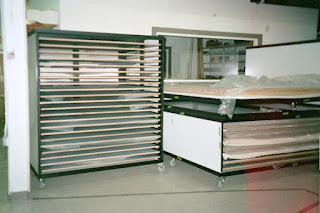
Flat storage of flag collection, art conservation of flags and banners, historic flag collections repair, restoration, mounting
Flag storage allowing flags to remain flat.


Changes in the location of the flags meant changes for the Museum.  It now had custody of the 340 flags and was to treat, and store, or ready them for exhibit in an already incredibly limited space.  Revolutionary thinking had to occur. And it was from this out of the box approach that the idea of a hybrid display case came to life.  The case would be housed in the exhibit space of the museum, and would simultaneously act as the storage space for additional flags to be rotated into the exhibit at an interval of every six months.  Revolutionary to the approach was also that the display cases were built for the size of the flags, not the space of the floor (previously some flags had to be folded to be stored).  Museum staff designed these hybrid cases with incorporated storage units hidden behind cloth covered panels, housed below the flag exhibit case.

simultaneous flag and banner display and storage, art conservation of flag collections
Large double capacity flag case for exhibit and storage.  Hidden storage for mounted flags that are ready to be rotated into exhibit is behind the cloth-covered front panels.


The display case accommodates two of the largest sized storage units in the hidden area below, this was designed mainly for the average size of the flag in the collection - Civil War guidons and regimental flags as well as military regimentals from the mid 1900's.  Flags being displayed are supported by an aluminum honeycomb panel which is held in place by angled iron supports.  An added feature is ease of use.  Flags can be removed from below and placed into the display case in less than one hour and can be accomplished by just two members of the museum staff.


The case also houses a datalogger for humidity monitoring as well as fiber optic lighting which have allowed museum staff to keep light levels at or below 2.5 fcs.  In addition, case lighting is tied to motion sensors, further limiting the amount of light which each flag is exposed to.

Light meter.  Replica flags were used for lighting adjustments.


Because the flags were stabilized in-house, and the panels were designed to go from storage to display, the costs to stabilize the flags was only 25 - 33% of what it was originally estimated.  Unfortunately, funding and practicality do not allow for each flag in the Museum's collection to be mounted (for example, the 85 foot pennant from a ship).  Yet each of Maine's flag's are stabilized and available to the public, via internet catalog, exhibit or replica, thus achieving the Museum's goals.

As a conservator, employing practicality in a project is rewarding.  The needs of this particular space clearly dictated the way the objects needed to be stored and demanded that the conservation team needed to approach this project in a way that challenged us all.  While the end result seems like such a simple and logical approach it also seems so underutilized, perhaps because we fall into the habit of doing things the way they have been done simply because they have been done that way for so long.

To read more about The Maine State Museum's exhibit visit here: http://collections.mainestatemuseum.com/collection/results.do;jsessionid=40236684A78BDFE062309B27AF7277E0?highlight=38

This post by Barbara Owens is a summary of a talk and paper by Gwen Spicer, "Saving Maine's Colors: Collaborative Strategies in Flag Conservation and Exhibition at the Maine State Museum" at Tales in the Textiles: The Conservation of Flags and Other Symbolic Textiles .

_____________________________
Gwen Spicer is a textile conservator in private practice.  Spicer Art Conservation specializes in textile conservation, object conservation, and the conservation of works on paper.  Gwen's innovative treatment and mounting of flags and textiles is unrivaled.   To contact her, please visit her website.


Friday, May 11, 2012

The Dilemma of Historic Conservation - Which Era to Preserve?

Imagine you are an influential architect who's life spans nearly a century and who's work resonates from your home where it is carried to all the commissions you receive.  Such is the case of Philip Johnson who built his famous Glass House in 1949 and its accompanying guest house, referred to as the Brick House.  Why was Johnson's second home so significant?  Simply because it is where he allowed his architectural dreams to take flight.  Here existed his "practice palette" for his most influential ideas.

Original 1949 floor plan of Johnson's Brick House
Brick House in foreground, Glass House in back ground (c. 1949) 

In 1953 Johnson created the dramatic interior of the Brick House.  The most important elements are the arched ceiling, supported by triangular pillars, and the Fortuny fabric, which hung as curtains, covering its walls.  Johnson would use these elements in many of his subsequent projects, some of which can still be seen today.  His choices in fabric and his architectural vision seem timeless.  In fact, the Fortuny fabric he used nearly 60 years ago is still available from the company's active line.

Johnson's weekend estate underwent many changes throughout the decades.  None were more dramatic than those that occurred in the 1980's; curtains became sliding panels, the fabric was stretched and stapled to these panels, the bed, floor and built-in bookshelves were all altered, all under the direction of Johnson, who was now in the early winter of his life.

Johnson's 1953 renovation - substantial changes only four years after the original construction. 


In 1986 the National Trust acquired the property and Johnson was allowed to remain in residence until his death in 2005.

What is in store for a historical landmark that has a history as rich and evolving as this?  Here lies the dilemma: interpretation.  Most historic sites are faced with common questions when the site undergoes restoration.
- Which elements are critical to the original concept?
- How have the elements changed over time?
(For example, has the Fortuny fabric altered sufficiently to no longer create the luminous quality Johnson intended?  How are decisions reached for restoration, and are they consistent from room to room?)

As with most decisions, underlying issues are at play.  One issue is mold and whether the levels are safe for visitors.  The other is the period of interpretation.

Brick House bedroom 1953 with original Fortuny Fabric curtains and Ditzel wicker chairs


WHICH TIME IS THE RIGHT TIME?

The National Trust states their period of interpretation is between 2001-2003, literally the final years of Johnson's life when the interior consisted of worn, fading and stained textiles and when Johnson was no longer actively working as both his sight and health were failing.  When the site was nominated as a historic landmark in 1997, the period of significance was indicated as between 1949 and 1995, (an long stretch of time based on the dates which reflect Johnson's working years.)

Clearly these two periods of interpretation are in conflict and are the crux of the tension derived from  such a decision.  The site must decide what is important: that it be left as it was at the end of his life?  Or restored to what he envisioned in 1953?  Or the 1980's.  Or perhaps some other time?

Brick House, art conservation of historic site, survey of collections
The Brick House bedroom during its 1980's renovation.  Johnson has replaced the curtains with panels with the fabric now stretched, the carpet is void of texture, the ottomans replace the original wicker chairs and the bed is narrowed.

DILEMMAS:

While era for interpretation may be the main dilemma, other dilemmas exists, which may not be as obvious, but will directly impact the site and how it moves forward.  Mold levels must be reduced, without this preventative step, the site may not be suitable for visitors.  As for long term preservation: what will be the traffic flow into the building?  How will it impact dust migration?  How will this impact wear and tear on the textile elements?  The Fortuny fabric covers every wall, it is a large component of the room and demands attention.  Will the site staff maintain the NT's period and surface clean only?  What about removal of the wall covering to treat it and return the original covering to the walls incorporated with with new mounting and backing?  Lastly, the fabric could be completely removed and re-housed, replacing it with vibrant "reproductions" (remember that the EXACT fabric can still be purchased today - a rare circumstance).

Lastly, is this an "all or nothing" dilemma?  Do all the pieces need to be treated or replaced?  These are the issues any historical site faces when evaluating renovation.  As a conservator, we must give our best  professional opinion and be prepared to assist the site in whichever it chooses.  Drawing on each aspect of conservation - treatment, re-housing, storage, preservation and stabilization - a site project of this magnitude provides both the challenge of dealing with these dilemmas, but most importantly, the opportunity to solve them.

This post by Barbara Owens is a summary of a talk given by Gwen Spicer called "Decoding the History of the Fortuny Fabric at Philip Johnson"s Brick House Interior" at the New England Conservation Association, held at the Shelburne Museum in 2010.

_____________________________
Gwen Spicer is a textile conservator in private practice.  Spicer Art Conservation specializes in textile conservation, object conservation, and the conservation of works on paper.  Gwen's innovative treatment and mounting of flags and textiles is unrivaled.   To contact her, please visit her website.


Wednesday, May 2, 2012

Conservation of a 400 Year-old Map; and the Difference Between Parchment and Vellum

by Barbara Owens

400 year-old maps are fragile, rare and priceless.  As a conservator, balancing the delicate nature of a skin artifact with the stabilization of the piece requires skill, concentration, and a gentle touch.


paper and object art conservation of parchment, vellum, skin and leather artifacts, historic maps, artifacts, Spicer Art Conservation


"Paper" in the 17th century existed as parchment or vellum.  Parchment and vellum at this time were both animal based, derived from cow, sheep or goat.  Vellum, parchment's finer cousin, required more steps to be produced (and therefore made it more expensive) it was also typically made of calf skin.  The Renselaerwyck Map is referred to as being printed on both parchment or vellum.  Truthfully, to distinguish one from the other in a piece from this era would be nearly impossible and would probably require chemical testing of the object.  Clearly, testing a historically valuable piece of this kind would not reveal any information pertinent to its history.  Conclusions can be drawn however, simply from the fact, that vellum was a more expensive medium and, Kiliaen van Rensselear is, at the time of its commissioning, one of the most important men in the new world and could certainly afford it.

The Map of Rensselaerwyck (printed on the map as "Renselaerwyck") is a piece of New York history reflecting the unique early Dutch settlements of the Hudson River.  This particular map was stabilized to be included in the exhibit: "1609" at the New York State Museum in Albany, New York.  

Surprisingly, for its age, this map was in very good condition.  Perhaps because of its inclusion in the restricted access section of the NYS Archives and its vaulted storage.  The map had suffered some small tears and losses which were repaired at some point in the past.  Comparison of photographs from the early 1900's shows the fragility of the ink and its susceptibility to the environment.  The map required a variety of treatments, from flattening the skin while in a controlled humidity chamber, to tears mended with Japanese tissue.  


check out the virtual tour of the "1609" exhibit here:  http://www.nysm.nysed.gov/1609/


_____________________________
Gwen Spicer is a textile conservator in private practice.  Spicer Art Conservation specializes in textile conservation, object conservation, and the conservation of works on paper.  Gwen's innovative treatment and mounting of flags and textiles is unrivaled.   To contact her, please visit her website.